 sariio
The Six Dimensions: How Four Factors Become a Map
- Six dimensions - Direction, Action, Approach, Impact, Commitment, Process - are every possible pairing of the four factors. Nothing falls between them.
- Each dimension is a two-axis field of nine cells, and each cell carries an attribute: the kind of person who sits there.
- Consistent, flexible and variable describe how your answers spread - confidence labels, never grades.
- The same six fields map a person, a team's culture and the profile of success in a role.
The four factors read a person one theme at a time: how they relate, plan, decide and deliver. But work does not happen one theme at a time. The moment that decides a project is usually a junction - where trust meets planning, where a decision meets its delivery, where relationships meet the standard of the work. The six dimensions exist to read those junctions, and they are the canvas every Sariio map is drawn on.
This is the executive summary for the set. Each dimension has its own reference article - Direction, Action, Approach, Impact, Commitment and Process - and this article explains the architecture they share.
What are the six dimensions of Sariio MAPS?
Direction, Action, Approach, Impact, Commitment and Process - the complete set of pairings of the four preference factors, not a curated shortlist. Direction pairs Relationships with Thinking and Planning; Action pairs Making Decisions with Getting Things Done; Approach joins planning to deciding; Impact joins relating to delivering; Commitment crosses relationships with decisions; Process runs from plan to completed work. Because the six are every pairing, nothing about how a person or group works falls between them.
The completeness matters more than it first appears. Four factors combine in exactly six ways - no more exist - so the six dimensions are not an editorial selection that a rival taxonomy could quarrel with. They are the geometry of the four factors, exhausted. If the factors cover the whole cycle of work, and the four-factors article makes that case, then the six dimensions cover every junction in it.
How the pairing works
How do four factors become six dimensions?
By pairing. Four factors combine in exactly six ways, and each pairing becomes a two-axis field: one factor runs horizontally, the other vertically, and a person's positions on both place them in one of nine cells. Each cell carries an attribute - a single adjective describing the kind of person who sits there, such as Purposeful, Bold or Methodical - and every attribute has real strengths and a plausible drawback. Nothing is recomputed: the dimensions re-read the same survey answers that build the twelve preference pairs.
Here is the whole canvas at once - the six fields as they appear in the app, in this case reading a benchmark with people placed against it:
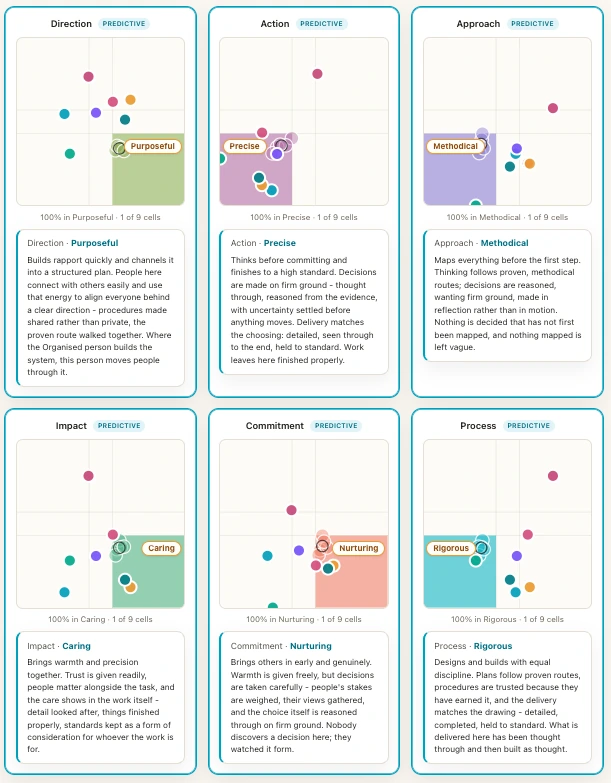
The attribute naming deserves a word, because it is where the instrument's values live. Every one of the 54 cells is named for the kind of person who sits there - Steady, Curious, Bold, Methodical, Caring, Daring - in what we call attribute voice: "people here tend to be Purposeful", never "you have landed in the Purposeful region". And every attribute passes a deliberate test: it must have a plausible drawback. A word that could never be a drawback - wise, loyal, trustworthy - is banned, because a map with flattering corners quietly indicts everyone standing elsewhere. There are no good cells. There are 54 recognisable kinds of strength.
Reading a position with the right confidence
What do consistent, flexible and variable mean in a myMAP?
They describe how your answers spread on each preference pair, never quality. Consistent means your answers sat close together - a steady preference. Flexible means they varied a little while staying on one side of the scale. Variable means they ranged across both sides, suggesting your preference shifts with the situation. None is better than another, and Variable says nothing about reliability or ability - the labels simply tell you how much confidence to read a position with.
These three labels sit beside every pair in a myMAP, and they matter to the dimensions because a cell placement is only as settled as the positions beneath it. Someone Consistent on both contributing pairs sits firmly in their cell; someone Variable on one axis genuinely moves between neighbouring cells as situations change - and the honest reading says so. This is a large part of what separates a measurement from a label: the instrument reports not just where you sit, but how firmly.
The three tensions
The six dimensions also pair with each other, and the geometry hands leaders three questions that need no translation. Direction faces Action: do we act on our direction? Approach faces Impact: does our approach create impact? Commitment faces Process: does our commitment match our process? A leadership team that scores high energy on Direction and low energy on Action has named its oldest frustration in two words - all vision, no follow-through - and can finally see which people, and which preferences, bridge the gap.
One canvas, every scale
How do the six dimensions map culture and successful roles?
The same six fields work at every scale. Aggregate an organisation's people onto them and you have a cultureMAP - the actual distribution of working preferences, read as centre of gravity, spread and camps. Curate the people who already succeed in a role and you have a successMAP - the cells where top performers cluster are the predictive ones, and any candidate can be placed against that pattern, dimension by dimension. One language, from one person to a whole organisation.
This is the strategic reason the dimensions exist. Culture can be mapped because culture is behaviour, and behaviour is these preferences aggregated - Kotter and Heskett's research tied that culture to economic performance across more than two hundred companies. Success in a role can be mapped for the same reason: where a role's proven performers cluster tightly on a dimension, that dimension predicts; where they scatter, it is telling you nothing, and now you know which is which. A candidate, a team, a department and the whole organisation are read in one vocabulary - so a client who starts with individual coaching and grows into an organisation-wide programme never has to learn a second language.
Where to go deeper
Each dimension's reference article covers its factor pairing, its two axes, its nine attributes and its tension partner: Direction on how the group sets out; Action on how choices become finished work; Approach on how the group works out what to do; Impact on what the group produces through people; Commitment on how agreement is reached; and Process on how plans become delivery. Beneath them all sit the four factors and twelve preference pairs.
See yourself on all six dimensions in twelve minutes - the individual survey is free, and your results are yours.
Sources
- Kotter, J.P. and Heskett, J.L. (1992), Corporate Culture and Performance, Free Press - culture's influence on economic performance across 200+ companies
- Schein, E.H. (2017), Organizational Culture and Leadership, 5th edn, Wiley - culture as enacted, shared behaviour
- Denison, D.R. (1990), Corporate Culture and Organizational Effectiveness, Wiley - measurable cultural traits linked to business outcomes
- Charvet, S.R. (1997), Words That Change Minds, Kendall/Hunt - the metaprogramme ancestry of the underlying preference pairs
- Adler, A., individual psychology - the whole person in social context. See Alfred Adler got it right
- Kristof-Brown, Zimmerman & Johnson (2005), 'Consequences of Individuals' Fit at Work: A Meta-Analysis' - the fit evidence behind reading people against role patterns