 sariio
The Commitment Dimension: How Agreement Is Reached
- Commitment pairs Relationships with Making Decisions: the junction where social dynamics meet buy-in.
- Nine attributes name its cells: Cautious, Patient, Instinctive, Considered, Accommodating, Perceptive, Nurturing, Empathic, Passionate.
- Its tension partner is Process: does our commitment match our process?
- At scale it explains why the same decision lands as engagement in one room and imposition in the next.
Announce the same decision to two departments and watch it land twice. In one room, people lean in - they were consulted, they are ready, they own it. In the other, arms fold: nobody asked us. The decision did not change between the two doors. What changed is the fifth of the six dimensions: Commitment, the junction where social dynamics meet buy-in.
What is the Commitment dimension in Sariio MAPS?
The fifth of the six dimensions: how people reach agreement and how quickly trust is extended. It pairs the Relationships factor with Making Decisions, covering the style of buy-in - whether decisions are made carefully with everyone's input, or quickly with confidence that others will follow. Like every dimension it is a two-axis field of nine cells, each named for the kind of person who sits there.
The two axes
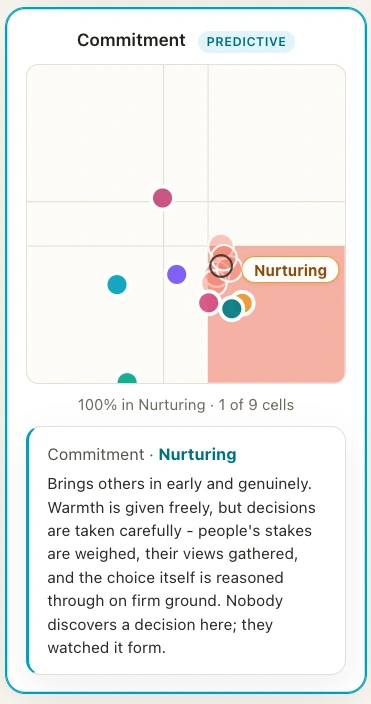
The horizontal axis carries Relationships: from guarded, task-led and self-reliant to warm, people-led and collaborative. The vertical axis carries Making Decisions: from reflective, reasoned and sure-footed to hands-on, gut-led and open-ended. Where the other Relationships pairing - Impact - reads what gets delivered with people, Commitment reads what gets agreed with them: the diagonal of the map where trust and choice cross.
The nine attributes
What are the nine attributes of the Commitment dimension?
Cautious, Patient, Instinctive, Considered, Accommodating, Perceptive, Nurturing, Empathic and Passionate. A Cautious person earns their commitment twice over; a Nurturing person brings others in early and genuinely; a Passionate person takes people and decisions on wholeheartedly, at once. Every attribute has real strengths and a plausible drawback, and none is better than another.
Across the field: Cautious people earn their commitment twice over; Patient people start guarded but can be won over by degrees; Instinctive people form conviction independently, on gut feel, without needing the room's agreement. In the centre, Considered people reach decisions through proper discussion; Accommodating people find the arrangement most people can live with; Perceptive people read the room quickly and let decisions move with it. On the warm side, Nurturing people bring others in early and genuinely; Empathic people extend backing readily and adjust willingly; Passionate people take people and decisions on wholeheartedly, at once.
The drawbacks are as human as the strengths: Cautious can be slow to board, Passionate can board too fast, Accommodating can split every difference. Nine ways of joining a decision, none of them the right one.
The tension with Process
Commitment's partner is Process, and the pairing asks: does our commitment match our process? An organisation can win hearts and then lose them in delivery that never lands; another can build immaculate delivery machinery for decisions nobody actually agreed to. The two dimensions together show whether buy-in and follow-through are the same size.
At scale: culture and roles
How is the Commitment dimension used in mapping culture and roles?
At scale, Commitment shows how decisions travel through an organisation - whether people expect to be consulted before choices land, and how trust and caution shape who commits to what. In a cultureMAP that explains why the same announcement lands as engagement in one department and imposition in another. In a successMAP, clustering on Commitment reveals roles where a particular buy-in style predicts success - rapid wholehearted adoption in one role, careful consultative agreement in another.
The same canvas does both jobs by design: culture read from the preferences that generate it, and role benchmarks placed on identical fields. The set completes with Process; the architecture is in the six dimensions, built on the four factors.
See where you sit on Commitment in twelve minutes - the individual survey is free.
Sources
- Charvet, S.R. (1997), Words That Change Minds, Kendall/Hunt - the metaprogramme ancestry of the underlying pairs
- Kotter, J.P. (1996), Leading Change, Harvard Business School Press - the coalition and buy-in stages where change succeeds or fails
- Adler, A., individual psychology - trust extended as social interest. See Alfred Adler got it right