 sariio
The Approach Dimension: How the Group Works Out What to Do
- Approach pairs Thinking and Planning with Making Decisions: where analysis becomes commitment.
- Nine attributes name its cells: Methodical, Structured, Primed, Analytical, Pragmatic, Decisive, Selective, Exploratory, Pioneering.
- Its tension partner is Impact: does our approach create impact?
- At scale, its camps explain the planning-versus-improvising friction no average reveals.
Between the plan and the decision sits a junction most instruments never look at: how does thinking actually become a choice here? Some people chart the route before departing. Some test their way forward and steer on contact. Approach, the third of the six dimensions, reads exactly that junction.
What is the Approach dimension in Sariio MAPS?
The third of the six dimensions: how a person or group works out what to do. It pairs the Thinking and Planning factor with Making Decisions - where planning meets deciding - so it shows whether people stick with what has worked before or try something new, and whether calls are made on evidence or instinct. Like every dimension it is a two-axis field of nine cells, each named for the kind of person who sits there.
The two axes
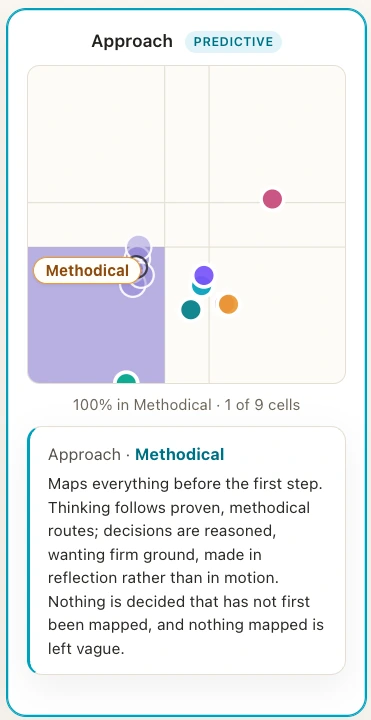
The horizontal axis carries Thinking and Planning: from analytical, consistent and step-by-step to bold, fresh and flexible. The vertical axis carries Making Decisions: from reflective, reasoned and sure-footed to hands-on, gut-led and open-ended. The crossing is the moment analysis becomes commitment - the working answer to "how do we know what to do?"
The nine attributes
What are the nine attributes of the Approach dimension?
Methodical, Structured, Primed, Analytical, Pragmatic, Decisive, Selective, Exploratory and Pioneering. A Methodical person maps everything before the first step; a Pioneering person conceives new directions and commits to them in the same breath; a Pragmatic person steers as they go. Every attribute has real strengths and a plausible drawback, and none is better than another.
Across the field: Methodical people map everything before the first step; Structured people set a thorough framework first and then make flexible decisions within it; Primed people do detailed groundwork precisely so the decision can be instant when the moment comes. In the centre, Analytical people trial approaches before committing; Pragmatic people steer as they go; Decisive people settle questions promptly while keeping the wider plan flexible and moving. On the novel side, Selective people generate ideas freely and then pick from them with care; Exploratory people explore new angles while bringing genuine judgement to the choices along the way; Pioneering people conceive new directions and commit to them in the same breath.
The drawbacks come free with the strengths: Methodical can be slow to depart, Pioneering can commit before the ground is checked, Pragmatic can drift. No cell is the clever one - which is precisely what lets a team discuss its mix honestly.
The tension with Impact
Approach's partner is Impact, and the pairing asks: does our approach create impact? An organisation can be sophisticated about route-finding and still produce little; another can produce prodigiously down a route nobody examined. The two dimensions side by side show whether cleverness is converting into consequence.
At scale: culture and roles
How is the Approach dimension used in mapping culture and roles?
At scale, Approach shows how an organisation moves from thought to choice - whether it charts the route before departing or tests its way forward, and whether that habit is shared or splits into camps. In a cultureMAP the split matters most: half a company planning carefully while the other half improvises explains friction no average would reveal. In a successMAP, tight clustering on Approach identifies roles where a particular route-finding style genuinely predicts success.
The double use is the design: culture mapped as it actually is, and role benchmarks read on the same canvas. The set continues with Impact; the architecture is in the six dimensions, built on the four factors.
See where you sit on Approach in twelve minutes - the individual survey is free.
Sources
- Charvet, S.R. (1997), Words That Change Minds, Kendall/Hunt - sameness/difference and procedures/options in the applied metaprogramme tradition
- Klein, G. (1998), Sources of Power, MIT Press - recognition-primed decision-making: instinct as trained pattern recognition
- Kotter, J.P. (1996), Leading Change, Harvard Business School Press - why change programmes stall when route-finding styles collide