 sariio
The Action Dimension: How Choices Become Finished Work
- Action pairs Making Decisions with Getting Things Done: decision speed meets delivery style.
- Nine attributes name its cells: Precise, Measured, Prepared, Thorough, Responsive, Driven, Assured, Agile, Bold.
- Its tension partner is Direction: do we act on our direction?
- At scale it shows whether an operation's default is to weigh or to move.
Every operation has a moment of truth that repeats a hundred times a day: a choice is made, and something has to get delivered. How fast the choice comes, and what state the delivery arrives in, is the practical texture of a workplace - and it is what Action, the second of the six dimensions, reads.
What is the Action dimension in Sariio MAPS?
The second of the six dimensions: how choices become finished work. It pairs the Making Decisions factor with Getting Things Done, covering decision speed - whether people reflect or jump in - and delivery style - whether they finish to the last detail or get something out the door and move on. Like every dimension it is a two-axis field of nine cells, each named for the kind of person who sits there.
The two axes
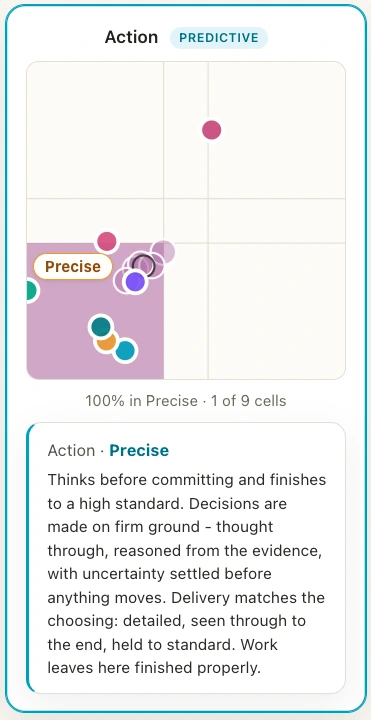
The horizontal axis carries Making Decisions: from reflective, reasoned and sure-footed to hands-on, gut-led and open-ended. The vertical axis carries Getting Things Done: from precise, completing and exacting to big-picture, initiating and practical. Where Direction is the blueprint layer, Action is its practical counterpart - the junction where commitment meets completion.
The nine attributes
What are the nine attributes of the Action dimension?
Precise, Measured, Prepared, Thorough, Responsive, Driven, Assured, Agile and Bold. A Precise person thinks before committing and finishes to a high standard; a Bold person decides and acts in the same moment; an Agile person reads situations quickly and adjusts in real time. Every attribute has real strengths and a plausible drawback, and none is better than another.
Across the field: Precise people think before committing and finish to a high standard; Measured people weigh decisions carefully and stay flexible on method once the call is made; Prepared people do thorough groundwork followed by swift release. In the centre, Thorough people stay open on the decision but carry every chosen task through to a proper finish; Responsive people match speed and method to whatever the task needs; Driven people keep things moving. On the committing side, Assured people make the call quickly on instinct, then deliver it thoroughly; Agile people read situations quickly and adjust in real time; Bold people decide and act in the same moment.
Each carries its drawback in plain sight: Precise can be slow to start, Bold can be quick to regret, Driven can flatten the detail. That symmetry is the design - the field describes kinds of strength, not ranks of merit.
The tension with Direction
Action's partner is Direction, and the pairing asks: do we act on our direction? An operation can be superb at Action - fast calls, finished work - while pointing the wrong way; another can set an immaculate course it never sails. Reading the two dimensions together shows a leadership team which failure mode is theirs.
At scale: culture and roles
How is the Action dimension used in mapping culture and roles?
At scale, Action shows an operation's centre of gravity between deliberation and commitment, perfection and pragmatism, starting energy and finishing discipline. In a cultureMAP that reveals whether the organisation's default is to weigh or to move; in a successMAP it shows whether a role's proven performers share an Action pattern - fast-committing thorough deliverers in one role, careful weighers in another - and whether that pattern predicts for hiring.
This is the same double use every dimension carries: culture mapped from real preference data, and successful roles benchmarked on the same canvas. The set continues with Approach; the architecture is in the six dimensions, built on the four factors.
See where you sit on Action in twelve minutes - the individual survey is free.
Sources
- Charvet, S.R. (1997), Words That Change Minds, Kendall/Hunt - the metaprogramme ancestry of the underlying pairs
- Klein, G. (1998), Sources of Power: How People Make Decisions, MIT Press - fast commitment as expertise, not recklessness
- Denison, D.R. (1990), Corporate Culture and Organizational Effectiveness, Wiley - measurable cultural traits linked to outcomes