 sariio
The Process Dimension: How Plans Become Finished Work
- Process pairs Thinking and Planning with Getting Things Done: the full journey from plan to completed work.
- Nine attributes name its cells: Rigorous, Ready, Composed, Meticulous, Persistent, Experimental, Creative, Tenacious, Daring.
- Its tension partner is Commitment: does our commitment match our process?
- At scale it reveals whether an operation has one definition of done - or several, in different corners.
Every organisation has a secret answer to the question "what happens between the plan and the thing?" In some, the drawing is followed to the millimetre. In others, the drawing is a suggestion and the thing emerges on the workshop floor. Process, the last of the six dimensions, reads that answer - the full journey from conception to delivery.
What is the Process dimension in Sariio MAPS?
The sixth of the six dimensions: how plans become finished work. It pairs the Thinking and Planning factor with Getting Things Done, reading the gap between conception and delivery - whether work is engineered step by step or improvised as it goes, and whether the finish line is perfection or good enough. Like every dimension it is a two-axis field of nine cells, each named for the kind of person who sits there.
The two axes
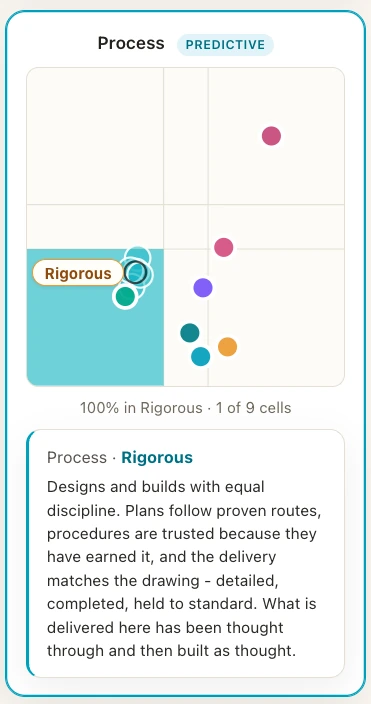
The horizontal axis carries Thinking and Planning: from analytical, consistent and step-by-step to bold, fresh and flexible. The vertical axis carries Getting Things Done: from precise, completing and exacting to big-picture, initiating and practical. It is the other diagonal of the map from Commitment - and where Approach reads how a route is chosen, Process reads how the route is actually travelled.
The nine attributes
What are the nine attributes of the Process dimension?
Rigorous, Ready, Composed, Meticulous, Persistent, Experimental, Creative, Tenacious and Daring. A Rigorous person designs and builds with equal discipline; a Daring person breaks new ground in both the conceiving and the doing; a Persistent person keeps things moving steadily forward without drama. Every attribute has real strengths and a plausible drawback, and none is better than another.
Across the field: Rigorous people design and build with equal discipline; Ready people prepare thoroughly so the doing can stay light; Composed people put structured preparation in service of a fluid performance. In the centre, Meticulous people keep the plan flexible but hold the finish to a high standard; Persistent people keep things moving steadily forward without drama; Experimental people improve their method by trying it. On the fresh side, Creative people conceive original work and build it with exactness; Tenacious people follow a new idea all the way to delivery; Daring people break new ground in both the conceiving and the doing.
The drawbacks keep the field honest: Rigorous can be inflexible, Daring can be unrepeatable, Persistent can persist too long. Nine routes from drawing to delivery, no house favourite.
The tension with Commitment
Process's partner is Commitment, and the pairing asks: does our commitment match our process? Wholehearted agreement feeding an improvised delivery machine produces enthusiasm and chaos; immaculate process serving decisions nobody bought produces compliance and quiet resistance. Together the two dimensions show whether an organisation's promises and its production line are the same size.
At scale: culture and roles
How is the Process dimension used in mapping culture and roles?
At scale, Process shows whether an organisation's planning style and finishing style pull in the same direction - whether work is finished fast, finished carefully, or finished differently in different corners. In a cultureMAP that last case is the finding that matters: two Process camps in one operation mean two definitions of done. In a successMAP, tight clustering on Process identifies roles where a particular plan-to-delivery style genuinely predicts success.
That completes the double duty every dimension performs - culture, mapped from real preference data, and successful roles benchmarked on the same six fields. The full architecture is in the six dimensions; the ground beneath it is the four factors and twelve preference pairs.
See where you sit on Process in twelve minutes - the individual survey is free.
Sources
- Charvet, S.R. (1997), Words That Change Minds, Kendall/Hunt - the metaprogramme ancestry of the underlying pairs
- Denison, D.R. (1990), Corporate Culture and Organizational Effectiveness, Wiley - consistency and adaptability as measurable cultural traits
- Kotter, J.P. and Heskett, J.L. (1992), Corporate Culture and Performance, Free Press - the performance consequences of how cultures deliver