AI and your people
It takes AI to keep the human at the centre.
Your clients and your board are asking what AI will change. The evidence so far is good news for people, and for the operations that look after them well.
AI is taking the routine contacts. The ones that reach a person are becoming the complex, emotional, judgement-heavy ones, and those depend on agents who are well coached and want to stay. Sariio points AI at that.
What the evidence says
AI replacing most people? Maybe not.
95%of service leaders plan to keep their human agents (Gartner, March 2025)
85%are expanding what human agents are responsible for (Gartner)
35%better results for the newest agents when AI helped them, across 5,172 agents (Quarterly Journal of Economics, 2025)
64%of customers would prefer companies not to use AI in service (Gartner, 2024)
 TL;DR
TL;DR
The AI paradox: making work human-centric
95% of service leaders are keeping their human agents, and the bigger opportunity is AI that prepares the coaching so managers can do the human part.
Read the exec summaryClose the exec summary
- Gartner found 95 per cent of customer service leaders planned to keep human agents, while only 20 per cent reported AI-driven staffing reductions. (Gartner, 2025)
- Across 20,000 consumers in 14 countries, nearly one in five said AI support brought them no benefit, four times the failure rate of other AI uses. (Forbes, 2025, reporting Qualtrics)
- A field study of 5,172 support agents found AI assistance raised issues resolved per hour by 13.8 per cent, with agent turnover falling by 8.6 points. (Quarterly Journal of Economics, 2025)
For leaders, use AI to prepare individual coaching, then keep the manager in charge of the conversation, especially during agents’ first ninety days.
 TL;DR
TL;DR
Can AI replace a call centre agent?
AI can take the routine contacts, and when it assists agents, productivity rose 13.8% across 5,172 agents and around 35% for the newest.
Read the exec summaryClose the exec summary
- In a 5,172-agent field study, AI suggestions raised issues resolved per hour by 13.8%; newer and lower-skilled agents improved around 35%, and turnover fell by 8.6 percentage points. (Brynjolfsson, Li & Raymond, QJE 2025)
- Gartner found 64% of customers would prefer companies did not use AI for customer service, and 53% would consider switching to a competitor over it. (Gartner, 2024)
- Gartner predicts agentic AI will resolve 80% of common customer service issues by 2029; its 2026 research found 85% of service leaders expanding human agent responsibilities. (Gartner, 2025 and 2026)
For leaders, plan automation around routine contacts and prepare people for the complex, judgement-heavy work that remains.
Your customers
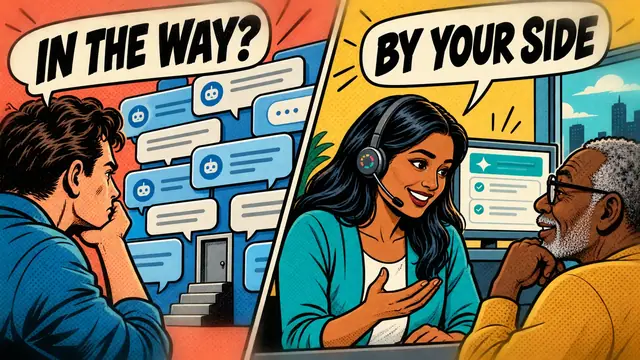
Using AI badly? Customers can tell.
AI improves the experience when it puts capability behind a person, and damages it when it puts a barrier in front of one. Agents who stay longer have better conversations, which makes attrition a customer measure as well as an HR one.
 TL;DR
TL;DR
How can AI improve customer experience, and where does it make it worse?
AI improves customer experience most reliably when it supports agents: one 5,172-agent study found 13.8% more issues resolved per hour.
Read the exec summaryClose the exec summary
- In a 5,172-agent field study, an AI assistant increased issues resolved per hour by 13.8%, improved customer sentiment and reduced escalations. (Brynjolfsson, Li & Raymond, QJE 2025)
- Gartner found 64% would prefer companies did not use AI in customer service, while 53% would consider switching over it. (Gartner, July 2024)
- Gartner predicts agentic AI will resolve 80% of common customer service issues by 2029. Klarna reversed its cost-led approach after acknowledging lower service quality. (Gartner, March 2025; CX Dive, 2025)
For leaders, use AI to handle routine queries and support agents, while keeping a clear path to a person for complex or sensitive issues.
 TL;DR
TL;DR
Can AI improve employee engagement?
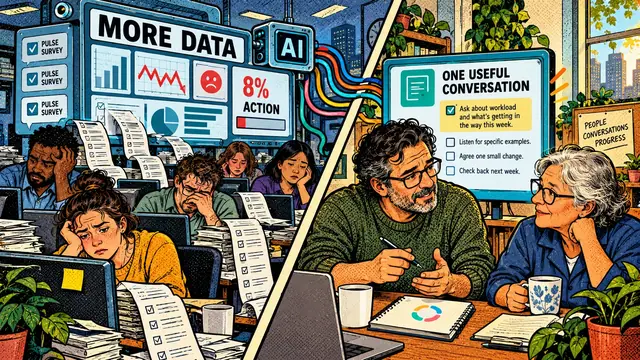
AI can help engagement when it supports managers’ conversations and coaching, while only 8 per cent of employees strongly agree their organisation acts on results.
Read the exec summaryClose the exec summary
- Only 8 per cent of employees strongly agree their organisation acts on results, exposing an action gap that faster sentiment tracking cannot fix. (Gallup, 2023)
- SHRM found 39 per cent of HR functions have adopted AI, while 56 per cent of HR professionals do not formally measure its success. (SHRM, 2026)
- An AI coach matched human coaches on goal attainment in ten-month randomised trials, supporting its potential to extend coaching to frontline teams. (Terblanche et al., 2022)
For leaders, point AI at manager preparation and accessible coaching, and choose tools that help people understand their preferences without reducing them to scores.
South Africa
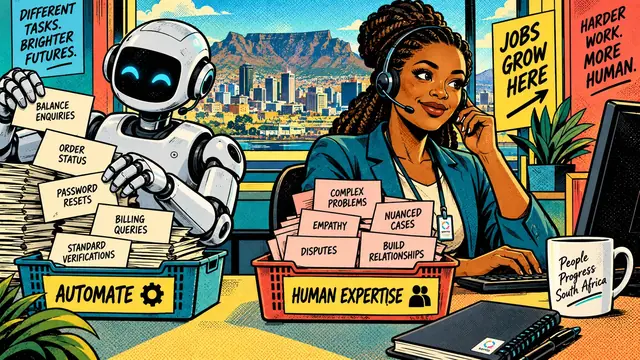
AI cannot outsmart South Africans on complex calls.
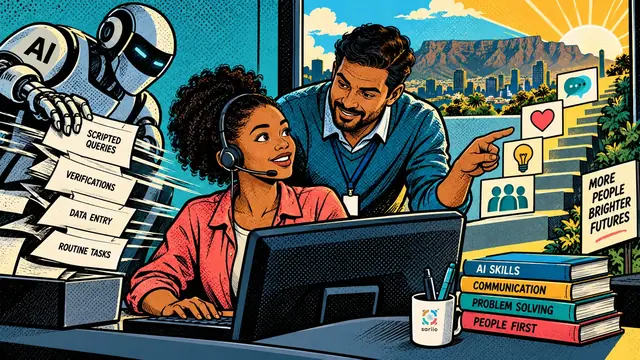
Many entry-level tasks can be automated, and the sector is growing anyway. If AI takes the routine layer, what remains is the difficult, human work South African teams are already chosen for. The first jobs change shape, and coaching decides how well people grow into them.
 TL;DR
TL;DR
Does AI threaten impact sourcing?
More than half of entry-level BPO tasks are automatable, yet AI assistance lifted novice agents’ productivity by around 35%, exposing both threat and opportunity.
Read the exec summaryClose the exec summary
- Entry-level roles make up 68% of Africa’s BPO and ITES workforce, and more than half of entry-level tasks are automatable (Caribou & Genesis Analytics / Mastercard Foundation, 2025).
- Cape Town added a record 11,496 BPO jobs in 2025/26, while the sector targets 500,000 jobs by 2030 (CapeBPO / Outsource Accelerator, 2026).
- In a study of 5,172 agents, AI assistance lifted new and lower-skilled agents’ productivity by around 35% and cut turnover by 8.6 percentage points (Brynjolfsson, Li & Raymond, QJE, 2025).
For leaders, redesign entry-level roles around judgement and empathy, and put AI beside new hires to build capability as routine tasks are automated.
 TL;DR
TL;DR
Will AI take call centre jobs in South Africa?
South Africa’s GBS sector more than doubled to roughly 150,000 jobs by 2024, while AI is set to reshape tasks and human roles.
Read the exec summaryClose the exec summary
- Around 40% of tasks in Africa’s BPO sector could be automated by 2030, while only 10% are fully resilient (Caribou & Genesis Analytics / Mastercard Foundation, 2025).
- South Africa’s GBS industry grew from 65,000 jobs in 2019 to roughly 150,000 by 2024, with a target of 500,000 cumulative jobs by 2030 (BPESA, 2025).
- 85% of service leaders are expanding human agent responsibilities, while 31% have implemented or plan AI-related layoffs through early 2027 (Gartner, April 2026).
For leaders, plan for fewer routine contacts and more complex human work, then shape reskilling and workforce planning around the people best suited to it.
How Sariio uses AI
The AI prepares. Your people decide.
It reads the words of the call.
Sariio works from the transcript and the scorecard. Sariio takes nothing from the voice, so tone and voiceprint play no part.
A person decides about a person.
The team leader reads, edits and owns every coaching note before the agent sees it. Each agent sees their own map first.
Your data stays yours.
Nothing from your operation trains a model, and data is held in the EU, in Frankfurt.
Trust & AI governance →
 TL;DR
TL;DR
What happens when someone needs help
If someone shares serious distress in Sariio Coach, the session pauses, they see verified human support and their employer is never told.
Read the exec summaryClose the exec summary
- When distress is recognised, Coach stops immediately, responds warmly and displays verified, country-specific crisis contacts. It does not diagnose, counsel or probe (Sariio, 2026).
- The employer receives no individual alert; organisations see only anonymous safeguard-event counts, with counts below three shown as “fewer than 3” (Sariio, 2026).
- US 988 Lifeline text volume grew 260% between 2022 and 2025, compared with 87% for calls, supporting messaging options alongside phone support (GAO, 2026).
For leaders, check that workplace coaching has clear safeguarding boundaries, verified local contacts and privacy protections, with human support easy to reach by phone or text.
Working together
Start with one campaign.
If your clients or your board are asking about AI, one campaign is a good place to show what AI looks like when it's pointed at your people. Half an hour with David is enough to see whether it fits.
Useful to bring
What your clients are asking.
The AI questions in your last client review, the campaign you'd start with and the measure you'd like to move.
 sariio