 sariio
The Impact Dimension: What the Group Produces Through People
- Impact pairs Relationships with Getting Things Done: working with people becomes delivering with people.
- Nine attributes name its cells: Independent, Consistent, Inventive, Exacting, Cooperative, Resourceful, Caring, Available, Energetic.
- Its tension partner is Approach: does our approach create impact?
- At scale it distinguishes solo-craft cultures from collective-delivery cultures - neither better, both consequential.
Ask what a team actually produced last quarter and you get a list. Ask how it was produced - alone or together, to whose standard, carried by whose energy - and you get the team's character. That second question is the territory of Impact, the fourth of the six dimensions: the junction where working with people becomes delivering with people.
What is the Impact dimension in Sariio MAPS?
The fourth of the six dimensions: what a person or group produces through people. It pairs the Relationships factor with Getting Things Done - where relationships meet delivery - so it shows whether standards are held individually or collectively, and whether output is precise and controlled or broad and practical. Like every dimension it is a two-axis field of nine cells, each named for the kind of person who sits there.
The two axes
The horizontal axis carries Relationships: from guarded, task-led and self-reliant to warm, people-led and collaborative. The vertical axis carries Getting Things Done: from precise, completing and exacting to big-picture, initiating and practical. The crossing reads the most visible thing about anyone's working life: the shape their finished work takes, and who it is finished with.
The nine attributes
What are the nine attributes of the Impact dimension?
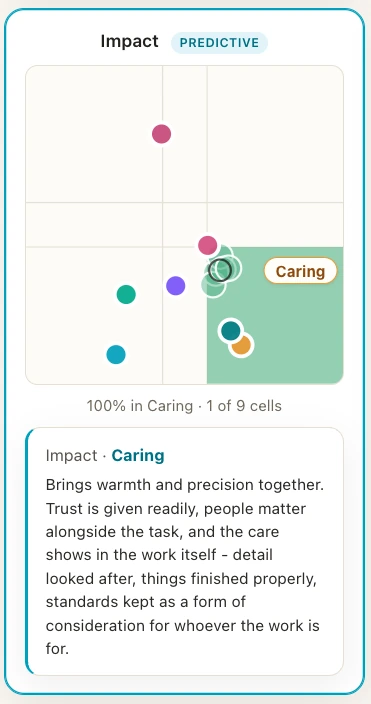
Independent, Consistent, Inventive, Exacting, Cooperative, Resourceful, Caring, Available and Energetic. An Independent person delivers detailed, completed work with little need from the room; an Energetic person gathers others quickly and points the energy at the goal; a Caring person brings warmth and precision together. Every attribute has real strengths and a plausible drawback, and none is better than another.
Across the field: Independent people deliver detailed, completed work with little need from the room; Consistent people keep output steady and reliable over time; Inventive people create things away from the spotlight. In the centre, Exacting people hold the standard on the group's behalf; Cooperative people carry effort jointly; Resourceful people turn contact with others into better ways of doing the work. On the people-led side, Caring people bring warmth and precision together; Available people attach to people first and let the work follow; Energetic people gather others quickly and point the energy at the goal.
As everywhere on the canvas, the drawbacks travel with the strengths: Independent can be unreachable, Available can be interruptible, Exacting can be exacting. Nine kinds of contribution, no rank order.
The tension with Approach
Impact's partner is Approach, and the pairing asks: does our approach create impact? A team can reason beautifully about routes and produce little at the end of them; a team can produce constantly without asking whether the route deserved the effort. The pair of dimensions, read together, shows whether thought and output are actually connected.
At scale: culture and roles
How is the Impact dimension used in mapping culture and roles?
At scale, Impact shows how an organisation turns collaboration into results - whether delivery is anchored in shared standards, personal drive or the energy of the group. In a cultureMAP that distinguishes a culture of solo craftspeople from a culture of collective delivery, each with its own strengths and blind spots. In a successMAP, tight clustering on Impact shows that a role rewards a particular delivery-through-people style - essential knowledge for hiring into team-shaped work.
One canvas, both jobs: culture mapped from the preferences that produce it, and role benchmarks read against the same fields. The set continues with Commitment; the architecture is in the six dimensions, built on the four factors.
See where you sit on Impact in twelve minutes - the individual survey is free.
Sources
- Charvet, S.R. (1997), Words That Change Minds, Kendall/Hunt - the metaprogramme ancestry of the underlying pairs
- Gallup, 'Why Great Managers Are So Rare' - delivery through people as the manager's real work
- Kristof-Brown, Zimmerman & Johnson (2005), 'Consequences of Individuals' Fit at Work: A Meta-Analysis' - fit between person and role pattern, and its outcomes