For brands and their BPO partners
You chose your partner for its people. Help them sound like you.
Brands choose a partner for its people as much as its price: the voice, the care and the judgement on the difficult calls. Every one of those calls carries your name.
Sariio helps your partner coach those people to your standard, in a way each of them recognises as their own. Your standard stays fixed. The coaching fits the person.
Questions brands ask
Good questions from brands that care how they sound.
Brand and culture
Customers meet your partner's culture through your brand.
Scripts and scorecards travel well. Culture travels with the people. 38% of organisations that bring outsourced work back in-house cite cultural alignment as a reason, and nearly 70% say their vendor management isn't yet mature enough to manage the relationship well.
The work preference layer gives you and your partner a shared language for how people on both sides prefer to work, so alignment becomes something you can see and talk about.
 TL;DR
TL;DR
Whose culture does the customer experience?
When outsourced agents handle your customers, they deliver the outsourcer’s culture; 38% of organisations cite cultural alignment when bringing services back in-house.
Read the exec summaryClose the exec summary
- South Africa’s BPO sector grew 131% from 65,000 workers in 2019 to 150,000 in 2024; UK clients account for 55% of GBS headcount. (BPESA, 2024)
- Deloitte found 38% of organisations cite better cultural alignment as a reason for bringing outsourced services back in-house, while nearly 70% say vendor management lacks maturity. (Deloitte, 2024)
- Impact-sourced employees in South Africa’s GBS sector have 72% lower attrition, and 73% of businesses report hiring more committed and motivated agents through impact sourcing. (Sigma Connected, 2024)
For leaders, assess how your brand’s values show up on the outsourcer’s floor, then agree how agents should handle feedback, escalation and customer decisions.
 TL;DR
TL;DR
Organisational culture is language and behaviour
Culture becomes measurable when leaders read the repeated language and behaviour of their people; culture-strong firms grew revenue 682% over eleven years.
Read the exec summaryClose the exec summary
- Culture is expressed through observable language and behaviour: Schein’s artefacts, espoused values and underlying assumptions all show up in what people say and do (Schein, 2016).
- Across 200+ companies, firms with performance-enhancing cultures recorded 682% revenue growth against 166%, and 756% v 1% net income growth over eleven years (Kotter & Heskett, 1992).
- The Competing Values Framework names four types, clan, adhocracy, market and hierarchy; the article argues a culture is better read as a distribution than a single label (Cameron & Quinn, 2011).
For leaders, notice the words people use and the behaviours they repeat, then map variation across teams before planning change.
Coaching to your standard
Your QA framework stays yours. The coaching reaches every agent.
Sariio works from the call and the standard you set: your QA framework and your SLAs. For each call worth discussing, it prepares a short coaching note around how that agent prefers to work. Your partner's team leader reviews it, decides what's said and coaches soon after the call.
The same standard on every site.
Preferences shape how something is coached, and never the score. Your standard is the one every agent is coached to.
Coaching that reaches everyone.
The preparation takes minutes, so team leaders can coach every agent on the account at the cadence you agree.
Evidence you can review together.
Time to feedback and the QA or customer measure you care about most, agreed at the start and reviewed together.
 TL;DR
TL;DR
What are the risks of BPO? The questions buyers should ask
BPO risks are inspectable before signing, and 35-38% agent turnover shows why buyers should examine account-level attrition alongside quality, data, costs and AI.
Read the exec summaryClose the exec summary
- Contact centre agent turnover reached 35-38% in recent years, while replacing one agent costs 30-50% of annual salary, roughly $20,800 in SQM's model (SQM Group, 2024).
- 64% of customers would prefer companies did not use AI in customer service; buyers should specify AI placement, disclosure, human escape hatches and experience measures in contracts (Gartner, 2024).
- The article identifies five BPO risk families and six diligence questions, including checks on attrition, account teams, quality, data protection, AI use and client exits (David Foggin, 2026).
For leaders, ask for account-level attrition, named delivery teams, quality calibration, data safeguards, AI disclosure and a clear client-exit example before signing.
 TL;DR
TL;DR
Why call centre agents really quit
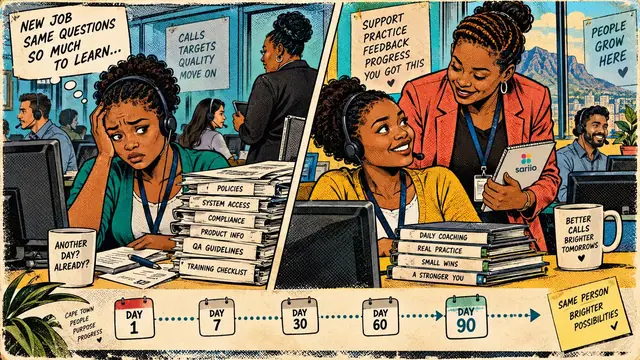
Around 70% of first-year leavers go within ninety days, so accurate recruitment, tailored onboarding and team leader support are where retention is won.
Read the exec summaryClose the exec summary
- Global contact-centre attrition averaged 39 per cent in 2024, reaching 41 per cent in EMEA (NICE, 2025).
- Around 70 per cent of first-year leavers leave within the first ninety days, concentrating retention efforts in early onboarding (COPC Inc.).
- Replacing one average-performing agent costs around $20,800, making early exits a substantial operating expense (SQM Group, 2023).
For leaders, check attrition by tenure and team leader, then focus on accurate role previews, tailored onboarding and manager support during the first ninety days.
Working together
Read both cultures before your customers do.
The culture is already there, on your side and your partner's. A Culture Blueprint reads both: how your brand team prefers to work, how your partner's teams on each site prefer to work, and where the two meet and differ.
It ends with a findings conversation with both leadership teams in the room, so the relationship moves from auditing each other to deciding together what to keep and what to change.
South Africa
Why so many brands choose South Africa.
In Ryan Strategic Advisory's 2025 survey of 819 contact centre leaders, South Africa ranked joint third of around 50 offshore destinations. The sector employs around 150,000 people serving international clients, and it's chosen for its people: the time zone, the cultural affinity with UK customers and its strength on complex, human calls.
 TL;DR
TL;DR
Is outsourcing to South Africa legit? What buyers actually ask
South Africa is a proven CX destination, ranking tied third among roughly 50 offshore markets, with ~150,000 international-facing jobs and ~US$2.91 billion in export revenue.
Read the exec summaryClose the exec summary
- Ryan Strategic Advisory ranked South Africa tied third among roughly 50 offshore destinations, based on input from 819 enterprise contact centre leaders, with US and Australian buyers naming it their first choice (Ryan Strategic Advisory, 2025).
- BPESA puts sector employment at roughly 150,000 international-facing jobs by 2024 and export revenue at around US$2.91 billion, up from US$1.04 billion in 2019 (BPESA, 2025).
- Operating costs can be 55-65% lower than in Manchester, Dallas or Sydney, with incentives cutting a further 7-10%; buyers should also check attrition, POPIA compliance and power resilience (BPESA, 2025; South African Government).
For leaders, assess each provider on retention, POPIA and GDPR controls and power resilience, and start with a small, bounded phase of live volume.
 TL;DR
TL;DR
What is impact sourcing, and why does South Africa lead?
South Africa's impact-sourcing model opens first jobs to young people, and 84% of GBS hires since 2010 are still in formal employment.
Read the exec summaryClose the exec summary
- Impact sourcing deliberately recruits and develops people excluded by the labour market into BPO roles. The term was coined in 2011 by Monitor Group in research for the Rockefeller Foundation. (Monitor Group, 2011)
- Over the past decade, around 90% of South Africa’s GBS new hires were young people, and more than 30% came from households with no previously employed member. (BPESA, 2025)
- Harambee reports 84% retention in formal employment among GBS hires since 2010, while the sector targets 500,000 jobs by 2030. (Harambee, 2026; BPESA, 2025)
For leaders, build intentional recruitment into workforce planning, then tailor training and support so new starters can find roles and progression that fit their strengths.
 TL;DR
TL;DR
Does AI threaten impact sourcing?
More than half of entry-level BPO tasks are automatable, yet AI assistance lifted novice agents’ productivity by around 35%, exposing both threat and opportunity.
Read the exec summaryClose the exec summary
- Entry-level roles make up 68% of Africa’s BPO and ITES workforce, and more than half of entry-level tasks are automatable (Caribou & Genesis Analytics / Mastercard Foundation, 2025).
- Cape Town added a record 11,496 BPO jobs in 2025/26, while the sector targets 500,000 jobs by 2030 (CapeBPO / Outsource Accelerator, 2026).
- In a study of 5,172 agents, AI assistance lifted new and lower-skilled agents’ productivity by around 35% and cut turnover by 8.6 percentage points (Brynjolfsson, Li & Raymond, QJE, 2025).
For leaders, redesign entry-level roles around judgement and empathy, and put AI beside new hires to build capability as routine tasks are automated.
Working together
Start with one campaign your partner runs for you.
Half an hour with David, ideally with your partner's operations lead, is enough to see whether the work preference layer fits the account. I'll tell you where Sariio can help, and where Sariio can't.
Useful to bring
The campaign, the partner and the standard.
The campaign you'd start with, your contact at the partner and the QA or customer measure you'd most like to move.
 sariio