 sariio
The Direction Dimension: How the Group Sets Out
- Direction pairs Relationships with Thinking and Planning: where trust meets planning, before work begins.
- Nine attributes name its cells: Steady, Thoughtful, Curious, Organised, Versatile, Imaginative, Purposeful, Open, Spirited.
- Its tension partner is Action: do we act on our direction?
- Read at scale, it shows whether ideas open socially or privately, and whether plans are built or improvised.
Before any work begins, two things have already been decided - usually without anyone deciding them. How much do we trust each other? And how much do we plan? Every kick-off meeting answers both in its first ten minutes, and the answers shape everything that follows. Direction, the first of the six dimensions, is where those answers become visible.
What is the Direction dimension in Sariio MAPS?
The first of the six dimensions: how a person or group sets out before work begins. It pairs the Relationships factor with Thinking and Planning - where trust meets planning - so it shows how cautious or open people are with each other, and whether they plan methodically or think on their feet. Like every dimension it is a two-axis field of nine cells, each named for the kind of person who sits there.
The two axes
The horizontal axis carries Relationships: from guarded, task-led and self-reliant on one side to warm, people-led and collaborative on the other. The vertical axis carries Thinking and Planning: from analytical, consistent and step-by-step to bold, fresh and flexible. Cross them and you get the blueprint layer of working life - how a person combines their approach to others with their approach to problems, before anything is done.
The nine attributes
What are the nine attributes of the Direction dimension?
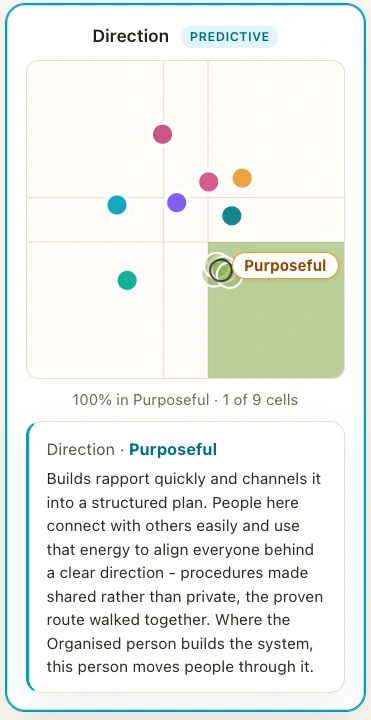
Steady, Thoughtful, Curious, Organised, Versatile, Imaginative, Purposeful, Open and Spirited. Each names the kind of person a position describes - a Purposeful person builds rapport quickly and channels it into a structured plan; a Steady person is measured and not easily shifted; a Spirited person connects instantly and turns that energy into new ideas. Every attribute has real strengths and a plausible drawback, and none is better than another.
Reading across the field: Steady people are measured and not easily shifted; Thoughtful people are reserved with people and even-handed with ideas; Curious people are drawn to the new but test it privately first. In the centre column, Organised people bring structure to the group; Versatile people move between the proven and the new as the situation asks; Imaginative people generate ideas collectively. On the open side, Purposeful people build rapport quickly and channel it into a structured plan; Open people think out loud and extend trust easily; Spirited people connect instantly and turn that energy into new ideas.
The attribute voice matters: these words describe people, not territories, and each one can be a drawback in the wrong moment - Steady can be immovable, Spirited can be scattered, Organised can be rigid. That is deliberate. A map with a best corner would be a verdict; this is a mirror.
The tension with Action
Direction's partner is Action, and the pairing asks the question every strategy away-day eventually reaches: do we act on our direction? A group rich in Direction energy - ideas opened, plans built, trust flowing - can still deliver nothing; a group rich in Action energy can deliver at speed in the wrong direction. Seeing both dimensions side by side shows which half of the bargain a team is keeping.
At scale: culture and roles
How is the Direction dimension used in mapping culture and roles?
At team and organisation scale, Direction shows how the group opens work: whether ideas are opened socially or worked privately, whether planning is structured or exploratory, and how much variety sits beneath the surface. In a cultureMAP it reveals the centre of gravity, spread and camps; in a successMAP it shows whether a role's proven performers cluster in particular Direction cells - and if they cluster tightly, the dimension is predictive for hiring into that role.
That double use - mapping culture and mapping successful roles - is the point of the shared canvas: a person, a team and a benchmark are all read in the same vocabulary. The set continues with Action, and the full architecture is in the six dimensions and the four factors beneath it.
See where you sit on Direction in twelve minutes - the individual survey is free.
Sources
- Charvet, S.R. (1997), Words That Change Minds, Kendall/Hunt - the metaprogramme ancestry of the underlying pairs
- Kotter, J.P. and Heskett, J.L. (1992), Corporate Culture and Performance, Free Press - culture read as shared behaviour, tied to performance
- Adler, A., individual psychology - trust and social interest as the ground of working life. See Alfred Adler got it right