 sariio
The Four Factors and Twelve Preference Pairs: the Foundation of Sariio MAPS
- Four factors - Relationships, Thinking and Planning, Making Decisions, Getting Things Done - cover the whole cycle of work: relating, planning, deciding, doing.
- Each factor is read through three preference pairs; the twelve descend from the NLP metaprogramme tradition, on Adler's purposive foundations.
- Positions are sliders, never boxes - a scientific stance, not a design taste.
- No pole is better than its opposite. The instrument orients; it never grades.
What does every job in the world have in common? Strip away the industry, the title and the tools, and four activities remain. You work with people. You think about what to do. You decide. You deliver. A surgeon and a scaffolder, a team leader and a chief executive - all of them relate, plan, decide and do, every working day, in their own way.
That observation is the foundation of Sariio MAPS. The instrument reads a person through four factors - Relationships, Thinking and Planning, Making Decisions and Getting Things Done - and reads each factor through three preference pairs: sliding scales between two equally legitimate ways of working. Twelve pairs in all, measured by sixty paired statements that take about twelve minutes to answer. This article is the reference for that structure: what the factors are, where the pairs come from, and why the whole thing is built on sliders rather than boxes.
What are the four factors of work preference?
Relationships - how you prefer to connect with the people work is done with. Thinking and Planning - how you prefer to process information and shape a route forward. Making Decisions - how you prefer to move from consideration to commitment. Getting Things Done - how you prefer to carry commitment through to completion. Relating, planning, deciding, doing: every job contains all four, whatever the industry and whatever the seniority.
The claim worth pausing on is completeness. The four factors are not a shortlist of interesting topics; they are the stages work actually passes through. Anything you did at work today began with people, passed through thought, crossed a moment of commitment and ended - or will end - in delivery. That is why a map built on these four can describe a customer service agent and a finance director with the same vocabulary, and why an organisation's culture can be read from the same data: the six dimensions of a cultureMAP are simply the pairings of these four factors.
Each factor has its own reference article in this set: Relationships, Thinking and Planning, Making Decisions and Getting Things Done.
The intellectual roots
What is Sariio MAPS based on?
Two traditions. Alfred Adler's individual psychology holds that people are purposive - behaviour makes sense once you understand what a person is moving towards - and that they must be understood as wholes in a social context. The NLP metaprogramme tradition supplies the working ancestry of the twelve preference pairs: the habitual filters by which people sort and act on information, described in Shelle Rose Charvet's Words That Change Minds. Sariio measures those patterns with sixty paired statements on sliders.
Adler supplies the stance. Where much of psychology asks what is wrong with a person, Adler asked what the person is for - what goal their behaviour serves, and how their striving fits the community around them. Three of his commitments run straight through Sariio's design. People are indivisible, so the instrument reads a whole working style rather than isolated traits. People are social, so a Relationships factor sits first among equals, and every map exists to improve a conversation between people. And people are purposive, so the instrument describes direction of travel - preferences that serve a person's way of working - rather than fixed properties.
The metaprogramme tradition supplies the machinery. Metaprogrammes are the habitual patterns by which people filter information and act on it: whether attention goes towards opportunity or away from risk, whether the familiar or the novel energises, whether a person prefers a set procedure or a spread of options. The tradition was codified for the workplace by Rodger Bailey's Language and Behaviour Profile and popularised in Charvet's Words That Change Minds. Sariio's twelve pairs are that ancestry made measurable: each pair takes a pattern with decades of applied use behind it and fixes it to a scale a person can actually be placed on, from their own answers.
The twelve pairs, factor by factor
What are the twelve preference pairs?
Three per factor. Relationships: Wary-Trusting, Concern for Task-Concern for People, Independent-Interdependent. Thinking and Planning: Problem Solver-Risk Taker, Similar-Different, Procedures-Options. Making Decisions: Thinking-Doing, Rational-Intuitive, Certainty-Ambiguity. Getting Things Done: Specific-General, Finisher-Starter, Perfectionist-Pragmatist. Each pair is a sliding scale between two equally legitimate ways of working, never a box.
Here is the full chassis, exactly as it appears in a myMAP - one person, twelve positions:
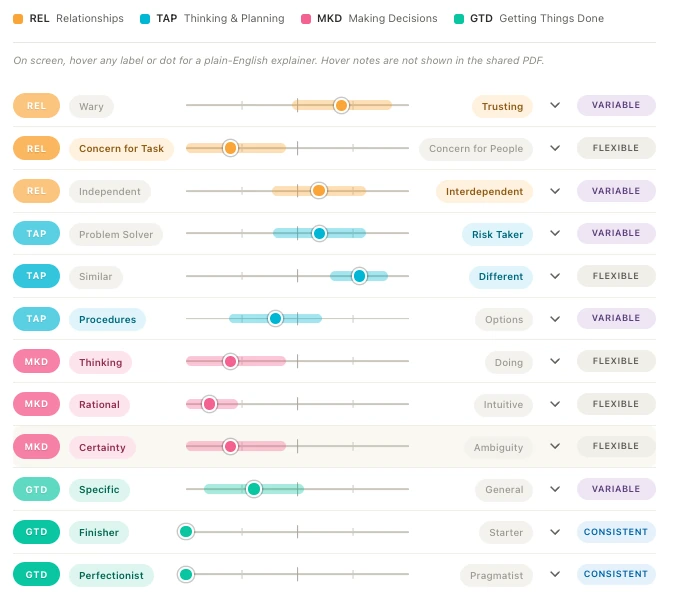
Notice what the picture is not. There are no quadrants to fall into, no colours to become, no four-letter code to be issued with. There are twelve positions, each meaningful on its own, and together they form a working style as individual as a signature. Sixty statements produce them - each pair read from five paired statements, answered on sliders in about twelve minutes.
Why sliders, not boxes
Type-based instruments make a hidden decision on your behalf: they round you to the nearest category. Answer one question differently and you can be issued a different letter, which is one reason around half of MBTI retakers get a different type within weeks. Sariio never rounds. Your position on each scale is kept as it is measured, so someone just left of centre on Thinking-Doing is recorded exactly there - not filed with the decisive types or the reflective ones.
This is a scientific position, not a design taste. Preferences are distributed continuously across people, and the information lives in where you sit, including the middle. A near-centre position is not indecision; it records genuine comfort with both poles, the ability to flex as the situation asks. A strong pull is not a limitation; it records where your energy naturally goes. And because preferences are not personality traits, positions can shift as your role and circumstances change - which is why a myMAP is a here-and-now picture, refreshed by re-survey, never a life sentence.
Is Sariio a personality test?
No. A personality test assigns you a type or scores your traits, and its own senior researchers dispute its value in hiring. Sariio measures preferences - the conditions under which you do your best work - as positions on twelve scales, from your own answers. There are no types, no grades and no verdicts; a position describes how you prefer to work today, and it can shift as your role and circumstances change.
No pole is better - and why that is the whole point
Every pair in the instrument holds two strengths in tension. A team of pure Risk Takers ships boldly and trips over the risk nobody scanned for; a team of pure Problem Solvers builds a fortress and never leaves it. Wary judgement and Trusting openness, Procedures and Options, Perfectionist polish and Pragmatist pace - work needs all of them, at different moments. The instrument's job is orientation: showing where each person's natural energy sits so that the differences become usable instead of irritating. The moment a tool starts grading poles, it stops being a mirror and becomes a verdict - and verdicts are precisely what the evidence against personality testing at work warns about.
That is also why the motivational science matters. As Daniel Pink's synthesis of the research argues, people do their best work under autonomy, mastery and purpose - and all three are easier to grant when you can see how a person actually prefers to work. We do our best work when we can play to our preferences. The four factors and twelve pairs exist to show you what those preferences are.
Where to go deeper
Each factor's reference article explains its three pairs in full, and why that factor earns its place among the four: the Relationships factor on how you connect; the Thinking and Planning factor on how you shape a route; the Making Decisions factor on how you commit; and the Getting Things Done factor on how you deliver.
The instrument that measures all twelve pairs is Sariio AI - and the individual survey is free, twelve minutes, your results yours.
Sources
- Adler, A. (1927), Understanding Human Nature, and the individual psychology tradition - purposive, holistic, socially embedded psychology. See also Alfred Adler got it right
- Charvet, S.R. (1997), Words That Change Minds, Kendall/Hunt - the Language and Behaviour Profile and the applied metaprogramme tradition, building on Rodger Bailey's LAB Profile
- NLP metaprogrammes: see Wikipedia, Methods of neuro-linguistic programming
- Pink, D. (2009), Drive: The Surprising Truth About What Motivates Us, Riverhead - autonomy, mastery and purpose. See the science of what actually motivates people at work
- Morgeson, Campion, Dipboye, Hollenbeck, Murphy & Schmitt (2007), 'Reconsidering the Use of Personality Tests in Personnel Selection Contexts' - the former journal editors' verdict on personality tests in hiring
- Pittenger, D.J. (2005), 'Cautionary Comments Regarding the Myers-Briggs Type Indicator', Consulting Psychology Journal - type instability on retest