 sariio
The Relationships Factor: How You Prefer to Connect at Work
- Relationships is where the cycle of work begins: nothing gets planned, decided or delivered except with people.
- Three pairs read it: Wary-Trusting, Concern for Task-Concern for People, Independent-Interdependent.
- Gallup attributes 70 per cent of the variance in team engagement to the manager - a relationship.
- No pole is better. The value is in seeing the mix and working with it.
Think about the last piece of work you were proud of. However technical it was, it started with people: someone briefed it, someone was consulted, someone received it. Work is a social act before it is anything else - which is why Relationships stands first among the four factors of Sariio MAPS, and why Alfred Adler, whose psychology underpins the instrument, insisted that a person can only be understood in their social context.
This article is the reference for the factor: what it covers, why it matters operationally, and what its three preference pairs mean in practice.
What is the Relationships factor in Sariio MAPS?
The first of the four factors: how you prefer to connect with the people you work with - how quickly you open up, where your attention naturally goes when work is under way, and how much you involve others in your thinking. It is read through three preference pairs: Wary-Trusting, Concern for Task-Concern for People, and Independent-Interdependent. No position on any of them is better than another.
Together the four factors cover the whole cycle of work - relating, planning, deciding, doing - and Relationships is the stage everything else passes through. A plan is agreed between people. A decision lands on people. Delivery is handed to people. Read a person's Relationships preferences and you know how they will experience every one of those moments.
Why this factor matters
Why do working relationships matter for performance?
Because almost no work is done alone, and the evidence puts relationships at the centre of engagement: Gallup attributes 70 per cent of the variance in team engagement to the manager, which is a relationship, and manager-report conversations, handovers and collaboration all run on how people connect. A team that understands its mix of relationship preferences turns friction into a working arrangement instead of a mystery.
The practical cases are everywhere. A new starter who trusts slowly joins a team that bonds fast, and reads as stand-offish when they are simply doing their diligence. A manager who leads with the task inherits a report who needs the people question asked first, and neither can name why their one-to-ones feel cold. A natural collaborator is dropped into a role designed for solo work and quietly starves. None of these is a performance problem - each is a preference mismatch, visible in twelve minutes on a map, and workable the moment it is seen. It is the same mechanism that empties contact centres in the first ninety days, scaled down to one relationship at a time.
The three pairs
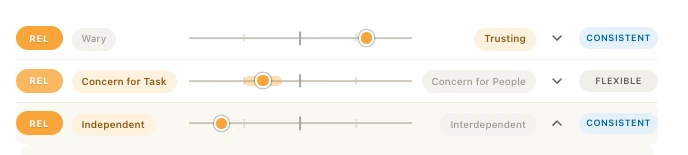
What does Wary versus Trusting mean at work?
It describes how you approach new people and new working relationships. A pull towards Wary means you evaluate first - trust is earned, and you take time to understand someone before relying on them, which makes for steady judgement. A pull towards Trusting means you connect fast - goodwill is extended early and rapport builds quickly, which makes collaboration feel easy from day one. Both are strengths; teams need both.
Watch this pair at work in any onboarding. The Trusting new starter has three allies by Friday; the Wary one has a considered read on who actually delivers. Six months later the difference has usually vanished - but the first month is experienced completely differently, and a team leader who can see the position coming treats the quiet start as diligence rather than disengagement.
Concern for Task - Concern for People
This pair is about where your attention goes first when work is under way. A pull towards Concern for Task means the work comes first: you focus on what needs doing, and you show your care for people by delivering for them. A pull towards Concern for People means the people come first: you notice how colleagues are feeling, and you know the work goes better when people are looked after.
The trap with this pair is moral misreading. Task-first people are not cold - their care is expressed through delivery, through never letting a colleague down on a commitment. People-first people are not soft - their attention to the room is often what keeps delivery possible at all. A manager-report pair split across this scale will each feel the other has priorities backwards until the difference is named; named, it becomes a division of labour.
What is the difference between independent and interdependent working?
The pair describes how much you involve others in your work and decisions. Independent means you rely on your own judgement, work things out alone, and take responsibility for the outcome. Interdependent means you naturally seek input - thinking out loud with others, sharing the load, building on other people's ideas. Neither is better: teams need self-sufficient finishers of thought and natural collaborators alike.
This pair quietly decides how meetings feel. The Interdependent colleague thinks by talking; the Independent one talks once they have thought. Put them in a brainstorm without understanding the difference and one seems to dominate while the other seems disengaged - when in truth both are working exactly as they work best. Knowing the positions lets a team design for both: space to think aloud, and space to think alone.
Reading the factor as a whole
Three pairs, read together, sketch how a person does connection. Trusting, People-first and Interdependent describes someone for whom work is fundamentally communal. Wary, Task-first and Independent describes someone whose reliability is the relationship. Most people are a mix - and near-centre positions record genuine flexibility, not absence of character. Whatever the pattern, it is a preference, never a grade: the instrument never ranks poles, because no pole is better.
The other three factors complete the picture: Thinking and Planning for how a route gets shaped, Making Decisions for how commitment happens, and Getting Things Done for how delivery lands.
See your own Relationships positions in twelve minutes - the individual survey is free, and your results are yours.
Sources
- Gallup, 'Why Great Managers Are So Rare' - the manager accounts for 70 per cent of the variance in team engagement
- Adler, A., individual psychology - the social embeddedness of the person. See Alfred Adler got it right
- Charvet, S.R. (1997), Words That Change Minds, Kendall/Hunt - the applied metaprogramme tradition behind the preference pairs
- Kristof-Brown, Zimmerman & Johnson (2005), 'Consequences of Individuals' Fit at Work: A Meta-Analysis' - person-environment fit and its outcomes