 sariio
The Getting Things Done Factor: How You Prefer to Deliver
- Getting Things Done is where the work cycle lands: the factor of delivery.
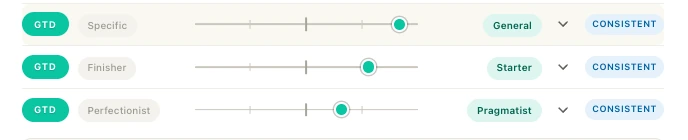
- Three pairs read it: Specific-General, Finisher-Starter, Perfectionist-Pragmatist.
- Delivery styles are preferences, not work ethic - and mismatches masquerade as performance problems.
- Teams need every pole: starters and closers, detail and shape, polish and pace.
Deadlines expose people - not their competence, but their style. As a date approaches, one colleague is deep in the detail, one is guarding the overall shape, one is spinning up the next project, and one is closing this one down properly. All four are delivering. They are just delivering differently - and that difference is the territory of the last of the four factors of Sariio MAPS: Getting Things Done.
This is the reference article for the factor: what it covers, why it matters, and what its three preference pairs mean in practice.
What is the Getting Things Done factor in Sariio MAPS?
The fourth of the four factors: how you prefer to deliver work - the level of detail you naturally work at, where your energy sits in the life of a task, and what done means to you. It is read through three preference pairs: Specific-General, Finisher-Starter, and Perfectionist-Pragmatist. As everywhere in the instrument, these are preferences rather than abilities, and no position is better than another.
The cycle the four factors cover - relating, planning, deciding, doing - ends here, where everything upstream becomes something real: the report sent, the call handled, the build shipped. Because delivery is the visible end of work, this is the factor most often confused with performance - and the one where seeing preference clearly pays back fastest, because delivery-style mismatches are routinely misread as attitude.
The three pairs
What is the difference between detail-oriented and big-picture people?
The Specific-General pair measures the level of detail a person naturally works at. Specific means fine grain - noticing the details, caring about precision, catching the small thing that would have caused a big problem. General means big picture - holding the overall shape of the work, keeping sight of the goal, and stopping detail from crowding out the point. Delivery needs both grains, usually in the same team and often in the same week.
The classic collision is the handover. A General colleague passes work to a Specific colleague and hears back a list of forty queries, which reads as pedantry; the Specific colleague receives a brief with the details unresolved, which reads as carelessness. Both are doing their jobs. A pair who can see each other's positions builds the bridge deliberately: the shape stated once, the detail owned explicitly, and the forty queries welcomed as the quality control they are.
Why are some people better at starting projects than finishing them?
Because starting and finishing draw on different energy, and the Finisher-Starter pair measures where a person's sits. Starters light up at the beginning - they get things off the ground while others hesitate. Finishers feel the pull to close - loose ends nag at them, and completing things properly is where the satisfaction is. It is a preference, not a flaw: teams stall without starters and drown in open loops without finishers.
Managers meet this pair as a staffing question they have been answering by instinct for years. Who opens the new site, and who lands the migration? Give the Starter the blank page and the Finisher the last mile, and both run on their own fuel. Reverse them and both jobs get done - slower, at a higher cost in energy, by two people privately wondering why the work feels heavy. The map turns the instinct into evidence.
What does done mean - perfectionist versus pragmatist?
The pair measures a person's natural standard for release. A Perfectionist wants it right - quality matters deeply, and the work is refined until it meets a standard to be proud of. A Pragmatist wants it fit for purpose now - judging what good enough looks like for the situation, delivering it, and moving to the next thing. Neither is better: some work deserves the polish, some work needs the pace, and knowing your pull tells you when to push against it.
The pair also explains a whole family of team arguments that are really calibration questions. When the Pragmatist ships and the Perfectionist winces, the real question is not who is right but what this piece of work deserves - a question best answered explicitly, per deliverable, rather than fought silently through review comments. Teams that name the pair get a vocabulary for that negotiation: "this one is a polish job; this one is a ship job".
Reading the factor as a whole
Three pairs, together, describe how a person lands work: the grain they see it at, the phase that fuels them, the standard they release at. It is the factor where preference is most often mistaken for virtue - the Finisher praised as conscientious, the Starter marked down as flighty, the Perfectionist as diligent, the Pragmatist as slapdash - and the instrument's refusal to grade poles matters most here. Every pole on every pair is a strength somewhere, a liability somewhere else, and a preference everywhere.
At the organisational scale this factor feeds the Action, Impact and Process dimensions of a cultureMAP - whether an operation finishes fast, finishes carefully, or finishes differently in different corners is these preferences, aggregated. And for a single career, the factor answers the most useful development question there is: not "how do I fix my delivery?" but "what work lets my delivery style be the strength it is?" We do our best work when we can play to our preferences - this factor is where that shows up as finished work.
The full set: the foundation article for the whole chassis, and the other three factors - Relationships, Thinking and Planning and Making Decisions.
See your own Getting Things Done positions in twelve minutes - the individual survey is free, and your results are yours.
Sources
- Charvet, S.R. (1997), Words That Change Minds, Kendall/Hunt - the applied metaprogramme tradition behind the preference pairs, including specific/general
- Adler, A., individual psychology - the indivisible person, read as a whole working style. See Alfred Adler got it right
- Kristof-Brown, Zimmerman & Johnson (2005), 'Consequences of Individuals' Fit at Work: A Meta-Analysis' - person-job fit and its outcomes, the evidence frame for preference-role mismatch
- Pink, D. (2009), Drive, Riverhead - mastery and autonomy in how work is delivered. See the science of what actually motivates people at work