 sariio
The Making Decisions Factor: How You Prefer to Commit
- Making Decisions is the hinge of the work cycle - where relating and planning become action.
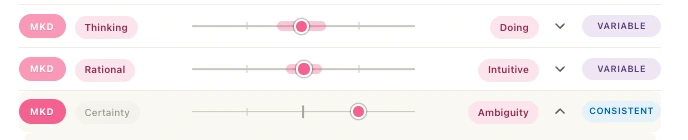
- Three pairs read it: Thinking-Doing, Rational-Intuitive, Certainty-Ambiguity.
- Decision speed is mostly preference, not confidence - and mismatched rhythms are a classic source of team friction.
- No pole is better: reflection and momentum, analysis and instinct, firm ground and open ground all make good decisions.
Every piece of work contains a hinge moment: the point where considering stops and committing starts. Some people reach it early and adjust as they go. Some reach it late and rarely have to adjust at all. Watch a team miss each other at that hinge - one half pressing for the call, the other half asking for a week - and you are watching the third of the four factors of Sariio MAPS at work.
This is the reference article for Making Decisions: what the factor covers, why it matters, and what its three preference pairs mean in practice.
What is the Making Decisions factor in Sariio MAPS?
The third of the four factors: how you prefer to move from thought to action - when you feel ready to commit, what kind of evidence persuades you, and how much clarity you need before you go. It is read through three preference pairs: Thinking-Doing, Rational-Intuitive, and Certainty-Ambiguity. Like every part of the instrument, it describes preferences rather than ability, and no position is better than another.
In the cycle the four factors cover - relating, planning, deciding, doing - this is the hinge. Relationships sets who is involved; Thinking and Planning shapes what could be done; Making Decisions is where somebody commits; and Getting Things Done is where the commitment becomes real. Organisations obsess over the quality of their decisions while staying blind to the machinery of them - who needs what evidence, in what form, with how much settled - and that machinery is exactly what this factor makes visible.
The three pairs
Why do some people decide quickly and others take longer?
Usually not confidence or competence but preference. The Thinking-Doing pair describes a natural rhythm: Thinking means reflecting first and committing once the decision has been turned over properly, which tends to produce well-grounded choices; Doing means acting, learning and adjusting - making a start and refining as you go, which gets things moving while others weigh up. Both rhythms make good decisions; they make them differently.
The friction comes when the rhythms meet unnamed. To a Doing colleague, the Thinking colleague is sitting on it; to the Thinking colleague, the Doing colleague is winging it. A manager and report split across this pair will grind in one-to-ones - one pressing "so what did you decide?", the other needing the space to say "I'm still working it through, and here's my date". Named, the difference becomes schedulable: agree when a decision is due, and let each rhythm run inside the window.
What does it mean to be a rational or an intuitive decision maker?
The pair describes the evidence that persuades you. Rational means trusting evidence and logic - wanting the data, the reasoning and the facts, and testing conclusions before accepting them. Intuitive means trusting your reading of the situation - picking up patterns quickly and often sensing the right call before you can fully explain it. Neither is superior: intuition is pattern recognition built from experience, and analysis is its check.
This pair decides what a persuasive case looks like, which makes it essential knowledge for anyone who has to carry a decision through other people. Present a gut-call to a Rational stakeholder and it bounces; drown an Intuitive stakeholder in spreadsheets and you lose the room. The same proposal, argued twice, lands twice. Sariio's own Compare view exists for precisely this moment: two maps side by side, showing each person how the other needs a case made.
How much certainty do people need before deciding?
It varies by preference, and the Certainty-Ambiguity pair measures it. A pull towards Certainty means you like things settled before you move - clear answers and firm ground give confidence, and you resolve open questions early. A pull towards Ambiguity means you can commit while some things remain unresolved, trusting that clarity will come along the way. Fast-moving operations need both: the drive to nail things down, and the nerve to move before everything is nailed.
Context decides which pole a role leans on. Compliance work rewards the Certainty pull; a start-up's first year runs on tolerated Ambiguity. Neither environment is wrong, and nor is either preference - but a strong-Certainty person in a permanently unresolved role, or a strong-Ambiguity person in a nail-everything-down role, will spend energy on the mismatch that never shows up in any performance review. The map shows where that energy is going.
Reading the factor as a whole
Together the three pairs answer the question every delegation depends on: what does this person need in order to commit well? Time or momentum; data or the pattern; firm ground or a direction of travel. A manager who knows the answers stops prescribing their own decision style and starts resourcing each person's - which is much of what the research behind autonomy, mastery and purpose says drives performance in the first place. At the organisational scale, this factor feeds the Action, Approach and Commitment dimensions of a cultureMAP - an organisation's decision-making culture is these preferences, aggregated.
The set completes with Getting Things Done: what happens after the commitment is made.
See your own Making Decisions positions in twelve minutes - the individual survey is free, and your results are yours.
Sources
- Charvet, S.R. (1997), Words That Change Minds, Kendall/Hunt - the applied metaprogramme tradition behind the preference pairs
- Klein, G. (1998), Sources of Power: How People Make Decisions, MIT Press - naturalistic decision-making and intuition as experience-built pattern recognition
- Pink, D. (2009), Drive, Riverhead - autonomy as a driver of performance. See the science of what actually motivates people at work
- Adler, A., individual psychology - purposive behaviour as the frame for reading preference. See Alfred Adler got it right