 sariio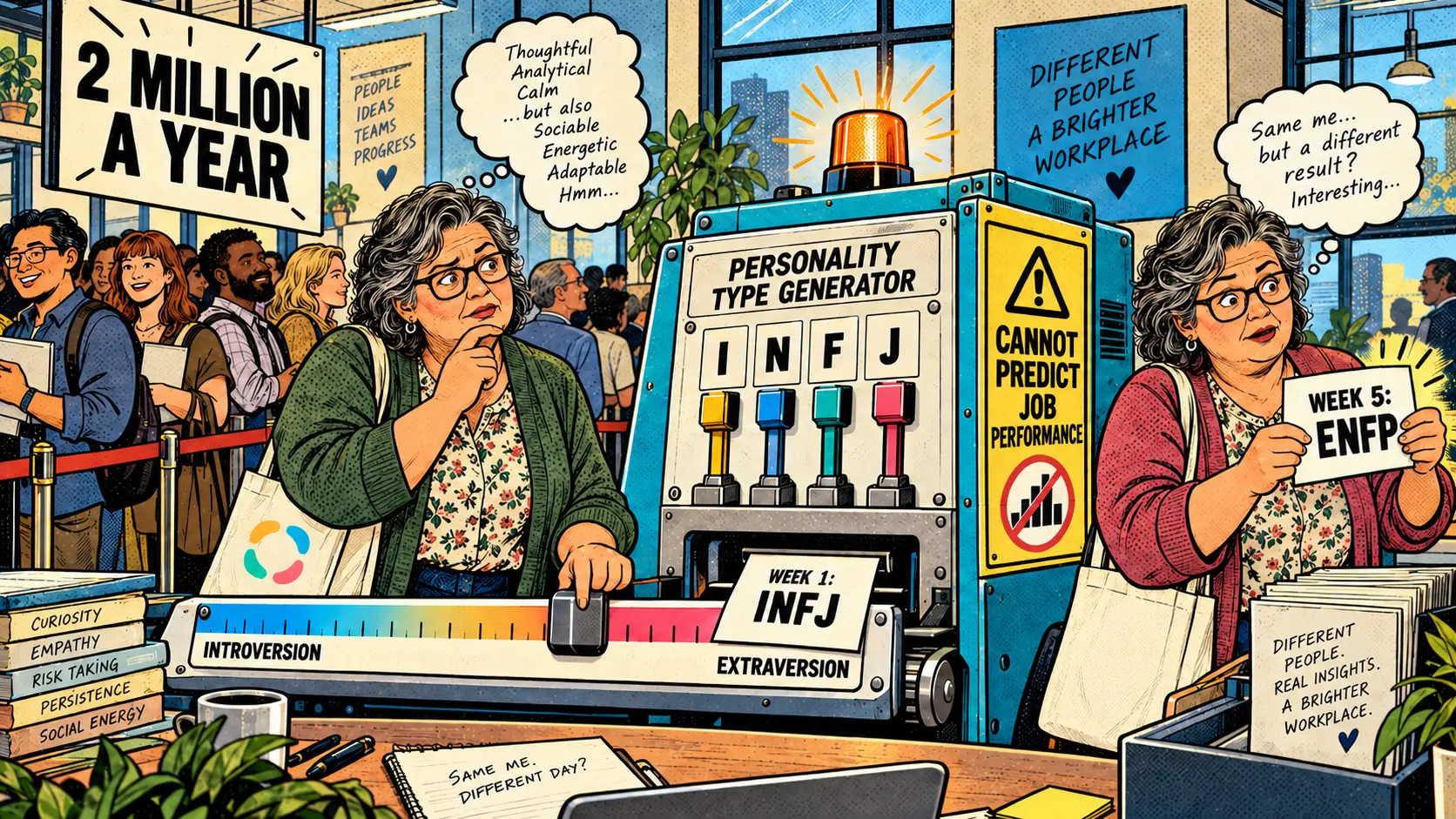
Has Myers-Briggs Been Debunked? What the Evidence Actually Says
- Up to half of MBTI takers get a different type on retest within five weeks.
- The publisher's own guidance says it should not be used for hiring - many employers use it for exactly that.
- Your type feels accurate because of the Barnum effect, demonstrated in 1949 with a horoscope.
- Two million people a year still take it. The hunger for self-knowledge is real; the label format is the failure.
Two million people a year take the MBTI, and 88 of the Fortune 100 use it. Yet up to half of retakers get a different type within five weeks, the publisher's own website says it cannot predict job performance, and the psychology profession moved on decades ago. What "debunked" really means here, why your type still feels so accurate, and what the appetite for self-knowledge deserves instead.
Has Myers-Briggs been debunked? As a piece of measurement, largely yes: the research record shows the sixteen types are unstable on retest, the either/or dichotomies are drawn through the middle of normal distributions rather than between real groups, and - by the publisher's own admission - the MBTI cannot predict how anyone will perform in a job. As a cultural phenomenon, plainly no: it remains one of the most-used assessments in corporate life. I have spent thirty years watching four-letter labels travel through workplaces, and the interesting question is not whether the instrument is flawed - that argument was settled in the academic literature before most of today's HR directors entered the profession. It is why something so flawed still feels so right, and what that tells us about what people actually want.
Where Did the Myers-Briggs Test Come From?
The MBTI was created not by research psychologists but by a mother and daughter - Katharine Briggs and Isabel Briggs Myers - working from Carl Jung's 1921 book Psychological Types, itself a work of theory Jung never tested empirically. Their story, told in Merve Emre's history The Personality Brokers, is genuinely remarkable: two determined women building an instrument at the kitchen table decades before psychology would have let them near a laboratory. But admiration should not be confused with validation. Neither had formal training in psychology, and when the Educational Testing Service examined the Indicator in the 1960s, its staff concluded the theory behind it was Jungian "but with even less in the meaning of the terms". The instrument's DNA is a hundred-year-old untested theory, operationalised by amateurs, then commercialised brilliantly.
What Does the Evidence Say About the MBTI's Accuracy?
The evidence says the MBTI fails the two tests any measure must pass: give the same answer twice, and measure something real. On the first, David Pittenger's review of the research found that as many as 50 per cent of people are classified into a different type on retest, even when the retest comes just five weeks later. A measure of your "innate type" that flips for half its takers in five weeks is measuring your mood, not your nature. On the second, the same review found no evidence of bimodal distributions: people do not cluster at the Extravert and Introvert poles - most score near the middle, meaning an "E" one point from the boundary is nearly identical to an "I" one point the other side, yet the two receive entirely different four-letter identities. The boundary runs through the middle of the crowd, not between two crowds.
"If you put a horoscope on one end and a heart monitor on the other, the MBTI falls about halfway in between."
- Adam Grant, organisational psychologist, Wharton
Why Does My Type Still Feel So Accurate?
Your type feels accurate because of a well-documented trick of the mind, not because it is accurate - psychologists call it the Barnum effect. In 1949, Bertram Forer gave 39 students what each believed was a personal personality sketch; every student received the identical text, assembled from an astrology book, and on average they rated its personal accuracy 4.3 out of 5. Descriptions that are flattering, general, and framed as being about you are experienced as uncannily true. The MBTI's sixteen portraits are masterworks of the genre: every type is a strength, nobody is ever told they are difficult, and the language is warm enough to hang on a fridge. Feeling seen is a real and valuable experience. It is just not evidence of measurement - and the difference matters the moment the label starts making decisions.
Should Employers Use the MBTI for Hiring or Promotion?
No - and you do not have to take my word for it, because the people who sell the MBTI say so themselves. The Myers & Briggs Foundation's ethics guidance states plainly that the assessment "is not designed to be used for hiring purposes", and the publisher's own site lists what the MBTI cannot do:
"Measure or predict job performance… Tell companies who they should hire."
- The Myers-Briggs Company, publisher of the MBTI
The academic verdict on personality testing for selection more broadly is just as blunt: a panel of former editors of the field's top journals concluded the central problem is personality tests' "very low validity" for predicting job performance. The best modern meta-analysis of selection methods - Sackett and colleagues, 2022 - puts structured interviews, job-knowledge tests and work samples at the top of the list; personality instruments trail far behind. Any typing tool being used to shortlist, promote or team-build-by-verdict is operating against the advice of its own maker and the whole weight of the selection literature.
Keep the Curiosity - Drop the Verdict
Here is the part the debunkers keep missing, in my opinion: two million people a year are not fools. They take the MBTI because the hunger to be understood at work is real, urgent and almost never fed - most employees will go a whole career without any structured attempt to understand how they work best. The MBTI's genius was to take that hunger seriously. Its failure is the verdict: sixteen fixed boxes, an identity stamped in four letters, a boundary drawn through the middle of a normal distribution and declared a difference in kind. People do their best work when they can play to their preferences - and a preference is everything a type is not. It is a position on a continuum, not a box; it carries no judgement, so there is nothing to fail and nothing to fake; and it is expected to be used - matched to work, discussed in one-to-ones, revisited as life changes - rather than worn as a label. Measure the preference, skip the verdict, and the curiosity that built a multi-billion-dollar typing industry finally gets an answer that would survive a retest. If you want to see yours, the twelve-minute survey is free for any individual - and it will never tell you what you are, only what you prefer.
Has the Myers-Briggs test been debunked?
As measurement, substantially: research shows up to 50 per cent of people get a different type on retest within five weeks, type scores are not bimodal (most people sit near the middle of each dichotomy), and the publisher itself states the MBTI cannot predict job performance. As a popular framework it remains widely used, which is a separate question from whether it measures what it claims.
Is the MBTI scientifically valid?
Its reliability and validity are widely criticised in the academic literature: unstable classifications on retest, dichotomies imposed on continuous traits, and little evidence linking type to workplace outcomes. Former editors of the field's leading journals describe personality tests generally as having "very low validity" for predicting job performance.
Can employers use Myers-Briggs for hiring?
The publisher and the Myers & Briggs Foundation both say no - the instrument "is not designed to be used for hiring purposes" and cannot "measure or predict job performance". Using it for selection also sits poorly with UK employment good practice, since the evidence base for job-relevance is weak.
Why does my MBTI type feel so accurate?
Largely the Barnum effect: people rate flattering, generalised descriptions presented as personal as highly accurate - in Forer's classic demonstration, students rated an identical horoscope-derived sketch 4.3 out of 5 for personal accuracy. Feeling recognised by a description is not evidence that the underlying measurement is sound.
What is a better alternative to the MBTI at work?
Instruments that measure work preferences as positions on continua rather than typing people: no categories, no verdict, nothing to fail. The evidence consistently shows person-job fit - how well work matches the individual - predicts satisfaction and retention far better than any personality label.
The wider evidence that personality tests don't predict performance is in personality tests don't predict job performance; how the typing industry got this big is in the cult of personality. What preferences are - and why they carry no judgement - is defined in what are work preferences. The instrument that measures them is Sariio AI.
Sources
- The Myers-Briggs Company, 'All About the MBTI Assessment' - the publisher's statement that the MBTI cannot measure or predict job performance, and its continued wide corporate use
- New York Review of Books (2018), 'The Myers-Briggs Test: Simple Answers to Profound Questions' - the MBTI's origins with Katharine Briggs and Isabel Briggs Myers, neither formally trained in psychology, and the scale of the assessment industry
- Pittenger, D. (1993), 'Measuring the MBTI… And Coming Up Short' - up to 50 per cent of takers classified into a different type on retest within five weeks, with no bimodal distributions
- Encyclopaedia Britannica, 'Barnum Effect' - Forer's 1949 experiment, in which an identical horoscope-derived sketch was rated 4.3 out of 5 for personal accuracy
- The Myers & Briggs Foundation, 'Ethical Use of the MBTI' - the foundation's guidance that the MBTI is not designed to be used for hiring
- Morgeson et al. (2007), 'Reconsidering the Use of Personality Tests in Personnel Selection Contexts', Personnel Psychology - former journal editors' conclusion that personality tests have "very low validity" for predicting job performance
- Sackett et al. (2022), 'Is Cognitive Ability the Best Predictor of Job Performance? New Research Says It's Time to Think Again', SIOP - structured interviews, job-knowledge tests and work samples rank above personality instruments for predicting performance