 sariio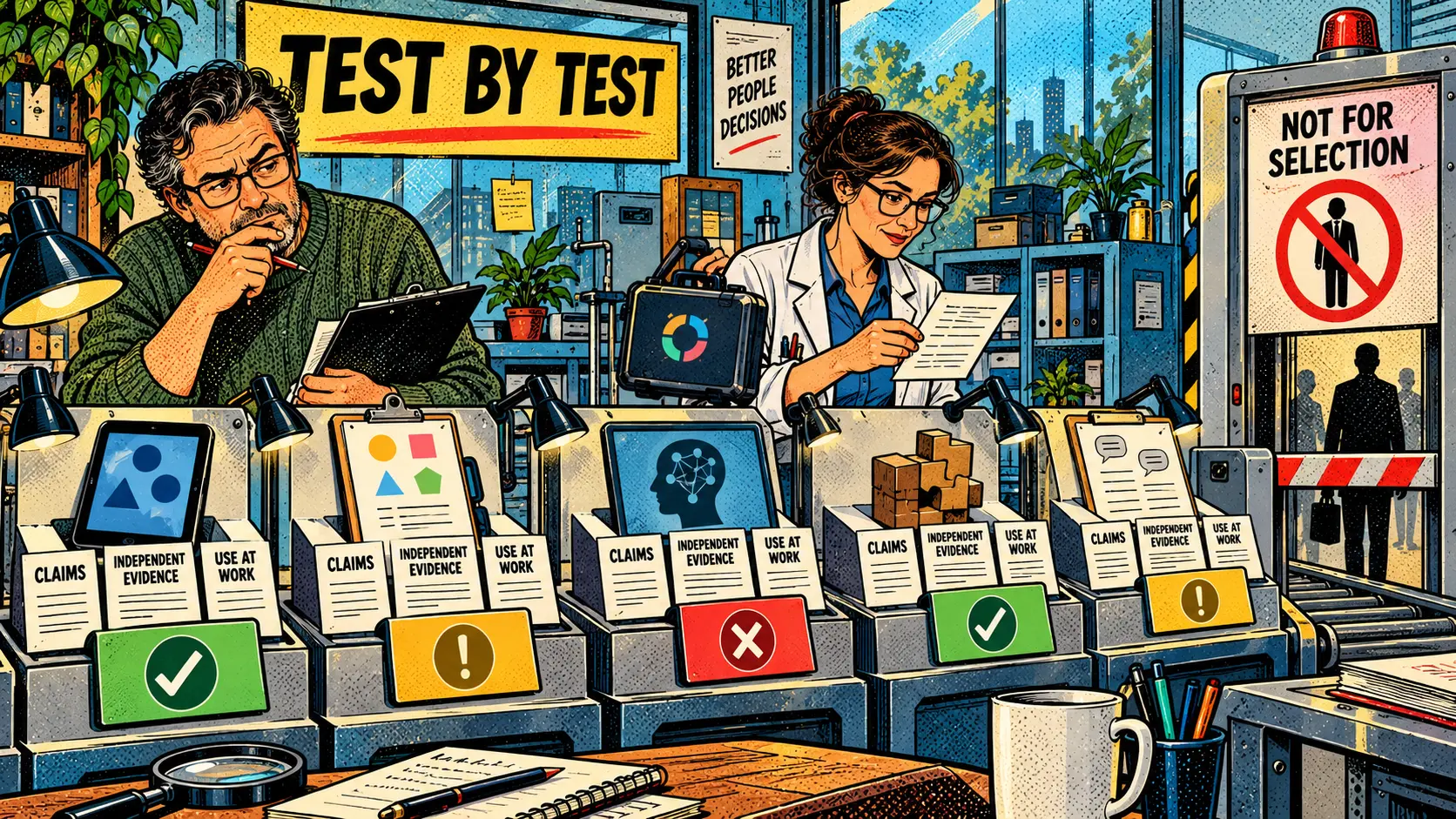
Personality Tests at Work: What the Evidence Says, Test by Test
- Test by test - MBTI, DISC, Insights, Hogan, CliftonStrengths - the publishers' own statements undercut the workplace uses.
- Structured interviews predict performance at .42, the best of any selection method. Personality tests sit far below.
- Five former journal editors called personality-test validity for selection "very low".
- Person-job fit correlates .56 with satisfaction - measure fit, not type.
The definitive verdict table. Every major personality test used in workplaces today - examined on its own terms, using its publishers' own words, the independent evidence, and the selection research. What each claims, what the data shows, and what to use instead.
This article is the pillar for the whole series. The individual deep-dives - on Myers-Briggs, on Insights Discovery, on DISC, on the pseudoscience question - each tell one instrument's story. This page holds them all in one place. If you are an HR director deciding which assessment to buy, a team leader wondering whether the colours on the wall mean anything, or a coach choosing what to put underneath a development conversation, this is the page to bookmark.
The Verdict Table
Here is what the evidence says about each major instrument used in workplaces today. Every claim below is sourced - from the publisher's own materials, from the independent research, or from the selection meta-analyses. Where a publisher's own words contradict the way the tool is commonly used, I have quoted those words directly.
Myers-Briggs Type Indicator (MBTI)
What it claims: Sixteen personality types based on four dichotomies (Extraversion/Introversion, Sensing/Intuition, Thinking/Feeling, Judging/Perceiving), derived from Carl Jung's 1921 typology. Described as a tool for self-awareness and understanding differences.
What the publisher says: The Myers-Briggs Company states the MBTI cannot "measure or predict job performance" and cannot "tell companies who they should hire." The Myers & Briggs Foundation states it "is not designed to be used for hiring purposes".
"The MBTI assessment is not designed to be used for hiring purposes… It is not designed to measure or predict job performance."
- The Myers-Briggs Company / Myers & Briggs Foundation
What the evidence says: Up to 50 per cent of takers receive a different type on retest within five weeks (Pittenger, 1993). No bimodal distributions - most people score near the middle of each dichotomy, meaning the type boundary runs through the crowd rather than between genuinely distinct groups. Created by two individuals without formal psychology training, from a theory Jung never tested empirically.
Fair use: Conversation-starting about working styles. Unsupported use: Hiring, promotion, team composition decisions. Full article: Has Myers-Briggs Been Debunked?
DISC (and Everything DiSC)
What it claims: Four behavioural dimensions - Dominance, Influence, Steadiness, Conscientiousness - derived from William Moulton Marston's 1928 theory. Positions itself as a tool for understanding behavioural style.
What the publisher says: Wiley, publisher of Everything DiSC, states DISC profiles are "not recommended for pre-employment screening" because they do not measure skills or aptitudes. However, Thomas International markets its DISC-based PPA as "built for hiring & development".
What the evidence says: Independent validation research is sparse. Studies that examined DISC-style instruments found the four dimensions were not psychometrically independent and were better explained as combinations of Big Five traits. Marston proposed the model in 1928 but never created an assessment from it - the first instrument was built by others in the 1940s. Dozens of competing versions exist, with no guarantee of agreement between them.
Fair use: Conversation-starting about behavioural tendencies. Unsupported use: Pre-employment screening, hiring decisions. Full article: How Accurate Is a DISC Assessment?
Insights Discovery
What it claims: Four "colour energies" (Cool Blue, Earth Green, Sunshine Yellow, Fiery Red) based on Jung's typology, with a 72-position type wheel. Described as a tool for self-awareness, team effectiveness, and interpersonal communication.
What the publisher says: Insights Learning & Development states its research team has "rigorously tested the validity and reliability of the model" over two decades. Accredited practitioners are taught to use it with significant care in recruitment - it should never screen candidates without face-to-face meetings and should never stand alone as a recruitment decision tool.
What the evidence says: Internal consistency is strong (Cronbach's alpha .92–.93 from a sample of 24,224 evaluators; test-retest correlations .81–.86). However, independent peer-reviewed validation is strikingly scarce for a tool used at this scale. Jung himself warned that anyone who was a "pure type" would belong in a lunatic asylum and criticised the reduction of his typology to catch-words.
Fair use: Team conversation, shared vocabulary for difference. Unsupported use: Standalone recruitment decisions, "colour-typing" people in promotion or allocation. Full article: How Accurate Is Insights Discovery?
Hogan Assessments (HPI, HDS, MVPI)
What it claims: Three instruments measuring normal personality (HPI), personality under stress (HDS - "dark-side" traits), and values/motives (MVPI). Built on the Big Five framework. Positions itself as predictive of job performance, leadership effectiveness, and derailment risk.
What the evidence says: Hogan is the strongest contender in the commercial personality-testing market. The HPI is grounded in the Five-Factor Model and has a substantial body of criterion-related validity evidence. The HDS (measuring derailment traits) and the MVPI (measuring motives and values) add dimensions other instruments ignore. However, the broader evidence on personality measures for selection still applies: Morgeson et al.'s (2007) "very low validity" finding covers the field, and Sackett et al.'s (2022) meta-analysis places personality measures well below structured interviews, job-knowledge tests, and work samples for predicting performance.
Fair use: Leadership development, coaching, derailment awareness. Cautious use: Selection - stronger evidence than type instruments, but still modest predictive validity for job performance relative to structured interviews.
CliftonStrengths (formerly StrengthsFinder)
What it claims: 34 talent themes identified through a timed online assessment. Developed by Gallup. Positions itself as a tool for identifying natural talents and building on strengths.
What the evidence says: CliftonStrengths has internal consistency and construct validity evidence published by Gallup, and the strengths-based development movement has organisational-level evidence linking strengths use to engagement. However, independent peer-reviewed research on CliftonStrengths specifically is limited relative to its market penetration, and the ipsative (forced-choice) format raises psychometric questions about comparing individuals on the same theme.
Fair use: Individual development conversations, team awareness. Cautious use: Comparing individuals or using for selection - the ipsative format limits valid between-person comparisons.
Big Five (Five-Factor Model)
What it claims: Five dimensions of personality - Openness, Conscientiousness, Extraversion, Agreeableness, Neuroticism - derived empirically through factor analysis of trait descriptions across languages and cultures.
What the evidence says: The most scientifically robust personality framework in existence. Replicable factor structure across thousands of studies since 1961. Conscientiousness predicts job performance across roles; extraversion predicts leadership emergence and sales outcomes; neuroticism predicts burnout risk. The HEXACO extension adds honesty-humility. However, even the Big Five's predictive validity for job performance is modest - personality is never the whole story. Sackett et al. (2022) puts personality measures well below structured interviews (.42), job-knowledge tests (.40), and work samples (.33) in the selection hierarchy.
Fair use: Research, development conversations, self-awareness within a validated framework. Cautious use: Selection - valid but modest predictive power relative to other methods.
What the Selection Evidence Actually Says
The meta-analysis every HR director should read is Sackett et al. (2022), which updated the landmark Schmidt and Hunter (1998) review with modern corrections for statistical artefacts. The headline findings:
Structured interviews have the highest mean operational validity for job performance at r = .42. Job-knowledge tests follow at .40. Empirically keyed biodata at .38. Work samples at .33. Cognitive ability at .31. Personality measures trail behind these.
Personality tests have "very low validity" for predicting job performance - and the authors recommended reconsidering their use in selection altogether.
- Morgeson et al., 2007 - a panel of former editors of Personnel Psychology
Morgeson et al. (2007), authored by a panel of former editors of Personnel Psychology, described the situation plainly: personality tests have "very low validity" for predicting job performance. They recommended reconsidering the use of personality tests in selection contexts altogether.
This does not mean personality measures are useless. It means they are being used for the wrong purpose. The evidence for personality measures in development - self-awareness, coaching, team conversation - is a different story. But the moment a profile becomes a verdict about whether someone gets a job, the evidence says you are making a weaker prediction than a well-run interview would give you.
What to Use Instead
The alternative is not a better personality test. It is a different unit of measurement.
Person-job fit - how well the work matches the individual - predicts job satisfaction (r = .56) and negatively predicts intent to quit (r = −.46), according to Kristof-Brown et al.'s 2005 meta-analysis. Those correlations are far stronger than anything a personality type can offer. The evidence says: match the person to the work, not the person to a category.
For selection, structured interviews (r = .42) outperform every personality measure. Combine them with job-knowledge tests and work samples for the strongest prediction the evidence supports.
For development and coaching, preferences - not types, not colours, not four letters. A preference is a position on a continuum, plain enough to read yourself, carrying no judgement, revisited as you change. It is measurement in the here and now, not a verdict from the there and then.
People do their best work when they can play to their preferences. If you want to see yours, the twelve-minute survey is free for any individual - and it will give you a map, not a label.
Which personality test is most accurate for the workplace?
No personality test has strong predictive validity for job performance. Even the Big Five - the most scientifically robust framework - has modest predictive power relative to structured interviews, job-knowledge tests, and work samples. For development and self-awareness, Big Five-based and Hogan instruments have the strongest evidence bases. For selection decisions, the evidence consistently favours structured interviews over any personality measure.
Can personality tests predict job performance?
Poorly. A panel of former editors of Personnel Psychology described personality tests' predictive validity for job performance as "very low" (Morgeson et al., 2007). Sackett et al.'s 2022 meta-analysis places structured interviews (r = .42) and job-knowledge tests (r = .40) well above personality measures. The MBTI publisher itself states the instrument cannot "measure or predict job performance."
Should personality tests be used for hiring?
The evidence advises against it for most instruments. The MBTI publisher says no. The DiSC publisher says "not recommended for pre-employment screening." Even Big Five-based instruments have modest predictive validity for selection. If you use a personality measure in hiring, it should supplement - never replace - structured interviews and work-relevant assessments.
What is the difference between MBTI, DISC, and the Big Five?
MBTI and DISC sort people into types or categories. The Big Five measures personality as positions on five continuous dimensions. The critical difference: types force either/or classifications on continuous variation, creating instability on retest. The Big Five describes where you sit on each scale without forcing a category - which is why it has survived six decades of scientific scrutiny while type instruments have not.
What predicts job satisfaction better than personality type?
Person-job fit - how well the work matches the individual's preferences, values, and capabilities. Kristof-Brown et al.'s 2005 meta-analysis found person-job fit correlates .56 with job satisfaction and −.46 with intent to quit. Those correlations are far stronger than any personality type can offer. The evidence points to matching the person to the work, not the person to a label.
The deep-dives: has Myers-Briggs been debunked · how accurate is Insights Discovery · how accurate is a DISC assessment · are personality tests pseudoscience. The wider case: personality tests don't predict job performance. What preferences are - and why they carry no judgement - is defined in what are work preferences. The instrument that measures them is Sariio AI.
Sources
- Sackett et al. (2022), 'Is Cognitive Ability the Best Predictor of Job Performance? New Research Says It's Time to Think Again' - structured interviews top the selection hierarchy at r = .42, with personality measures trailing
- Morgeson et al. (2007), 'Reconsidering the Use of Personality Tests in Personnel Selection Contexts' - former Personnel Psychology editors' "very low validity" verdict
- Kristof-Brown et al. (2005), 'Consequences of Individuals' Fit at Work' - person-job fit correlates .56 with job satisfaction and −.46 with intent to quit
- The Myers-Briggs Company, 'All About the MBTI Assessment' - the publisher's statement that the MBTI cannot measure or predict job performance
- The Myers & Briggs Foundation, 'Ethical Use of the MBTI' - the instrument is not designed for hiring purposes
- David Pittenger (1993), 'Measuring the MBTI… and Coming Up Short' - up to 50 per cent of takers receive a different type on retest
- Wiley / DiSCProfile.com, 'Everything DiSC and Hiring' - DISC profiles not recommended for pre-employment screening
- Thomas International, 'Personal Profile Analysis (PPA)' - a DISC-based assessment marketed for hiring and development
- Wikipedia, 'DISC assessment' - the four DISC dimensions are not psychometrically independent
- DiSCProfile.com, 'The History of DISC' - Marston never built an assessment from his 1928 theory
- Insights Learning & Development, 'Validity' - the publisher's claim of rigorous validity and reliability testing
- Iridium Consulting (2012), 'Can I use Insights Discovery in recruitment?' - practitioner guidance against standalone recruitment use
- Insights Learning & Development, Insights Discovery Validation Fact Sheet - Cronbach's alpha of .92–.93 and test-retest correlations of .81–.86 from 24,224 evaluators
- Carl Jung Depth Psychology (2020), 'Carl Jung on the Misinterpretation by Americans of Introvert and Extrovert' - Jung's warning that a "pure type" would belong in a lunatic asylum
- PositivePsychology.com, 'Hogan Assessments' - the HPI's grounding in the Five-Factor Model
- Gallup, 'The Science of CliftonStrengths' - the publisher's internal consistency and construct validity evidence
- Wikipedia, 'CliftonStrengths' - independent research limited relative to the instrument's market penetration
- Psychology Today (2022), 'Personality Assessments: Separating Science from Nonsense' - the Big Five's replicable factor structure across decades of studies