 sariio
The Thinking and Planning Factor: How You Prefer to Shape a Route
- Thinking and Planning is the second stage of the work cycle: between the people and the decision sits the plan.
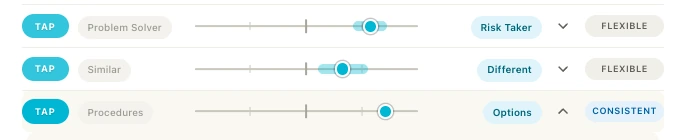
- Three pairs read it: Problem Solver-Risk Taker, Similar-Different, Procedures-Options.
- Each pair descends from a metaprogramme with decades of applied use - towards and away-from, sameness and difference, procedures and options.
- A team's planning style is its planners' preferences, aggregated. Seeing the mix makes it deliberate.
Two capable colleagues look at the same proposal. One immediately sees the three ways it fails; the other immediately sees the market it opens. Neither is wrong - they are running different scans. That difference, multiplied across every plan an organisation makes, is the territory of the second of the four factors of Sariio MAPS: Thinking and Planning.
This is the reference article for the factor - what it covers, why it matters, and what its three preference pairs mean in practice.
What is the Thinking and Planning factor in Sariio MAPS?
The second of the four factors: how you prefer to process information and shape plans - what you scan for when you look ahead, how you respond to the familiar and the new, and what kind of route you want once a destination is agreed. It is read through three preference pairs: Problem Solver-Risk Taker, Similar-Different, and Procedures-Options. These are preferences rather than abilities, and no position is better than another.
In the cycle that the four factors cover - relating, planning, deciding, doing - this is the stage between the people and the commitment. Relationships determines who is in the room; Thinking and Planning determines what the room produces to decide on. And its pairs have the deepest roots in the metaprogramme tradition the instrument descends from: towards and away-from motivation, sameness and difference, procedures and options are among the most-used patterns in Shelle Rose Charvet's Words That Change Minds, applied for decades in recruitment and management before Sariio made them measurable on sliders.
The three pairs
What is the difference between a problem solver and a risk taker?
The pair describes what you naturally scan for when you look ahead. A Problem Solver focuses on removing what could go wrong - spotting risks, gaps and weak points early, and stress-testing a plan before anyone commits. A Risk Taker moves towards opportunity - seeing what could be gained, energised more by the possibility of a win than worried by the possibility of a stumble. Sound planning needs both scans.
This is the towards/away-from pattern of the metaprogramme tradition, and once you can see it you hear it in every planning meeting. The Problem Solver's questions - what if the supplier fails, where is the single point of failure - are not negativity; they are the scan doing its work. The Risk Taker's enthusiasm is not recklessness; it is the other scan, the one that finds the upside worth the journey. A plan reviewed by only one scan is half-reviewed.
Similar - Different
This pair is about how you respond to what is familiar and what is new. A pull towards Similar means you look for patterns and precedent: you draw on what has worked before, value continuity, and build confidence from proven approaches. A pull towards Different means you are drawn to novelty and change: fresh ideas give you energy, and you are quick to spot when something needs a rethink.
Organisations feel this pair most sharply during change. The Similar colleague asking "what was wrong with the old way?" is doing something valuable - insisting that hard-won experience is not discarded casually. The Different colleague proposing the rethink is doing something equally valuable - refusing to let the familiar outlive its usefulness. Change programmes fail when they treat the first as resistance and the second as disruption, rather than as two necessary readings of the same proposal.
Why do some people prefer procedures and others prefer options?
It is a genuine preference about the route, not a difference in competence. A pull towards Procedures means a clear, established way of doing things gives confidence, and consistency in following it through is the strength. A pull towards Options means generating alternatives is the strength - keeping possibilities open and naturally producing several ways a thing could be done. Operations need reliable execution and fresh alternatives; the pair shows where each person's energy sits.
In operational settings this pair is close to destiny. A contact centre runs on procedure - scripts, compliance, consistency - and people with strong Options energy can experience that as a cage unless their alternative-generating strength is given somewhere to live: process improvement, exception handling, the queue nobody has designed a script for yet. Conversely, a role that is all improvisation exhausts the Procedures preference. The pair does not say who is capable; it says what shape of route lets each person run.
Reading the factor as a whole
How do work preferences affect planning in a team?
A team's plans carry the fingerprint of its planners' preferences. Heavy Problem Solver-Similar-Procedures energy produces robust, proven, repeatable plans that can miss the opportunity; heavy Risk Taker-Different-Options energy produces bold, novel, flexible plans that can skip the stress-test. Seeing the mix on a map lets a team assign the scanning deliberately - and stops each side reading the other as obstruction or recklessness.
That aggregation is not a metaphor: it is literally how a cultureMAP reads an organisation, with this factor contributing to the Direction, Approach and Process dimensions. And at the individual level, the factor hands a manager the most practical planning question there is: not "is this person a good planner?" but "what does a plan need to look like for this person to trust it?"
The set continues with Making Decisions - what happens when the plan meets the moment of commitment - and Getting Things Done, where the route becomes the delivered thing. The factor before it, Relationships, decides who shapes the plan with you.
See your own Thinking and Planning positions in twelve minutes - the individual survey is free, and your results are yours.
Sources
- Charvet, S.R. (1997), Words That Change Minds, Kendall/Hunt - towards/away-from, sameness/difference and procedures/options in the applied LAB Profile tradition, building on Rodger Bailey's work
- NLP metaprogrammes: see Wikipedia, Methods of neuro-linguistic programming
- Adler, A., individual psychology - purposive behaviour as the frame for reading preference. See Alfred Adler got it right
- Kotter, J.P. and Heskett, J.L. (1992), Corporate Culture and Performance, Free Press - why cultures that stop seeing themselves clearly fail, the change-programme context for the Similar-Different tension