 sariio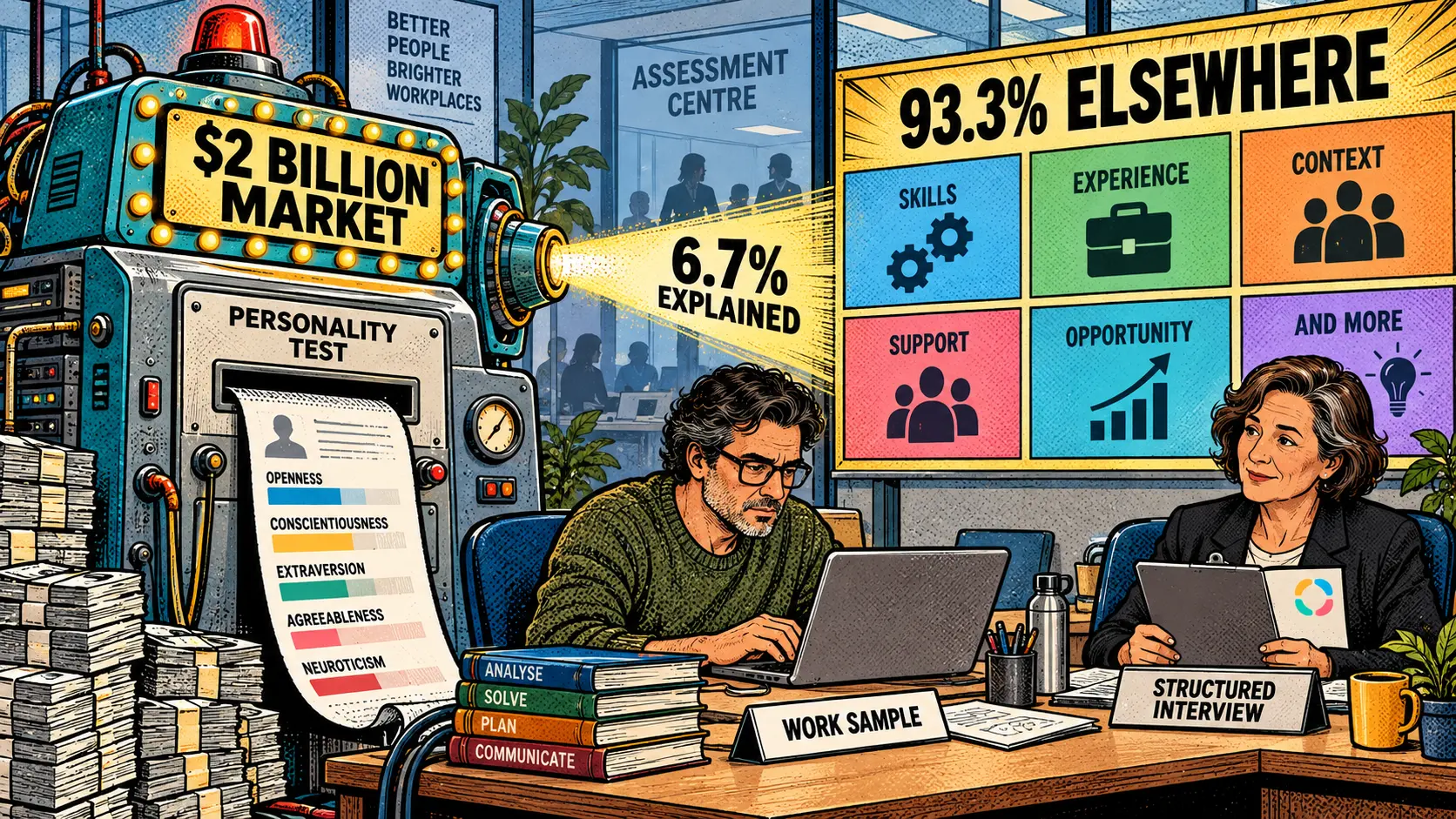
Decades of research show personality assessments explain as little as 6% of job performance. The evidence demands a rethink.
Every year, organisations around the world spend more than $2 billion on personality assessments. The premise is intuitive and appealing: if you can identify someone's personality type, you can predict how they will perform in a role, how they will fit into a team, and whether they will stay long enough to justify the cost of hiring them. Personality tests have become a fixture of corporate talent strategy, embedded into recruitment pipelines, leadership development programmes, and team-building workshops across virtually every industry.
The assumption underpinning this investment is straightforward - that knowing someone's "type" reveals something meaningful about their future job performance. Entire consulting practices have been built on this belief. HR departments have certified thousands of internal practitioners to administer and interpret these tools. And millions of employees have accepted their four-letter codes, colour categories, or numbered profiles as genuine reflections of who they are at work.
A growing body of peer-reviewed research tells a different story. The evidence, accumulated over decades across multiple independent research programmes, consistently shows that personality assessments are remarkably poor predictors of job performance. The gap between what organisations believe these tools can do and what the science says they actually deliver has become impossible to ignore.
What Harvard Business Review Got Right in 2014
In August 2014, Harvard Business Review published "The Problem with Using Personality Tests for Hiring" - an article that became one of the most cited critiques of workplace personality assessments in mainstream business media. The piece drew on existing research to argue that most personality tests measure traits with no direct correlation to job performance, and that the widespread corporate reliance on these tools was fundamentally misplaced.
The HBR article established three criteria that any credible hiring assessment should meet. First, it should measure stable traits - characteristics that remain consistent over time rather than shifting with mood, context, or circumstance. Second, it should be normative, allowing meaningful comparison between candidates rather than simply describing each person in isolation. Third, it should demonstrate predictive validity for specific role requirements - evidence that high scores on the assessment correlate with high performance in the job.
Most popular personality assessments fail all three criteria. They measure states rather than traits, describe rather than compare, and lack evidence linking their outputs to job success. Park Square Executive Search reinforced this analysis, noting that the most common "four-quadrant" assessments measure transient psychological states that shift as context changes. If a person's results look different depending on when and where they take the test, the foundation for any predictive claim collapses entirely.
How can an individual's assessment results be used to predict future job performance when the results themselves change over time?
The question remains unanswered by the personality testing industry. More than a decade after HBR's critique, the same tools continue to dominate corporate talent practices - and the same fundamental problems persist.
The Numbers: 6% to 16% Explained Variance
Do personality tests predict job performance?
Poorly. The most granular recent review - Pletzer and Abrahams, 2025 - found personality traits explain just 6.7 per cent of the variance in task performance, leaving more than 93 per cent driven by factors the tests do not capture. Used in isolation, without structured interviews or work samples, predictive success drops to as low as 6 per cent. Conscientiousness is the most consistent predictor across occupations, and even its standalone power is modest.
When researchers quantify how well personality tests predict job performance, they use a metric called "explained variance" - the percentage of differences in job outcomes that can be statistically attributed to personality traits. The numbers are consistently low, and they have remained low across decades of study.
A 2021 review published in the Journal of Applied Psychology found that personality assessments explain approximately 16% of the variance in job performance at best - meaning that 84% of what determines how well someone performs has nothing to do with what these tests measure. When personality tests are used in isolation, without supplementary methods such as structured interviews or work sample tests, their predictive success rate drops to as low as 6%.
The landmark 2025 review by Pletzer and Abrahams, published in Current Opinion in Psychology, provided the most granular picture yet. Their analysis found that personality traits are strongest at predicting counterproductive work behaviours - things like absenteeism and rule-breaking. They show moderate predictive power for organisational citizenship behaviours, such as volunteering for extra tasks or helping colleagues. But for actual task performance - the core of what organisations hire people to do - personality traits explain just 6.7% of the variance. The remaining 93.3% is driven by factors these tests do not capture.
Variance in task performance explained by personality traits
Source: Pletzer & Abrahams, 2025 review in Current Opinion in Psychology
Conscientiousness - the tendency toward discipline, reliability, and thoroughness - is the most consistent personality predictor of job performance across occupations. Even so, its standalone predictive power remains modest. Conscientiousness alone cannot account for the complex interplay of skills, motivation, context, relationships, and organisational culture that determines whether someone succeeds in a role.
The Meta-Analysis That Changed Everything
What predicts job performance better than personality tests?
Structured interviews, work sample tests and cognitive ability assessments - the corrected evidence from Sackett and colleagues' 2022 re-analysis puts all three ahead of personality measures. That paper also showed earlier meta-analyses had inflated personality-test validity through incorrectly applied statistical corrections, which means the scientific case for personality testing in high-stakes hiring was built partly on inflated numbers.
In 2022, Sackett and colleagues published a landmark paper in the Journal of Applied Psychology that sent shockwaves through the field of industrial-organisational psychology. Their research revisited the statistical methods used in decades of previous meta-analyses - the large-scale reviews that had formed the evidence base for personality testing in hiring - and discovered that those analyses had systematically overestimated personality test validity.
The problem was technical but consequential. Earlier meta-analyses had applied statistical corrections intended to account for measurement error and range restriction. Sackett et al. demonstrated that these corrections had been applied incorrectly, inflating validity estimates "sometimes to a substantial degree." The tools that organisations believed were moderately predictive turned out to be weaker than previously reported. The scientific case for using personality tests in high-stakes hiring decisions had been built, in part, on inflated numbers.
Key Findings from Sackett et al. (2022)
Previous meta-analyses systematically overestimated the validity of personality tests for predicting job performance. Statistical corrections applied in earlier reviews inflated estimates, sometimes substantially. The corrected figures suggest that structured interviews, work sample tests, and cognitive ability assessments are stronger predictors than personality measures. Despite these findings, 89% of Fortune 100 companies continue to use personality assessments in their talent processes.
The implications extend beyond academic debate. If structured interviews are stronger predictors of job performance than personality tests - as the corrected evidence suggests - then organisations may be investing in the wrong tools while underinvesting in methods with better track records. A survey by the Talent Management Alliance found that 47% of hiring managers already doubt whether personality tests accurately capture the complexity of human behaviour. The research now validates those doubts with rigorous evidence.
Yet adoption remains stubbornly high. The same Fortune 100 companies whose hiring managers express scepticism continue to administer personality assessments at scale. The disconnect between what the evidence shows and what organisations do reveals something important about why these tools persist.
Why Organisations Keep Using Them Anyway
Why do companies still use personality tests?
Three reasons the evidence keeps meeting resistance: institutional inertia - licences bought, practitioners certified, switching costs high; the appearance of science - structured questionnaires and 40-page reports look rigorous whether or not the measurements are valid; and confirmation bias - when a report captures something a manager already knows, the known truths validate the unknown predictions. The market exceeds $2 billion a year, 89 per cent of Fortune 100 companies use the tools, and 47 per cent of hiring managers privately doubt them.
The personality testing market exceeds $2 billion annually and continues to grow. Understanding why requires looking beyond the science and into the organisational dynamics that sustain these tools even when the evidence undermines them.
Institutional inertia plays a significant role. Organisations that have invested heavily in personality testing - purchasing licences, training internal practitioners, building certification programmes, and embedding results into performance management systems - face substantial switching costs. Abandoning a tool means writing off years of investment and acknowledging that decisions made on its basis may have been misguided. Few leadership teams are willing to make that admission.
The tools themselves are designed to feel scientific. Structured questionnaires, detailed reports with professional graphics, and specialised terminology create an impression of rigour that satisfies organisational requirements for evidence-based practice. The appearance of science substitutes for the substance of it. A 40-page personality report looks authoritative regardless of whether its underlying measurements are valid.
Confirmation bias compounds the problem. Personality test results typically reflect some observable truths about the person - they are agreeable, or they are detail-oriented, or they prefer working independently. When a report accurately captures something a manager already knows, it creates false confidence in the claims the manager cannot verify. The known truths validate the unknown predictions, and the entire framework feels credible. Research from the Society for Human Resource Management indicates that 32% of HR professionals continue to use personality assessments for executive-level hiring despite privately doubting their accuracy - a testament to how deeply embedded these tools have become in organisational practice.
Measuring What Actually Matters
Sariio takes a fundamentally different approach. Rather than claiming to predict performance from personality categories, MAPS measures work preferences - how people prefer to connect with others, think through problems, make decisions, and implement plans. These preferences are observable in daily behaviour, contextual in their expression, and evolving over time. They provide a practical foundation for coaching and team development without the false precision of static type labels.
The MAPS Approach to Work Preferences
MAPS measures preferences across four factors - Relationships, Thinking & Planning, Making Decisions, and Getting Things Done - producing one of 81 unique archetypes. Periodic retesting - at least twice a year, closer to quarterly where coaching is active - captures genuine shifts in how people work, rather than treating a single score as permanent truth. AI-orchestrated coaching adapts to each person's current profile, responding to who they are today rather than a label assigned months or years ago. The result is a dynamic, evidence-informed approach to professional development that acknowledges the complexity the research demands.
Preferences are useful precisely because they do not claim to be permanent. A person's preference for structured decision-making may strengthen during a period of organisational change and relax once stability returns. MAPS captures that movement, giving managers and coaches an evolving picture of how best to support each individual. The focus shifts from categorising people to understanding them - and from predicting performance to enabling it.
Key Research Findings
- Personality assessments explain as little as 6.7% of task performance variance, leaving more than 93% of job performance unaccounted for (Pletzer & Abrahams, 2025).
- Previous meta-analyses systematically overestimated personality test validity due to incorrect statistical corrections (Sackett et al., 2022).
- Most popular personality assessments fail to measure stable traits, lack normative comparison, and show no predictive validity for specific roles (HBR, 2014).
- 47% of hiring managers doubt that personality tests capture the complexity of human behaviour, yet 89% of Fortune 100 companies continue to use them.
- Structured interviews and work sample tests consistently outperform personality assessments as predictors of job performance.
Sources
- Adler, R.W. (2014), 'The Problem with Using Personality Tests for Hiring', Harvard Business Review - three criteria for credible hiring assessments
- Park Square Executive Search - four-quadrant assessment critique
- Pletzer, J.L. and Abrahams, L. (2025), 'Personality at Work', Current Opinion in Psychology, 65 - 6.7% task performance variance
- Sackett, P.R. et al. (2022), 'Revisiting Meta-Analytic Estimates of Validity', Journal of Applied Psychology, 107(11) - overestimated validity corrections
- Morgeson, F.P. et al. (2007), 'Reconsidering the Use of Personality Tests', Personnel Psychology, 60(3) - conscientiousness validity
- NeuroLeadership Institute (2023), 'Personality Tests for Hiring Decisions Can Backfire' - analysis of testing industry practices