 sariio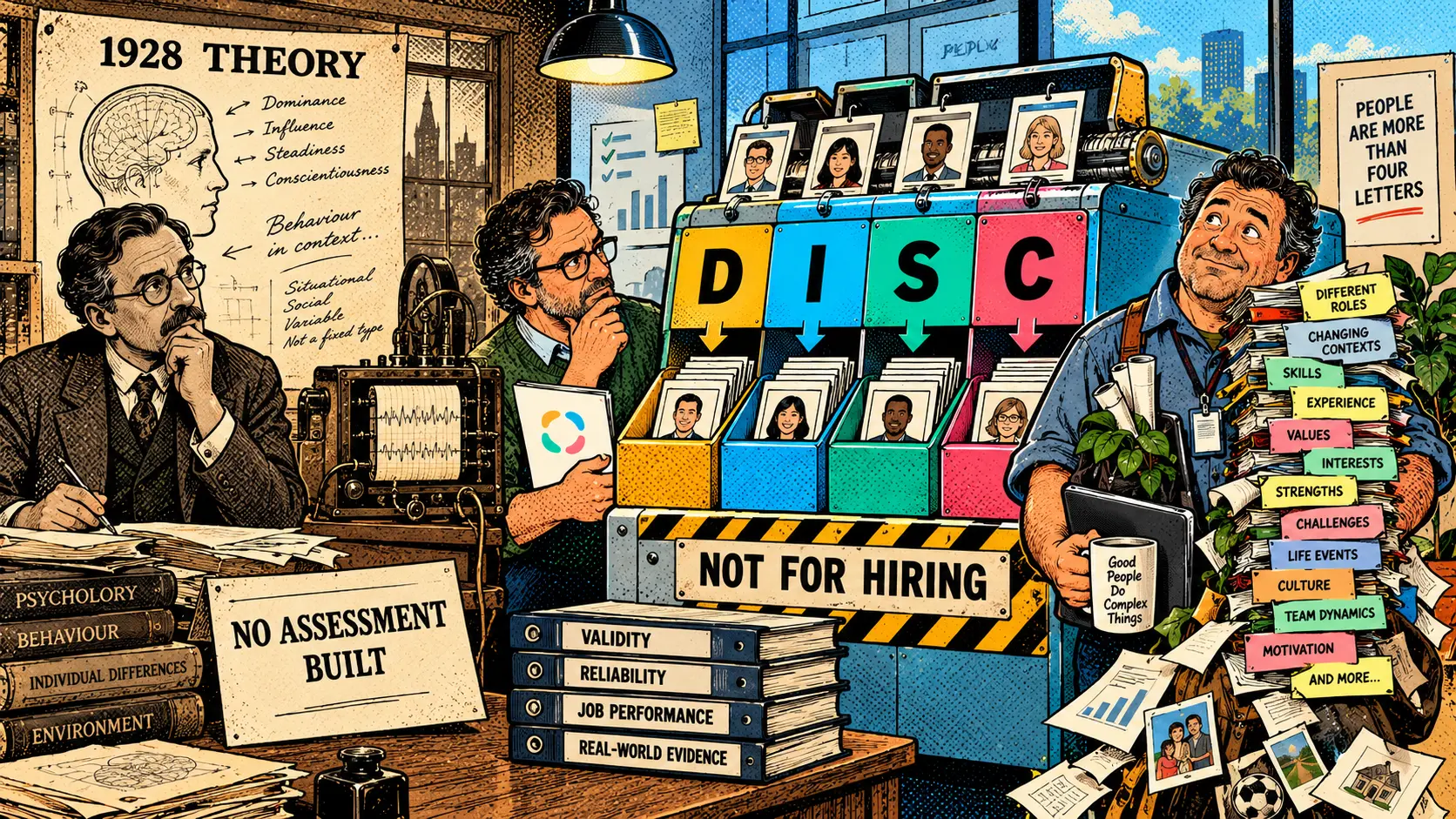
How Accurate Is a DISC Assessment? The Four Letters, the Four Colours, and the Evidence
- Marston proposed the DISC model in 1928 - and never built an assessment. Others did, and competing versions needn't agree.
- Independent research found the four dimensions aren't statistically independent - they're better explained by the Big Five.
- Wiley says its DiSC is "not recommended for pre-employment screening". Another vendor markets DISC as "built for hiring".
- The top Google questions - "What DISC type is Elon Musk?" - tell you what register the tool actually operates in.
DISC and its colourful cousins sort the world's workforce into four boxes, and HR has bought them by the million. The model was proposed in 1928 by the psychologist who invented the lie-detector prototype and Wonder Woman - and who never built an assessment at all. What the evidence says about DISC's accuracy, what its own publisher says about hiring, and why four colours cannot hold a person.
How accurate is a DISC assessment? Accurate enough to start a conversation; nowhere near accurate enough to make a decision about a human being. Independent researchers who have examined DISC-style instruments have questioned whether the four dimensions are even statistically separate from one another, the model's own major publisher does not recommend it for pre-employment screening, and the theory underneath it was proposed in 1928 and never turned into an assessment by its own author. I have sat in workshops where grown professionals introduced themselves by colour for years afterwards. The tools are memorable, likeable and quick. The question this article answers is whether they are true - and what the appetite behind them actually deserves.
Who Invented the DISC Assessment?
Nobody invented the DISC assessment - and that is the strangest fact in its history. The model comes from William Moulton Marston's 1928 book Emotions of Normal People, which proposed four emotional dimensions: Dominance, Inducement, Submission and Compliance. Marston was a genuine original - inventor of an early lie-detector prototype and, later, creator of Wonder Woman - but as the modern DiSC publisher's own history page records, he had little interest in measurement:
"Because Marston himself had little interest in theoretical concepts of personality or temperament, he never created a psychological instrument to measure his model."
- DiSCProfile.com, history of DISC
The first actual assessment was built from his theory by others, in the 1940s, and dozens of competing DISC instruments have been derived since - which is why your DISC profile from one vendor need not agree with your DISC profile from another. The foundation is a ninety-eight-year-old theory of emotion, pre-dating almost everything modern psychology knows about measuring people, monetised by many hands the author never shook.
How Accurate Is a DISC Assessment, According to Research?
The independent evidence on DISC is thin, and what exists is unflattering. Unlike the Big Five model - built and rebuilt across thousands of peer-reviewed studies - DISC-family instruments have attracted remarkably little independent validation research; the studies that have looked found the four dimensions were not psychometrically independent of one another and were better explained as combinations of the better-evidenced Big Five traits. Ask the practical questions and the picture repeats: search data shows real people asking "can your DISC assessment change" - and yes, like all trait measures taken as type verdicts, profiles shift on retest. Meanwhile the broader science of using personality measures to predict work outcomes is settled and sobering: former editors of the field's top journals concluded the core problem is their "very low validity" for predicting job performance, and the most rigorous modern meta-analysis of selection methods puts structured interviews, job-knowledge tests and work samples at the top - not four-quadrant profiles.
There is also a tell hiding in plain sight in the search results: among the most-asked DISC questions on Google are "What DISC type is Elon Musk?", "What DISC personality is Donald Trump?" and "What DISC type are most CEOs?". When a workplace instrument generates the same questions as a star sign, it is telling you what register it actually operates in.
Can You Fail a DISC Assessment - and Should It Be Used for Hiring?
You cannot fail a DISC assessment - every publisher is emphatic that there are no wrong answers - which makes it all the more striking that DISC-family tools are routinely found in hiring processes. Here the industry openly disagrees with itself. Wiley, publisher of Everything DiSC, the best-known version, states its position plainly:
"Although DiSC profiles are often used as part of the hiring and onboarding process, they're not recommended for pre-employment screening."
- DiSCProfile.com (Wiley), on hiring
Yet Thomas International markets its DISC-based Personal Profile Analysis as "built for hiring & development" - an eight-minute questionnaire positioned to help employers avoid "costly mistakes with mishires". Thomas's assessments are registered with the British Psychological Society, and it is worth being precise about what that means: BPS registration attests that a test's documentation, materials, reliability evidence and norms meet technical standards - it is a quality mark for the paperwork, not a finding that an eight-minute behavioural profile should decide who gets a job. Employers must square that use against the model publisher's own caution and the selection evidence above; in my view the two cannot be squared.
What About the Colour Tests - Insights Discovery and the Four Energies?
The colour tests are the same four-box idea in brighter packaging. Insights Discovery - built, like the MBTI, on Carl Jung's 1921 typology - renders people as a mix of Fiery Red, Sunshine Yellow, Earth Green and Cool Blue "energies", and has charmed its way into large organisations across the UK and Europe. It is, by common consent, a pleasant experience: the language is warm, the workshops are fun, and "I'm a Sunshine Yellow" is easier to say in a meeting than anything a psychometrician would recognise. The instrument holds industry certifications of the kind described above, and the same precision applies: certification speaks to technical documentation, not to the wisdom of describing a colleague as a colour. Independent peer-reviewed evaluation of the colour model is scarce to the point of absence - which, for a tool used on this scale, is itself the finding. Jung, it is worth remembering, never tested his types empirically; a century later, his four categories are a corporate colour scheme.
Four Colours Cannot Hold a Person
I understand exactly why HR bought the four boxes, and it was not gullibility - it was an unmet need, in my opinion the most legitimate need in workplace life: a shared vocabulary for how people differ. Teams genuinely work better when differences can be discussed without offence, and DISC and the colours supplied the first vocabulary most organisations were ever offered - simple, memorable, kind. The seduction was real because the need was real. But the price of a four-box vocabulary is that it rounds every human being to the nearest quarter of the population, hands them a verdict dressed as an insight, and - on the evidence above - measures the person about as reliably as the decade it was born in could manage. People do their best work when they can play to their preferences - and preferences need no boxes at all. Measured properly, how you work is a set of positions on continua: procedure or options, thinking-first or doing-first, starting or finishing - each one discussable, none of them a colour, none of them a verdict, nothing to fail and nothing to fake. That vocabulary does everything the four boxes promised, without the rounding error. The twelve-minute survey is free for any individual; it will give you a map, not a label.
How accurate is a DISC assessment?
Independent validation research is sparse, and studies that have examined DISC-style instruments found the four dimensions were not statistically independent and were better explained by the Big Five model. DISC profiles can also change on retest. Publishers position DISC as a conversation-starter about behaviour, not a predictive measure.
Who invented the DISC assessment?
Nobody, strictly: psychologist William Moulton Marston proposed the DISC model in his 1928 book Emotions of Normal People but never built an assessment from it. The first DISC instrument was constructed by others in the 1940s, and many competing versions exist today. Marston is also remembered for the lie-detector prototype and for creating Wonder Woman.
Can you fail a DISC assessment?
No - publishers are unanimous that there are no right or wrong answers and no passing score. That is also a reason to treat its use in hiring with caution: an instrument with no wrong answers is measuring style, not capability.
Should DISC be used for hiring?
Wiley, publisher of Everything DiSC, says DISC profiles are "not recommended for pre-employment screening" because they do not measure skills or aptitudes. Some DISC-based products are nonetheless marketed for hiring. The selection research consistently ranks structured interviews, job-knowledge tests and work samples far above personality profiles for predicting performance.
What are the four colour energies in Insights Discovery?
Fiery Red, Sunshine Yellow, Earth Green and Cool Blue - a four-quadrant rendering of Jung's 1921 typology, presented as each person's mix of "colour energies". The framework is widely used in UK and European organisations; independent peer-reviewed evaluation of the colour model is scarce.
The companion piece on the four-letter version is has Myers-Briggs been debunked; the wider selection evidence is in personality tests don't predict job performance. The judgement-free alternative is defined in what are work preferences - and measured by Sariio AI.
Sources
- DiSCProfile.com (Wiley), 'DiSC and Hiring' - the publisher's statement that DiSC profiles are not recommended for pre-employment screening
- Encyclopaedia Britannica, 'William Moulton Marston' - Marston as inventor of an early lie-detector prototype and creator of Wonder Woman
- DiSCProfile.com (Wiley), 'History of DISC' - Marston proposed the model in 1928 but never created an instrument; the first DISC assessment was built by others in the 1940s
- Wikipedia, 'DISC assessment' - independent studies found the four DISC dimensions not psychometrically independent and better explained by Big Five traits
- Morgeson et al. (2007), 'Reconsidering the Use of Personality Tests in Personnel Selection Contexts', Personnel Psychology - former journal editors' conclusion that personality tests have "very low validity" for predicting job performance
- Sackett et al. (2022), 'Is Cognitive Ability the Best Predictor of Job Performance? New Research Says It's Time to Think Again', SIOP - structured interviews, job-knowledge tests and work samples top the selection rankings, not four-quadrant profiles
- Thomas International, 'Personal Profile Analysis (PPA)' - the eight-minute DISC-based questionnaire marketed as built for hiring and development
- British Psychological Society, 'About BPS Test Reviews and Registration' - what BPS registration attests: technical documentation standards, not endorsement of a use case
- Insights, 'Insights Discovery' - the four colour energies product and its positioning
- Insights, 'Validity' - Insights Discovery's stated basis in Carl Jung's 1921 typology
- New York Review of Books (2018), 'The Myers-Briggs Test: Simple Answers to Profound Questions' - Jung never tested his types empirically