 sariio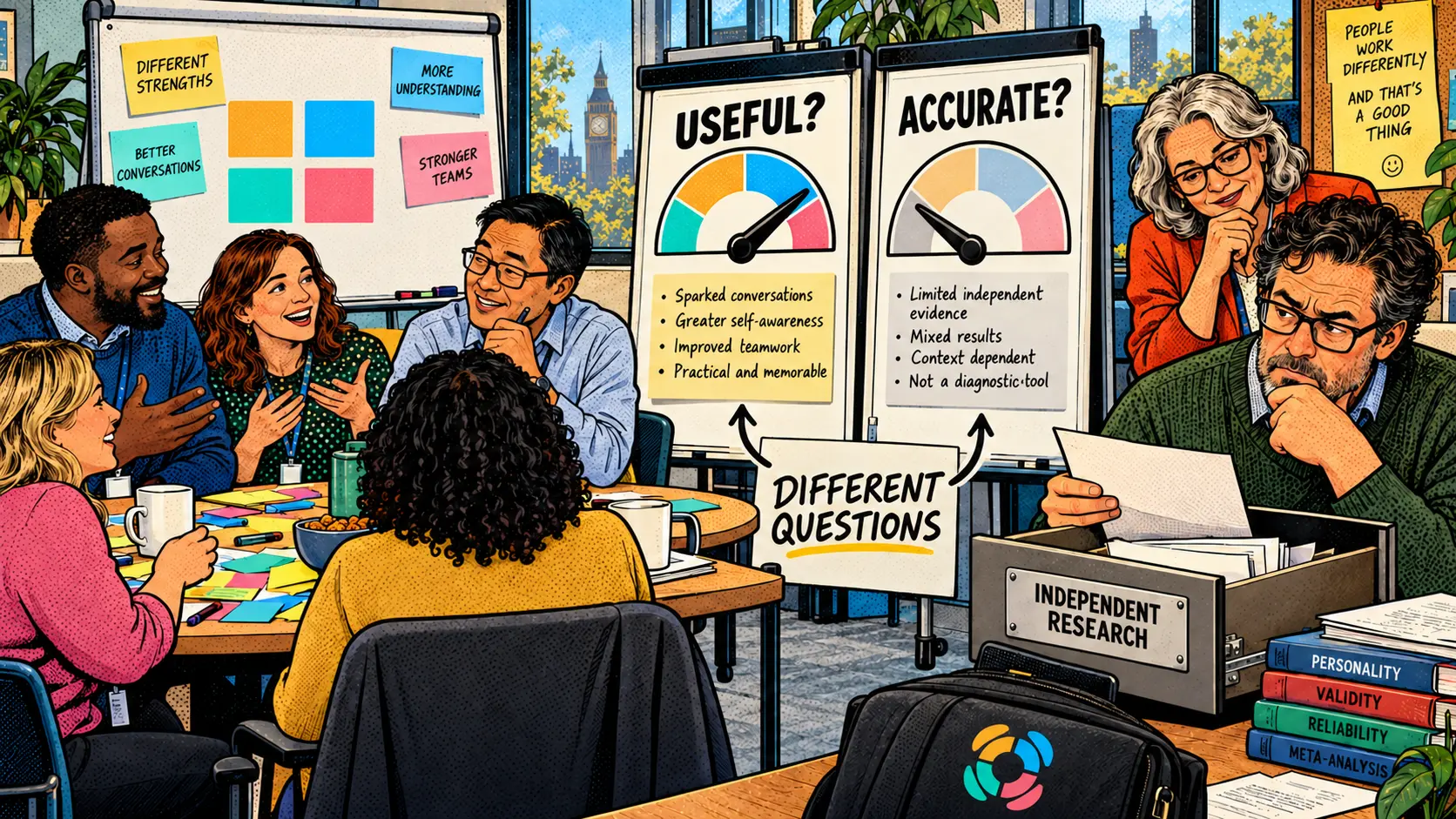
How Accurate Is Insights Discovery? The Colour Wheel, the Evidence, and the Question Nobody Asks
- The publisher's numbers are respectable: alpha .92–.93, retest .81–.86. Internal consistency isn't usefulness.
- Jung, on film, in 1957: "There is no such thing as a pure extrovert or a pure introvert. Such a man would be in the lunatic asylum."
- A 72-position wheel collapses to four colours. Is the complexity measurement work, or persuasion work?
- The Scottish Government spent £133,547 on it across four years - with no formal efficacy evaluation released.
Insights Discovery is the best-crafted of the Jungian colour systems and the most popular in UK corporate life. Its four colour energies have charmed their way into boardrooms across Europe. But the model's own patron saint warned against exactly this use of his typology, the independent research is strikingly thin, and the question buyers actually need answered is not "how accurate?" but "how useful?" The two answers differ.
How accurate is Insights Discovery? By its own published statistics, the evaluator's internal consistency is strong - Cronbach's alpha coefficients of .92 to .93 across the four colour scales, and test-retest correlations of .81 to .86. Those are respectable numbers. But accuracy and usefulness are different questions, and the one that matters most to a buyer - does using this instrument improve a real decision about a real person in the here and now, and can that person act on the result without an interpreter? - gets a different answer. I sat the three-day accreditation course myself, years ago. The experience is polished, the facilitators are properly taught, serious professionals, and the language is warm enough that people leave the room genuinely energised. None of that is the same as evidence that four colours can hold a person.
Accurate - or Useful?
The title of this article asks the question searchers type. The article's turn is that it is the wrong question.
Accuracy, in psychometric terms, is the instrument's home turf - internal consistency, reliability coefficients, factor loadings. Insights Discovery performs well on that terrain, and there is no reason to pretend otherwise. The numbers above are from the publisher's own validation fact sheet, drawn from a sample of over 24,000 completed evaluators, and they clear the standard thresholds comfortably.
But here is what a Cronbach's alpha of .92 actually tells you: the items within each colour scale agree with one another. It does not tell you the measurement is stable over time in the way a buyer assumes "accurate" means. It does not tell you the four-colour output predicts anything about how someone will perform in a role. And it does not tell you the person can do anything with the result without paying for an accredited practitioner to interpret it. The .70 threshold that the industry treats as a pass mark was a rule of thumb from Jum Nunnally's 1978 textbook Psychometric Theory - and recent research by Hussey and colleagues has found a suspicious pile-up of reported alpha values at exactly .70, suggesting the threshold has become a target rather than a standard.
Usefulness asks a different set of questions. Does using this tool improve a real decision, about a real person, in the here and now? Can the person act on the result themselves? Does the reading move with them as they change? On those questions, the evidence is a different story.
What Is Insights Discovery?
Insights Discovery is a psychometric profiling tool built on Carl Jung's 1921 theory of psychological types. It renders personality as a mix of four "colour energies" - Cool Blue (analytical, methodical), Earth Green (nurturing, supportive), Sunshine Yellow (dynamic, creative), and Fiery Red (decisive, action-oriented). Behind the four colours sits a more elaborate architecture: eight types (Director, Motivator, Inspirer, Helper, Supporter, Coordinator, Observer, Reformer) and a 72-position type wheel that maps each person's conscious and unconscious preferences across circles, segments, and graded positions.
The instrument is administered through an online evaluator questionnaire, and the output is a personal profile - typically a multi-page document describing the person's leading colour energy, their conscious and less-conscious personas, their communication style, and their potential blind spots. The experience is, by common consent, engaging and well-designed. The profiles read warmly, every colour is a strength, and the language is generous enough that nobody leaves the room feeling categorised unfairly.
Insights Learning & Development, the company behind the instrument, states that its research team has "rigorously tested the validity and reliability of the model" over two decades, across more than thirty languages globally. The company's validity page references a downloadable fact sheet but does not disclose specific psychometric statistics on the page itself.
"Rigorously tested the validity and reliability of the model over two decades, across more than thirty languages globally."
- Insights Learning & Development, validity page
What Jung Himself Said
Every Jungian instrument claims Carl Jung as its intellectual ancestor. It is worth asking what the ancestor thought about the inheritance.
In 1957, in his filmed interview with Richard Evans at the University of Houston, Jung said it plainly:
"There is no such thing as a pure extrovert or a pure introvert. Such a man would be in the lunatic asylum."
- Carl Jung, filmed interview with Richard Evans, 1957
And later, on the misuse of his categories: "They have a catch word, and then everything is schematized along that word." Jung was describing exactly what had already begun to happen to his typology - the reduction of nuanced psychological tendencies into labels that people carry like business cards. He went further: "My whole scheme of typology is merely a sort of orientation… The classification of individuals means nothing at all. It is only the instrumentality." And: "It is just a sort of skeleton to which you have to add the flesh… a means to an end."
The patron saint of Jungian typology was its first and sharpest critic. He saw the catch-word problem coming sixty years before "I'm a Sunshine Yellow" became a way of introducing yourself in a meeting.
The Complexity Question
This is worth asking as a straight question, because the answer tells you something important about how the instrument works.
The 72-type wheel is a genuinely elaborate construction. Circles within circles, segments, graded positions, conscious and unconscious personas, the interplay of all four colour energies at different intensities.
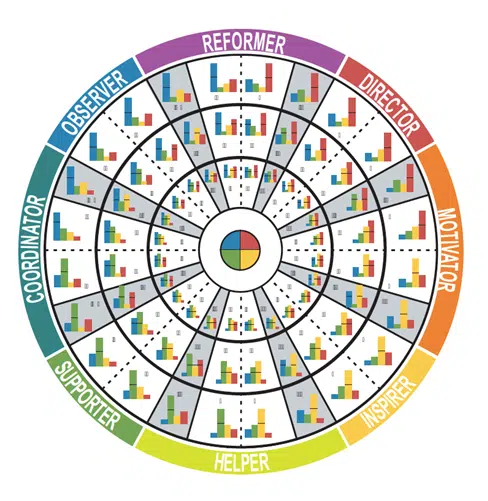
The evaluator questionnaire feeds into this machinery, and what comes out - for most practical purposes, in most workshop settings - is a leading colour. Four categories. Sometimes eight, if the facilitator works with the types. But the working vocabulary that sticks, the thing people carry back to their desks and use for years afterwards, is the colour.
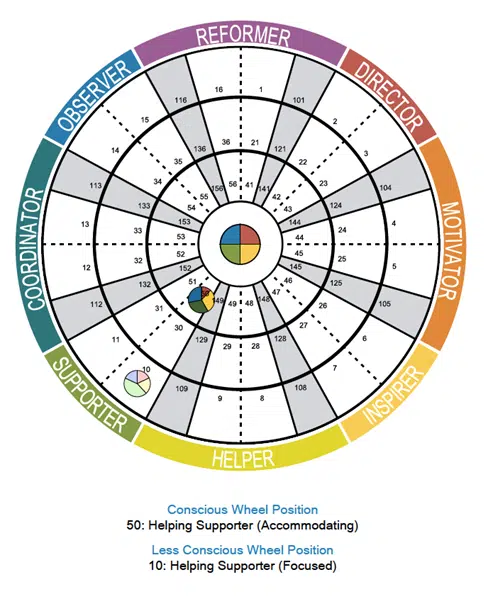
When a model's internal complexity vastly exceeds the granularity of its output, the fair question is: what is the complexity doing? Is it measurement work - genuinely capturing distinctions that the output reflects? Or is it persuasion work - creating the impression of scientific depth behind a result that could have been reached more simply?
I am not accusing anyone of deception. I sat the accreditation. The wheel is taught seriously and the practitioners I trained alongside were thoughtful, experienced professionals. But the corridor question afterwards - "so which colour am I?" - tells you what the output actually is once the workshop ends. And four colours, applied to every human being who walks through the door, is a rounding error dressed in elegance.
The Evidence Audit
Three things matter here: what happens when you test any type system, what the reliability badge actually means, and what the independent literature says.
Type-architecture problems. These attach to any instrument that sorts people into types rather than placing them on continua. David Pittenger's widely cited review of type instruments found that up to 50 per cent of people are classified into a different type on retest, even within five weeks. The reason is structural: when a continuous distribution is carved into categories, people near the boundary - and most people are near the boundary - cross it on normal day-to-day variation. This is not a flaw in the execution. It is a feature of the architecture. Any Jungian type instrument inherits it, including Insights Discovery.
The reliability badge. The publisher reports Cronbach's alpha values of .92 to .93 for the four colour scales, from a sample of 24,224 evaluators. Test-retest Pearson correlations range from .81 to .86. These are strong numbers - and they measure internal consistency: the items within each scale agree with each other. That is a necessary condition for a good instrument, but it is not sufficient. Internal consistency does not mean the tool predicts anything useful, nor that the categories it assigns are stable in the way that matters for workplace decisions. It means the questions are pointing in the same direction. The distinction matters, because "reliable" in lay English and "reliable" in psychometrics are not the same claim.
The independent literature. This is the finding that tells the whole story. Search the peer-reviewed literature for independent - not publisher-linked - validation studies of Insights Discovery, and what you find is strikingly thin. The instrument is used at scale across the UK and Europe. The absence of a substantial body of independent research, for a tool used by this many organisations, is itself a data point. It does not prove the tool fails; it means the evidence base rests substantially on the publisher's own technical papers. In any other field, that would raise questions.
BPS Registration
Insights Discovery holds registration with the British Psychological Society. It is worth being precise about what this means, because "BPS registered" sounds like an endorsement, and it is not. Registration attests that a test's documentation, materials, reliability evidence and norms meet defined technical standards - it is a quality mark for the paperwork. It is not a finding that the instrument should be used for any particular purpose, and it is not an endorsement of the four-colour model's validity for workplace decisions. The distinction matters, and the BPS itself is clear about it.
What the Scottish Government's FOI Revealed
In 2025, a Freedom of Information request asked the Scottish Government for its total spend on Insights Discovery, the business cases demonstrating value for money, and the number of staff trained. The response disclosed £133,547 in total expenditure across four financial years (2022–2026), approximately 1,452 staff trained - and no formal efficacy evaluation or pre-expenditure business case released. Decisions to use the instrument were "informed by consultant scoping calls with stakeholders to assess need."
That is not an indictment. It is a picture of how these tools are actually bought: on trust, on reputation, on the quality of the workshop experience - not on outcome data. The Scottish Government is not unusual here. It is representative.
What This Means for Buyers
The fair-use cases are real. Insights Discovery starts conversations about difference. It gives teams a shared vocabulary that feels safe and generous - every colour is a strength, nobody is told they are difficult, and the language creates permission to discuss working styles without offence. That is a genuine contribution, and the organisations that bought it were responding to a real need with the best tool on the table.
The unsupported cases are also real. Using colour profiles to screen candidates, to "type" colleagues in decisions about promotion or team composition, or to treat a colour as a fixed identity - "she's an Earth Green, she won't cope with that role" - runs beyond what the evidence supports. The instrument's own accredited practitioners are taught to use it with care in recruitment contexts - the profile should never screen candidates without face-to-face meetings, should never stand alone as a recruitment decision tool, and should never replace capability assessments.
The question worth sitting with is whether the conversation-starting function - which is real and valuable - requires the type architecture at all. Or whether the same conversation could happen with a measurement that doesn't round every person to the nearest colour.
What Preferences Look Like Without the Wheel
The appetite that Insights Discovery serves - the desire to understand how people work, to talk about difference without judgement, to make the invisible visible - is one of the most legitimate needs in workplace life. The question is not whether that appetite is real. It is whether four colours are the right answer.
People do their best work when they can play to their preferences - and a preference is everything a colour is not. It is a position on a continuum, not a box. It carries no judgement, so there is nothing to fail and nothing to fake. It is read in the here and now - in the person's own language, revisited as they change - not a position against a normative crowd from the there and then. And the results are plain enough that the person themselves can act on them without paying for an accredited interpreter to tell them what they mean. The twelve-minute survey is free for any individual - and it will give you a map, not a colour.
How accurate is Insights Discovery?
By its own published data, the evaluator's internal consistency is strong - Cronbach's alpha of .92 to .93 across the four colour scales, with test-retest correlations of .81 to .86. These numbers mean the items agree with each other. They do not mean the four-colour output predicts workplace outcomes, nor that a colour assignment is stable in the way most buyers understand "accurate" to mean. Independent peer-reviewed validation is scarce.
Is Insights Discovery useful? As a conversation-starter about working styles, genuinely yes - the language is warm, every colour is a strength, and teams often find it easier to discuss difference through this framework. As a measurement tool for decisions about people - hiring, promotion, team composition - the evidence does not support that use, and the instrument's own practitioners are taught to handle recruitment contexts with significant care.
Is Insights Discovery scientifically valid?
The instrument is built on Carl Jung's 1921 typology - a theory Jung himself never tested empirically and later warned against reducing to fixed categories. The publisher reports solid internal consistency, but the independent peer-reviewed literature on Insights Discovery specifically is strikingly thin for a tool used at this scale. BPS registration attests to technical documentation standards, not to the validity of the colour model for workplace decisions.
How does Insights Discovery compare to MBTI and DISC? All three are built on type-based architectures that sort people into categories. The MBTI uses four dichotomies to produce sixteen types; DISC uses four behavioural dimensions; Insights Discovery renders Jung's typology as four colour energies with a 72-position wheel underneath. All three share the same structural limitation: they impose categorical boundaries on continuous distributions, so people near the boundary - and most people are near the boundary - may be classified differently on retest. Insights Discovery is generally considered the most engaging workshop experience of the three. None of them were designed to predict job performance, and their own publishers say so. The deeper comparison is in the companion articles: has Myers-Briggs been debunked and how accurate is a DISC assessment.
Can Insights Discovery be used for hiring?
With significant caution. Accredited practitioners are taught that the profile should never screen candidates without face-to-face meetings, should never stand alone as a recruitment decision, and should never replace capability assessments. The instrument measures preference, not skill, competence, or likely performance.
What do the four Insights Discovery colours mean?
Cool Blue represents analytical and methodical tendencies, Earth Green nurturing and supportive, Sunshine Yellow dynamic and creative, Fiery Red decisive and action-oriented. Behind the four colours sit eight types and a 72-position wheel, but the four-colour summary is the working vocabulary most people take away.
How much does Insights Discovery cost?
Individual profiles range from roughly $150 to $400 (£120–£320). Team workshops - which include profiles, a facilitated session, and follow-up materials - typically run from £2,000 to £5,000 per day depending on the practitioner, group size, and location. Accreditation as a licensed practitioner costs several thousand pounds and requires a multi-day training course. The Scottish Government's FOI disclosure showed £133,547 spent on Insights Discovery across four years for approximately 1,452 staff - roughly £92 per head, which suggests a bulk or framework-agreement rate.
Can I take the Insights Discovery test for free? No. Insights Discovery profiles are only available through licensed practitioners and cannot be completed independently online. Individual profiles typically cost between $150 and $400 (£120–£320), depending on the version and the practitioner's pricing. Several websites offer free "colour personality" quizzes inspired by the same Jungian categories, but these are not Insights Discovery profiles and carry no connection to the instrument's scoring system. If you want a free, evidence-informed reading of how you work - without types, without colours, and without needing an interpreter - the Sariio twelve-minute survey measures preferences on continua and gives you the result in plain language.
Is there a free alternative to Insights Discovery?
Several free tools exist in the personality-profiling space, though most replicate the same type-based architecture. The Sariio twelve-minute survey takes a different approach: it measures preferences on continua rather than sorting you into types, returns the result in plain language you can act on without an interpreter, and is free for any individual. What it produces is not a personality profile - it is a preference map, measured in the here and now, that moves as you do.
The companion pieces: has Myers-Briggs been debunked examines the most famous Jungian instrument; how accurate is a DISC assessment covers the four-letter version; are personality tests pseudoscience takes the charge head-on; the full verdict table is in personality tests at work. What preferences are - and why they carry no judgement - is defined in what are work preferences. The instrument that measures them is Sariio AI.
Sources
- Hussey et al. (2025), 'An aberrant abundance of Cronbach's alpha values at .70' - evidence that the .70 reliability threshold has become a target rather than a standard
- Insights Learning & Development, 'Validity' - the publisher's claim of two decades of validity and reliability testing
- David Pittenger (1993), 'Measuring the MBTI… and Coming Up Short' - up to 50 per cent of people classified as a different type on retest
- British Psychological Society (2009), 'Test review: Insights Discovery Preference Evaluator' - what BPS registration does and does not attest to
- Scottish Government (2025), 'Freedom of Information response FOI/202500498819' - £133,547 spent and 1,452 staff trained, with no formal efficacy evaluation released
- Iridium Consulting (2012), 'Can I use Insights Discovery in recruitment?' - practitioner guidance that profiles must never stand alone in recruitment decisions