 sariio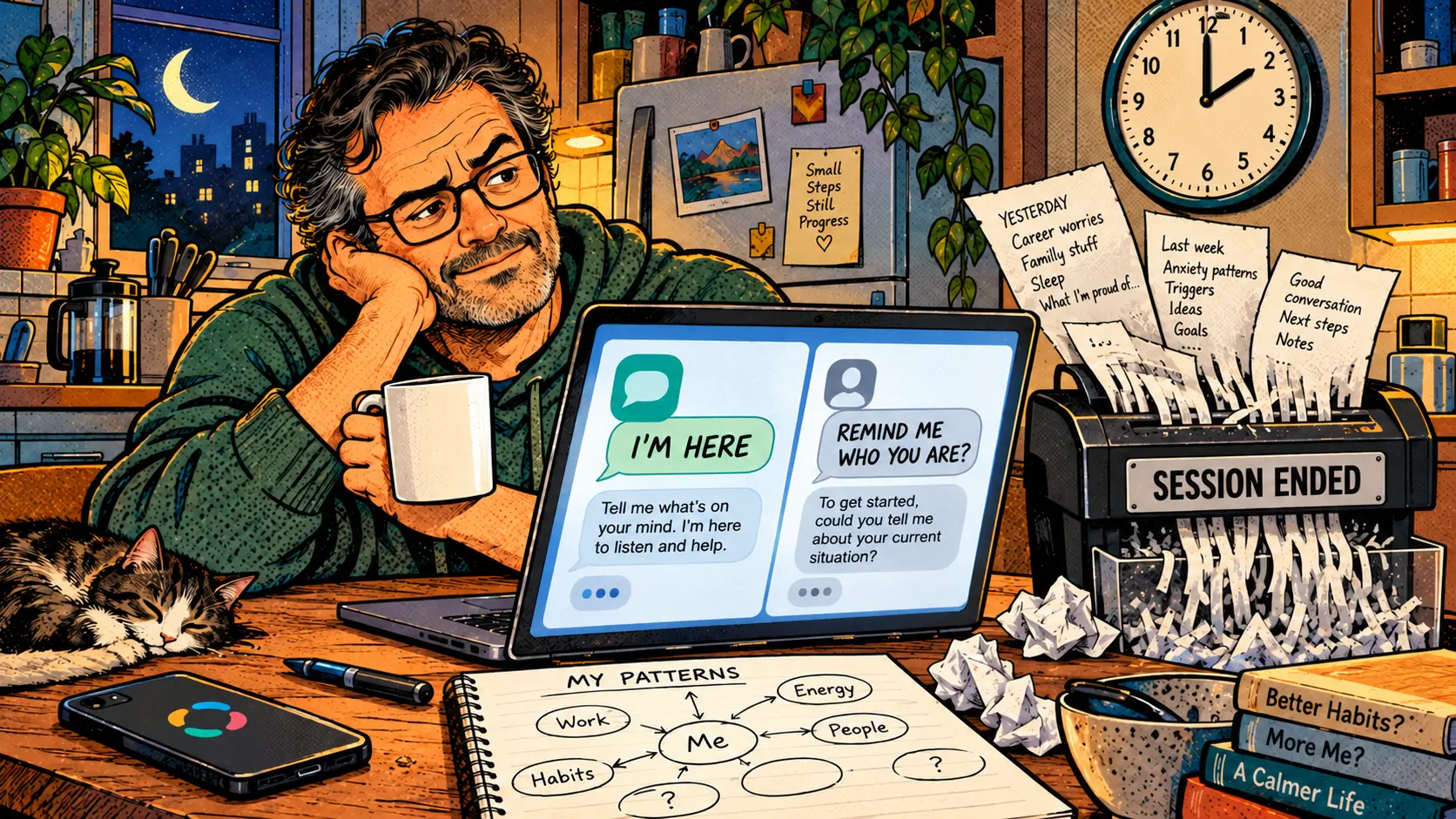
Can ChatGPT Be My Life Coach? What the Evidence Says About AI and Self-Knowledge
- People aren't waiting for permission: 49% of AI users with mental-health conditions already use LLMs for support.
- The first RCT of a therapeutic chatbot cut depression symptoms 51% in eight weeks - comparable to outpatient CBT.
- The catch: general-purpose models responded inappropriately to symptoms at least 20% of the time in Stanford's testing.
- A general chatbot starts every conversation from zero. Coaching quality depends on what the coach knows about you.
Millions of people are already using ChatGPT for coaching, therapy, and self-improvement - and the early evidence says it works better than most people expect. But a general chatbot knows nothing durable about how you actually work. The quality of coaching depends on what the coach knows about you, and that is the part nobody has solved yet.
Can ChatGPT be your life coach? Yes - and for millions of people it already is. A 2025 survey by Sentio University found that nearly half of AI users with mental health conditions use large language models for therapeutic support, and 63 per cent say the experience improved their wellbeing. The first randomised controlled trial of a therapeutic chatbot - Dartmouth's Therabot study, published in NEJM AI - found a 51 per cent average reduction in depression symptoms over eight weeks, comparable to traditional outpatient cognitive behavioural therapy. These are not trivial numbers. But there are two caveats that matter more than the headline, and both point in the same direction: towards a question the general chatbot cannot answer.
Why People Are Already Doing This
The numbers are striking because they are not hypothetical. People are not waiting for permission. Nearly half of young adults aged 18–21 have already used AI for mental health advice. Among those who use both AI and human therapy, 75 per cent rated the AI experience as comparable or better - a finding that says more about the unmet need than about the technology.
The reasons are practical, not ideological. Ninety per cent cite accessibility - available at two in the morning, no waiting list, no appointment needed. Seventy per cent cite cost - free, or near-free, against an average therapy session that costs between $65 and $200. And one in three cite something more personal: they feel less judged by an AI than by a human. That last statistic is worth sitting with, because it reveals the gap that human coaching often fails to bridge: the gap between wanting help and being willing to be seen asking for it.
The Evidence That It Works
The Dartmouth Therabot trial is the landmark study. Published in NEJM AI in March 2025, it enrolled 106 participants with major depressive disorder, generalised anxiety disorder, or eating disorders. Over eight weeks, those using the chatbot saw a 51 per cent reduction in depression symptoms and a 31 per cent reduction in anxiety - results the researchers described as "comparable to what is reported for traditional outpatient therapy." Participants averaged six hours of engagement, equivalent to roughly eight therapy sessions, and reported trust and communication levels comparable to working with mental health professionals.
A broader meta-analysis in Nature npj Digital Medicine found a Hedge's g of 0.64 for depression reduction across AI conversational agents - a medium-to-large clinical effect. And 56 per cent of licensed psychologists have now used AI in their practice, up from 29 per cent in 2024, according to the APA's 2025 Practitioner Pulse survey. The direction of travel is clear.
The Two Caveats
Both are serious, and both point to the same gap.
Caveat one: emotional reliance. OpenAI's own study - conducted jointly with MIT - examined nearly 40 million ChatGPT interactions alongside a randomised trial of approximately 1,000 participants. The findings were mixed and worth reading carefully. Brief voice interactions correlated with improved wellbeing, but prolonged daily use was associated with worse outcomes. Users who viewed ChatGPT as a personal friend, or who had stronger attachment tendencies, experienced more negative effects. Personal conversations generated higher loneliness at moderate usage levels. The researchers were careful to note that causation could not be established - but the pattern is consistent with a familiar risk: a tool that fills a gap in human connection can also deepen the awareness of the gap.
Separately, independent testing by Stanford researchers found that general-purpose models responded inappropriately to mental health symptoms at least 20 per cent of the time - including missing suicidal intent in indirect prompts. And 9 per cent of users in the Sentio survey reported receiving a harmful or inappropriate response. A USC study in 2026 found that AI models "consistently overestimated their own performance and missed safety risks that human experts easily identified."
"AI models consistently overestimated their own performance and missed safety risks that human experts easily identified."
- USC Viterbi School of Engineering, 2026
These are not reasons to dismiss the technology. They are reasons to be clear about its limits.
Caveat two: the knowledge problem. This is the one that matters most for coaching - as distinct from therapy - and it is the one almost nobody is talking about.
A general chatbot starts every conversation from zero. It knows nothing durable about how you work, what energises you, what drains you, where your preferences sit, or how they have shifted since the last time you talked about this. It can respond to whatever you tell it in the moment, and it does that remarkably well. But it cannot hold a map. It cannot say "last time we spoke, you were struggling with the detail-work on that project, and your preference profile suggests that is because you sit strongly towards big-picture thinking - here is what you might try." It can only work with what you give it, each time, from scratch.
Coaching quality depends on what the coach knows about you. A good human coach spends sessions building that picture - what you care about, how you react, where your patterns show up. A general AI does not have that picture, and the conversation-by-conversation approach means it can never build one that persists, grows, and changes as you do.
A tool that answers any question is powerful. A tool that knows which question to ask you - because it knows how you work - is transformative.
What Good AI Coaching Actually Needs
The Dartmouth trial succeeded partly because Therabot was not a general chatbot. It was designed around evidence-based therapeutic frameworks, with safety protocols and structure. The lesson is not that any AI can coach. It is that AI coaching works best when the AI has something to work with - a framework, a structure, a map of the person.
That is the missing layer. Not the conversational ability - ChatGPT already has that. Not the availability - AI is already there at two in the morning. Not the safety protocols - those are being built, imperfectly but genuinely. The missing layer is the knowledge: a persistent, evolving reading of how this person works, in their own language, updated as they change, that gives the AI's questions somewhere to land.
Without that layer, AI coaching is a brilliant conversationalist talking to a stranger. With it, AI coaching becomes something the profession has never had at scale: a coach who already knows you, available whenever you need one, whose understanding of you grows richer every time you check in.
Will AI Replace Coaching?
No. This question comes up in every conversation about AI and coaching, and the answer is consistent across the evidence: AI will replace the parts of coaching that were information delivery dressed as conversation, and it will make the human parts more valuable, not less.
The APA's 2025 data shows 77 per cent of psychologists already have patients who discuss their AI use. The best coaches will be the ones who use AI-generated preference data as their starting point - walking into a session already knowing how the person works, what has shifted since last time, and which questions are worth asking. That is not replacement. It is augmentation. The coach becomes more effective, not less needed.
But the augmentation only works if the AI has something real to share - not a recycled personality type from a questionnaire the person took three years ago, but a living reading of their preferences, updated in their own language, that moves as they move.
People do their best work when they can play to their preferences. A preference map gives the AI coach - and the human one - something no general chatbot can generate on its own: a reading of how you work right now, in plain language, that carries no judgement and needs no interpreter. The twelve-minute survey is free for any individual - and what it creates is not a verdict but a map. A map the AI can read, a map the coach can use, and a map that belongs to you.
Can ChatGPT be my life coach?
Yes, and for millions of people it already is. Nearly half of AI users with mental health conditions use LLMs for support, and 63 per cent report improved wellbeing. The first randomised controlled trial found depression reductions comparable to traditional therapy. The limitation is not conversational ability but durable knowledge: a general chatbot starts from zero each time and cannot hold a persistent, evolving picture of how you work.
Is AI therapy effective?
The evidence is stronger than most expect. The Dartmouth Therabot RCT found a 51 per cent reduction in depression symptoms over eight weeks, comparable to outpatient CBT. A meta-analysis found a medium-to-large clinical effect (Hedge's g of 0.64) across AI conversational agents. Significant safety limitations remain - general-purpose models respond inappropriately to mental health symptoms at least 20 per cent of the time - and no AI is ready for fully autonomous mental health use.
Will AI replace life coaches?
No. AI will replace the information-delivery parts of coaching and make the human elements - judgement, relationship, challenge, accountability - more valuable. The best coaches will use AI-generated preference data as their starting point, walking into sessions already knowing how the person works. That is augmentation, not replacement.
Is it safe to use ChatGPT for mental health?
With awareness of the limits, it can be helpful. OpenAI's own study found that brief interactions improved wellbeing but prolonged daily use was associated with worse outcomes. Independent testing found inappropriate responses at least 20 per cent of the time, including missed suicidal intent. AI mental health tools are most effective with clinical oversight and structured frameworks, not as unsupervised substitutes for professional care.
What makes AI coaching better than a chatbot conversation?
Context. A general chatbot answers whatever you ask but knows nothing about you between conversations. AI coaching that works from a persistent preference map - a reading of how you work, updated as you change - can ask better questions, spot patterns, and give advice grounded in your actual working style rather than generic frameworks.
The companion pieces: how AI changes engagement measurement is in can AI improve employee engagement; the human coaching layer is in the coach who knows you; the preference map that gives coaching conversations somewhere to land is defined in what are work preferences. The instrument is Sariio AI.
Sources
- Sentio University / Rousmaniere, T. et al. (2025), 'Large Language Models as Mental Health Resources: Patterns of Use in the United States' - usage rates among people with mental health conditions, 63% wellbeing improvement, 75% comparable-or-better rating, 9% harmful responses
- Dartmouth College (2025), 'First Therapy Chatbot Trial Yields Mental Health Benefits' - Therabot RCT: 51% reduction in depression symptoms over eight weeks, published in NEJM AI
- Psychology.com (2026), 'AI Therapy Statistics 2026: Usage, Effectiveness & Safety' - young-adult usage, meta-analysis effect size (Hedge's g = 0.64), APA practitioner data and Stanford safety-testing figures
- OpenAI / MIT Media Lab (2025), 'Early Methods for Studying Affective Use and Emotional Well-Being on ChatGPT' - prolonged daily use associated with worse wellbeing outcomes
- USC Viterbi School of Engineering (2026), 'Can ChatGPT Be Your Therapist? USC Study Tests AI Responses to Mental Health Questions' - AI models overestimated their own performance and missed safety risks