 sariio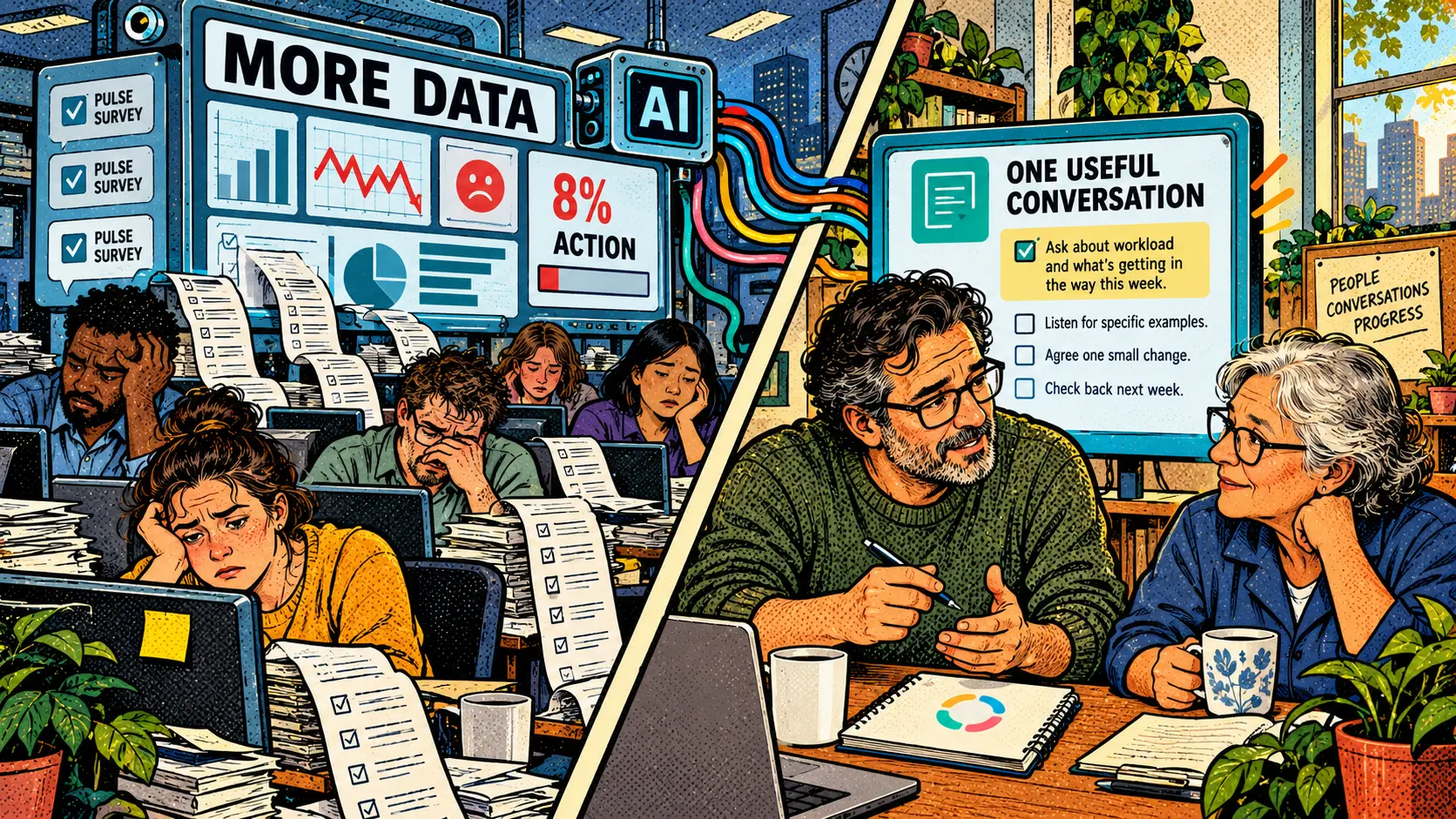
Can AI Improve Employee Engagement - or Just Measure the Misery Faster?
- Measurement was never the bottleneck: only 8% of employees say their organisation acts on survey results.
- 56% of HR functions using AI don't formally measure whether it works.
- The strongest lever is one meaningful 15–30 minute manager conversation a week - and AI coaching matched human coaches in a ten-month randomised trial.
- The buying test: does the tool produce a judgement about the person, or a map for the person? Buy maps.
HR is adopting AI at speed - 39 per cent of HR functions already use it - while engagement sits at a global low of 20 per cent. Whether AI helps depends entirely on where you point it. Pointed at measurement, it makes the thermometer faster. Pointed at the action gap - the manager's weekly conversation, coaching, fitting work to the person - the evidence says it can move numbers nothing else has moved.
Can AI improve employee engagement? Yes - but almost never in the way it is currently being sold. Most "AI for engagement" products point the technology at measurement: always-on sentiment analysis, automated pulse surveys, dashboards that update in real time. Measurement was never the bottleneck. Engagement surveys already work - and only 8 per cent of employees strongly agree their organisation acts on the results. A faster thermometer does not treat the patient. Where AI genuinely moves engagement is on the action side of that gap: giving each team leader something meaningful to say to each person, coaching the people who would never be offered a coach, and fitting work to the individual doing it. After thirty years in workforce operations, I would put it this way: AI's opportunity in engagement is not to know the score sooner - it is to finally know the person.
How Is AI Actually Being Used in HR Today?
AI is already inside the HR function, and spreading fast: SHRM's 2026 research finds 39 per cent of HR functions have adopted AI, with another 7 per cent launching this year - led by recruiting (27 per cent), HR technology, learning and development, and employee experience. The workforce is moving even faster than the function: Gallup finds half of employed Americans now use AI in their role, with daily use at 13 per cent and climbing. But the same SHRM research carries a familiar warning in new clothing: 56 per cent of HR professionals do not formally measure whether their AI investments are working at all. HR has been here before - a generation of engagement platforms was bought on the same faith. The technology is new; the pattern of adoption-without-evaluation is not.
Can AI Fix What Engagement Surveys Couldn't?
Not by doing more of what surveys already do - because the surveys were never the problem. As I set out in how engagement is actually measured, the instruments are sound and the outcomes they predict are real; yet global engagement sits at 20 per cent, the lowest since 2020, costing an estimated $10 trillion a year. The industry's failure lives in the gap between measuring and acting - the 8 per cent action figure above. Much of today's "AI for engagement" simply industrialises the measuring side: sentiment analysis of every message, pulse surveys without end, attrition-risk scores updated nightly. That is the old thermometer with a better battery - and it adds a new cost the old surveys never had, because an employee who discovers their mood is being continuously analysed has one more reason to disengage. If the last twenty-five years proved anything, it is that no organisation ever measured its way to engagement.
Where Does AI Genuinely Move Engagement?
AI moves engagement where it closes the action gap - and the strongest evidence sits exactly there. Gallup's data points to one habit above all others: a meaningful 15-30 minute conversation between manager and employee every week - and the manager, who accounts for at least 70 per cent of the variance in team engagement, usually lacks not the willingness but the material. AI that briefs a team leader on how this person prefers to work - before the one-to-one, for each of the twelve names on the roster - turns the known habit into a practical one. The second lever is coaching at scale: in randomised trials over ten months, an AI coach matched human coaches on goal attainment - which matters for engagement because coaching reaches the frontline people the $244-an-hour industry never will, as I argued in the coach who already knows you. Both levers share a design principle: the AI is pointed at the individual, not at the average.
What Are the Risks of Using AI for Engagement?
The biggest risk is that AI industrialises the workplace's oldest bad habit - typing people - at a scale no paper questionnaire ever managed. Cambridge researchers who examined AI hiring and people-analytics tools were unsparing about the versions that score personality from data exhaust:
Claims made for some AI people-tools make them "little better than an 'automated pseudoscience'" - reducing candidates to personality tropes in ways reminiscent of physiognomy.
- Drage & Mackereth, University of Cambridge, Philosophy & Technology
An algorithm that sorts your workforce into four boxes is not less wrong than a 1928 questionnaire that does the same; it is the same error with better distribution. The second risk is surveillance: engagement tools that read private messages for sentiment convert a trust problem into a bigger one. The test I would apply to any AI engagement product is simple: does it produce a verdict about the person, or a map for the person? Verdicts - scores, types, risk flags - flow upward to dashboards and quietly corrode trust. Maps flow toward the person and their manager, and get used in conversations. Buy maps.
Engagement Is a Fit Problem - Give the AI a Map
Engagement, in my opinion, was never a mood problem to be measured; it is a fit problem to be solved - one person, one Tuesday, one mismatch at a time - and that is precisely why AI can matter now in a way it could not before. The evidence has pointed the same way for two decades: person-job fit correlates .56 with satisfaction and -.46 with intending to quit, the manager carries 70 per cent of the variance, and the fix is a weekly conversation with real content. What was missing was never intent - it was the impossibility of any organisation knowing, at scale, how each individual actually prefers to work. That is the one thing software can now hold: a preference map for every person, read by the coach before it asks its first question, briefed to the team leader before the one-to-one, consulted when work is assigned. People do their best work when they can play to their preferences - and AI's real contribution to engagement is to make playing to them administrable at last. Point the machine at the mood and you will get a faster report of the same 20 per cent. Point it at the person, and the number finally has a reason to move. The map starts with a twelve-minute survey, free for any individual.
Can AI improve employee engagement?
Yes, where it is pointed at action rather than measurement: briefing managers for meaningful weekly conversations, coaching frontline staff at scale (an AI coach matched human coaches on goal attainment in randomised trials), and fitting work to individual preferences. AI that merely measures sentiment faster addresses the part of the system that was already working.
How is AI used in employee engagement today?
Common applications include pulse-survey automation, sentiment analysis, attrition-risk prediction, personalised learning, manager coaching prompts and AI coaching. SHRM's 2026 research finds 39 per cent of HR functions have adopted AI, with employee experience among the leading use cases - though 56 per cent of HR professionals do not formally measure their AI's success.
Will AI replace engagement surveys?
More likely it will demote them: always-on measurement can supplement annual surveys, but the engagement industry's core problem - only 8 per cent of employees strongly agree their organisation acts on survey results - is an action gap that faster measurement cannot close. The survey's future is as one input among several, not the centrepiece.
What are the risks of using AI for employee engagement?
Chiefly typing people at scale - Cambridge researchers describe personality-scoring AI tools as risking "automated pseudoscience" - plus sentiment surveillance that erodes the trust engagement depends on. A useful buying test: prefer tools that produce a map for the person over tools that produce a verdict about them.
Why the instruments were never the problem is in how employee engagement is actually measured. The manager who carries the variance is in the 70 per cent manager; the coach who reaches the frontline is in the coach who already knows you. The map itself is built by Sariio AI.
Sources
- Gallup (2023), 'So You Administered an Employee Engagement Survey. Now What?' - only 8% of employees strongly agree their organisation acts on survey results
- SHRM (2026), The State of AI in HR 2026 - 39% of HR functions have adopted AI; 56% do not formally measure its success
- Gallup (2026), 'Rising AI Adoption Spurs Workforce Changes' - half of employed Americans use AI at work, 13% daily
- Gallup (2026), State of the Global Workplace - global engagement at 20%, the lowest since 2020, costing an estimated $10 trillion a year
- Gallup (2023), 'U.S. Employee Engagement Needs a Rebound in 2023' - the meaningful 15–30 minute weekly manager conversation
- Terblanche, N. et al. (2022), 'Comparing Artificial Intelligence and Human Coaching Goal Attainment Efficacy', PLOS ONE - AI coach matched human coaches on goal attainment in ten-month randomised trials