 sariio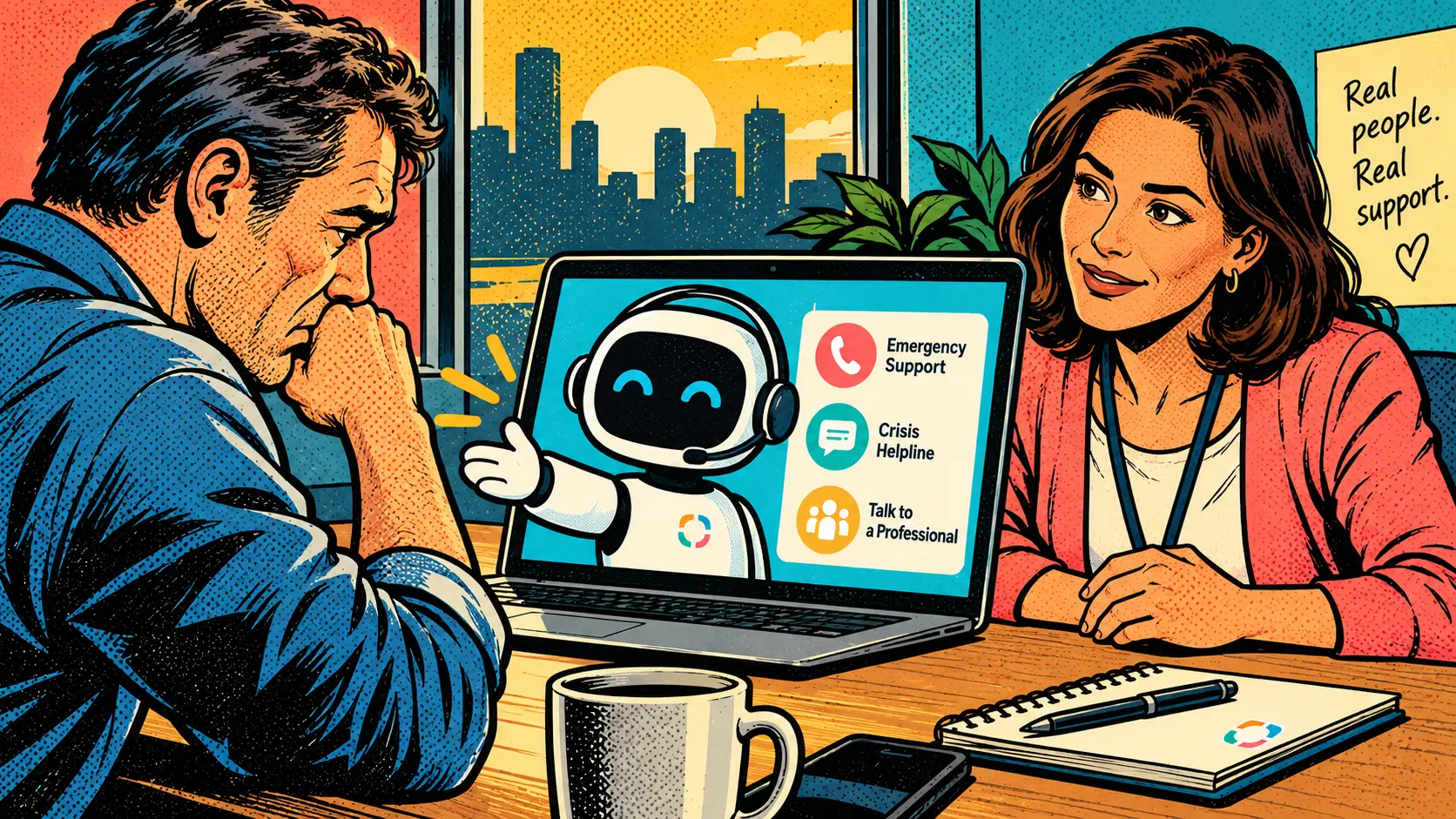
What Happens When Someone Needs Help: How an AI Coaching Platform Handles Real Distress
- The question is when, not whether. Any AI coaching space will eventually meet someone in real pain. What matters is what the platform does in that moment.
- Recognise, care, connect, step back. Sariio detects distress, stops coaching, responds with warmth, and connects the person to verified, free, confidential human support in their own country.
- Never a report to the boss. The AI does not diagnose, counsel, probe, or tell the employer. Organisations see only an anonymous, threshold-protected count.
- Context beats keywords. Detection reads the whole conversation rather than matching trigger words. That catches more - and it is still not infallible, which Sariio says plainly.
- Verified numbers, or none. Crisis resources for South Africa, the UK and the US are injected as maintained data and rechecked at every release. Stale crisis numbers are worse than none.
What happens when someone brings their pain to an AI coaching conversation?
This is not a hypothetical. Sariio Coach is a question-led coaching space built into the platform. People open it voluntarily, and the AI asks before it advises. Most sessions are about work - a difficult conversation to prepare for, a team dynamic to think through, a commitment to make and keep. But people bring their whole selves to any conversation, and sometimes what surfaces is not a coaching matter. It is despair.
A contact-centre agent working night shifts in a South African township. A manager in a UK distribution centre carrying more than they can hold. A recruiter in an American call centre who has stopped sleeping. When these people type what they are feeling, the platform has a responsibility. Not to be their therapist - it is not one. But to recognise what is happening and to do the right thing.
This is a plain account of what the platform does, what it does not do, and why we made these choices. It is written for the people who use the coaching space, for the HR and operations leaders deciding whether to trust an AI tool with their teams, and for anyone weighing what responsible AI in the workplace should look like.
The moment it happens
What happens when someone tells an AI coach they are struggling?
Sariio Coach stops the coaching conversation immediately. The AI acknowledges what the person has shared with warmth and without judgement, then provides verified crisis support numbers for their country - free, confidential lines staffed by trained counsellors. Those numbers stay visible on screen and remain there when the person returns to the session. Nobody at their organisation is notified. The person can start a new coaching session whenever they are ready. The AI does not diagnose, counsel or probe. Its job is to recognise what is happening and connect the person to humans who can help.
That is the core of the design. Recognise, care, connect, step back.
The system distinguishes between two situations. The first is acute - the person describes immediate danger to themselves or someone else. In that case, emergency service numbers appear first, plainly and without hedging, followed by crisis support lines. The second is general distress - hopelessness, overwhelm, grief, emotional pain without an immediate safety concern. Here, the support lines appear first, warmly framed, with messaging options included for people who find a phone call difficult.
In both cases, the numbers come from a verified, maintained resource list injected into the AI's response as data. The model is never asked to recall a crisis number from its own training knowledge. Large language models can produce plausible-looking but wrong information, and there is no context in which that failure costs more.
A wrong number in a crisis is worse than no number at all. So the model is never asked to remember one - every number is injected as verified data, checked against the provider's own published information before each release.
- The Sariio safeguarding design principle
The support card itself stays on screen. It does not scroll away with the transcript, and when the person returns to that session later, the card is still there - quietly present, with click-to-dial links for every number, because someone reaching for help on a phone should not have to retype eleven digits with shaking hands.
How the recognition works
How does an AI detect that someone is in distress?
Sariio's detection is contextual rather than mechanical. There is no fixed list of trigger words. The AI reads the whole conversation and recognises patterns that indicate distress - direct statements of intent, expressions of hopelessness, withdrawal language, sudden shifts in tone. It is instructed to err on the side of caution: offering support to someone who does not need it is a small cost, while missing someone who does is not. The approach catches indirect language a keyword scanner would miss, though no detection system is infallible, and Sariio does not present it as one.
Some signals are explicit. "I don't see the point any more" is clear. Others are indirect. "Nobody would notice if I wasn't here" could be a throwaway remark or a cry for help. A person in distress rarely uses clinical language. They say things like "what's the use" or "I have nothing left" or "everything is falling apart". Context matters, and an AI reading the full conversation picks up what a word-scanner would miss.
The limitation is real and worth stating. The detection is not deterministic. There is no guarantee that every expression of distress will be caught, and no guarantee that the AI will never misread a figure of speech. The system is designed to fail safe - when in doubt, it offers support. But it is not a clinical screening tool and we do not present it as one. Independent testing of general-purpose AI models has found inappropriate responses to mental health symptoms at least 20 per cent of the time, including missed suicidal intent. That finding is exactly why Sariio's design keeps the AI's role so narrow: recognise and connect, never assess or treat.
The numbers themselves
What mental health helplines are available in South Africa, the UK and the US?
In South Africa, SADAG runs two free 24-hour lines: the Suicide Crisis Line on 0800 567 567 and the Mental Health Line on 0800 456 789, plus WhatsApp counselling on 076 882 2775. Lifeline South Africa answers 0861 322 322 around the clock. In the UK, Samaritans are free on 116 123 and Shout offers 24-hour text support - text SHOUT to 85258. In the US, call or text 988 for the Suicide and Crisis Lifeline, or text HOME to 741741 for Crisis Text Line. All are confidential.
Sariio maintains this list as verified data. Each resource is checked against its provider's current published information before any release, and the verification date is recorded. Stale crisis numbers are worse than none, so the platform treats this as a maintenance obligation, not a one-off task.
The text and messaging options matter more than they might appear to. Data from the US 988 Lifeline shows text and chat volumes growing faster than calls, particularly among younger users.
Some people find it easier to type what they cannot say aloud. For a young agent on a prepaid mobile plan with WhatsApp data but no call credit, the messaging route may be the only one that works. That is why the South African set includes SADAG's WhatsApp service, and why every locale carries at least one free voice line and one text-based option.
Organisations can add their own layer on top. A client with an Employee Assistance Programme records the EAP's name, number and hours once in their settings, and those details render alongside the national lines whenever the support card appears for their people. Where nothing is configured, the national lines stand alone - the feature degrades safely rather than leaving a gap.
Who gets told
Does my employer find out if I use workplace mental health support?
Not through Sariio. When a coaching session ends because someone is struggling, nobody at the organisation is told - not the administrator, not the manager, not any named individual. Coaching confidentiality is the foundation the product is built on, and reporting distress to an employer without consent has no lawful basis under UK, South African or US data protection and privacy law. Organisations receive only an anonymous count of safeguard events per period, protected so that small numbers display as 'fewer than three' and no event can be traced to a person.
This deserves dwelling on, because it is the decision most likely to be questioned - usually by well-meaning people who assume that alerting a manager is the caring thing to do.
It is not. If people believed that expressing distress would trigger a report to their employer, they would not use the coaching space at all. The very population the safeguarding exists to protect would be the first to avoid it.
Silent reporting to an employer is surveillance wearing the clothes of safeguarding, and it collapses the trust the whole product depends on.
- The confidentiality position, aligned with EMCC and ICF codes of ethics
The position aligns with the confidentiality codes of the European Mentoring and Coaching Council and the International Coaching Federation, and with UK workplace mental-health guidance. It is also, as the next section sets out, the only position the law supports.
The aggregate signal organisations do receive tells them something useful without identifying anyone: that people brought heavy matters to a private space. Counts below three display as "fewer than 3", so a single known event can never be correlated to a person. A rising count is a prompt to look at workload, culture and support provision. It is a signal, not an identification tool.
The legal ground
What does the law say about mental health at work?
Employers in the UK, South Africa and the US all carry enforceable legal duties to protect employees' mental health. The UK's Health and Safety at Work Act 1974 covers mental as well as physical health, backed by thirty years of case law on foreseeable psychiatric harm. South Africa's Occupational Health and Safety Act requires a safe work environment, and POPIA treats mental health data as special personal information under the strictest controls. In the US, the OSHA General Duty Clause and the Americans with Disabilities Act apply. The WHO's 2022 guidelines add international weight.
The detail is worth knowing, because the obligations are tightening in all three places.
In the United Kingdom, the Health and Safety at Work etc. Act 1974 requires employers to ensure, so far as reasonably practicable, the health, safety and welfare of employees - and that duty covers mental as well as physical health. The Health and Safety Executive treats work-related stress as a workplace risk requiring assessment under the Management of Health and Safety at Work Regulations 1999, and its Working Minds campaign has made clear it will act against employers who ignore the duty. Where a mental health condition amounts to a disability, the Equality Act 2010 requires reasonable adjustments. The case law goes back to Walker v Northumberland County Council in 1995, which established employer liability for psychiatric injury caused by work-related stress, and Hatton v Sutherland in 2002, whose sixteen propositions courts still apply today. The HSE's latest figures put work-related stress, depression or anxiety at 52 per cent of all work-related illness in Great Britain.
In South Africa, the Occupational Health and Safety Act 1993 requires a safe work environment, and that duty extends to psychological health. POPIA - the Protection of Personal Information Act 2013 - classifies health information, explicitly including mental health, as special personal information carrying the strongest legal protection available. New regulations published by the Information Regulator on 6 March 2026 tightened the rules on how employers process health data, with immediate effect and no transitional period. Mental health information disclosed in a coaching session falls squarely within this scope. This is one of the structural reasons Sariio never reports safeguard events to employers: quite apart from the trust argument, there is no lawful basis for doing so without the individual's explicit consent. The Employment Equity Act and Labour Relations Act add protection against discrimination on mental health grounds.
In the United States, the OSHA General Duty Clause requires a workplace free from recognised hazards, increasingly read to include psychosocial risks. The Americans with Disabilities Act protects employees with mental health conditions and requires reasonable accommodations. The Mental Health Parity and Addiction Equity Act requires insurers to cover mental health treatment on the same terms as physical health. And the federal government's investment in the 988 Lifeline - established by the National Suicide Hotline Designation Act and expanded since - signals how seriously crisis access is now taken: early research in JAMA links the 988 rollout to an 11 per cent reduction in suicide deaths among people aged 15 to 34.
Above all three jurisdictions sits the World Health Organisation's 2022 Guidelines on Mental Health at Work, which recommend that employers prevent harm through organisational design, train managers to recognise and respond to distress, and provide access to support. The International Labour Organisation treats psychosocial hazards with the same risk-management seriousness as physical ones.
For any organisation deploying AI tools in the workplace, none of these obligations disappear because the tool is digital. If the space exists and people use it, the duty of care applies.
What AI must not pretend to be
Can AI replace a therapist or crisis counsellor?
No, and a responsible platform does not try. Sariio Coach performs no risk assessment, asks no screening questions and offers no diagnosis or treatment. What it can do is be present at the moment someone surfaces their pain, and connect them to trained humans - quickly, warmly and with verified numbers rather than guesses. The connection happens when the person picks up the phone or sends the message themselves. A system that attempted crisis counselling would need clinical training, regulatory oversight and a depth of relationship that no chat window provides.
There is one more thing the platform deliberately does not do: follow up. No email the next day, no "how are you feeling" on next login, no flag in anyone's journal but the person's own. A message referencing a distressing session is itself a privacy breach on a shared screen. The safeguard closing is the end of the platform's involvement in that moment. What remains is the support card, quietly present whenever the person returns, and an open door back to coaching whenever they are ready.
This is a narrower role than some might expect from an AI product. It is deliberately narrow. The responsible thing is to know what you are and to be excellent at the part that is yours.
Steal this: a crisis resource card for your organisation
Copy this, adapt the country sections to where your people work, and put it somewhere everyone can find it - the intranet, the break room, the back of the staff handbook.
If you are struggling, these services are free, confidential, and staffed by trained people who can help.
South Africa: SADAG Suicide Crisis Line 0800 567 567 (free, 24h) · SADAG Mental Health Line 0800 456 789 (free, 24h) · SADAG WhatsApp 076 882 2775 (weekdays 8am-5pm) · Lifeline 0861 322 322 (24h) · Emergency 10111 / 112
United Kingdom: Samaritans 116 123 (free, 24h) · Shout: text SHOUT to 85258 (free, 24h) · Emergency 999 / 112
United States: 988 Suicide and Crisis Lifeline: call or text 988 (free, 24h) · Crisis Text Line: text HOME to 741741 (free, 24h) · Emergency 911
Numbers verified August 2026. Check your national provider's website for the current list where you are.
What we built for
Building an AI coaching product and hoping nobody ever brings their pain to it is not a plan. People will. The question is what you build for that moment.
Sariio's answer is plain. Recognise it. Care about it. Connect the person to humans who can help. Step back. Keep the door open. And never tell their boss.
The companion pieces: what the coaching space is and how it works from a preference map is in the coach who already knows you; the evidence on AI and mental health support is examined in can ChatGPT be my life coach; the case for coaching itself is in does workplace coaching improve performance.
Sources
Crisis resources (verified 21 August 2026)
- SADAG (South African Depression and Anxiety Group), helpline directory
- Lifeline South Africa, National Counselling Line
- 988 Suicide and Crisis Lifeline
- Crisis Text Line
- Samaritans
- Shout 85258
Legislation and case law
- Health and Safety at Work etc. Act 1974 (UK), s.2
- Management of Health and Safety at Work Regulations 1999 (UK), reg.3
- Equality Act 2010 (UK), ss.6, 15, 20-21
- Walker v Northumberland County Council [1995] 1 All ER 737
- Hatton v Sutherland [2002] EWCA Civ 76
- Occupational Health and Safety Act 1993 (South Africa), Act 85 of 1993
- Protection of Personal Information Act 2013 (South Africa), ss.26, 32(6)
- Information Regulator (South Africa), Regulations Relating to the Processing of Data Subjects' Health Information by Certain Responsible Parties, 2026. Government Gazette No. 54268, 6 March 2026
- Employment Equity Act 1998 (South Africa), Act 55 of 1998
- Labour Relations Act 1995 (South Africa), Act 66 of 1995
- Americans with Disabilities Act 1990 (US), 42 U.S.C. § 12101 et seq.
- OSH Act 1970 (US), General Duty Clause, s.5(a)(1)
- Mental Health Parity and Addiction Equity Act 2008 (US), 29 U.S.C. § 1185a
- National Suicide Hotline Designation Act 2020 (US), Public Law 116-172
Guidance and research
- World Health Organisation (2022), Guidelines on Mental Health at Work
- International Labour Organisation, psychosocial hazards at work
- Health and Safety Executive (UK), Working Minds campaign and annual work-related ill health statistics 2024/25
- U.S. GAO (2026), Suicide Prevention: Capacity and Federal Assessment of the 988 Lifeline, GAO-26-108114
- KFF (2026), 988 Enters Its Fourth Year as Demand Grows
- JAMA Research Letter (2026), Association of 988 Suicide and Crisis Lifeline Implementation with Youth Suicide Deaths
- USC Viterbi School of Engineering (2026), Can ChatGPT Be Your Therapist? USC Study Tests AI Responses to Mental Health Questions
- EMCC Global, Global Code of Ethics
- International Coaching Federation, Code of Ethics