 sariio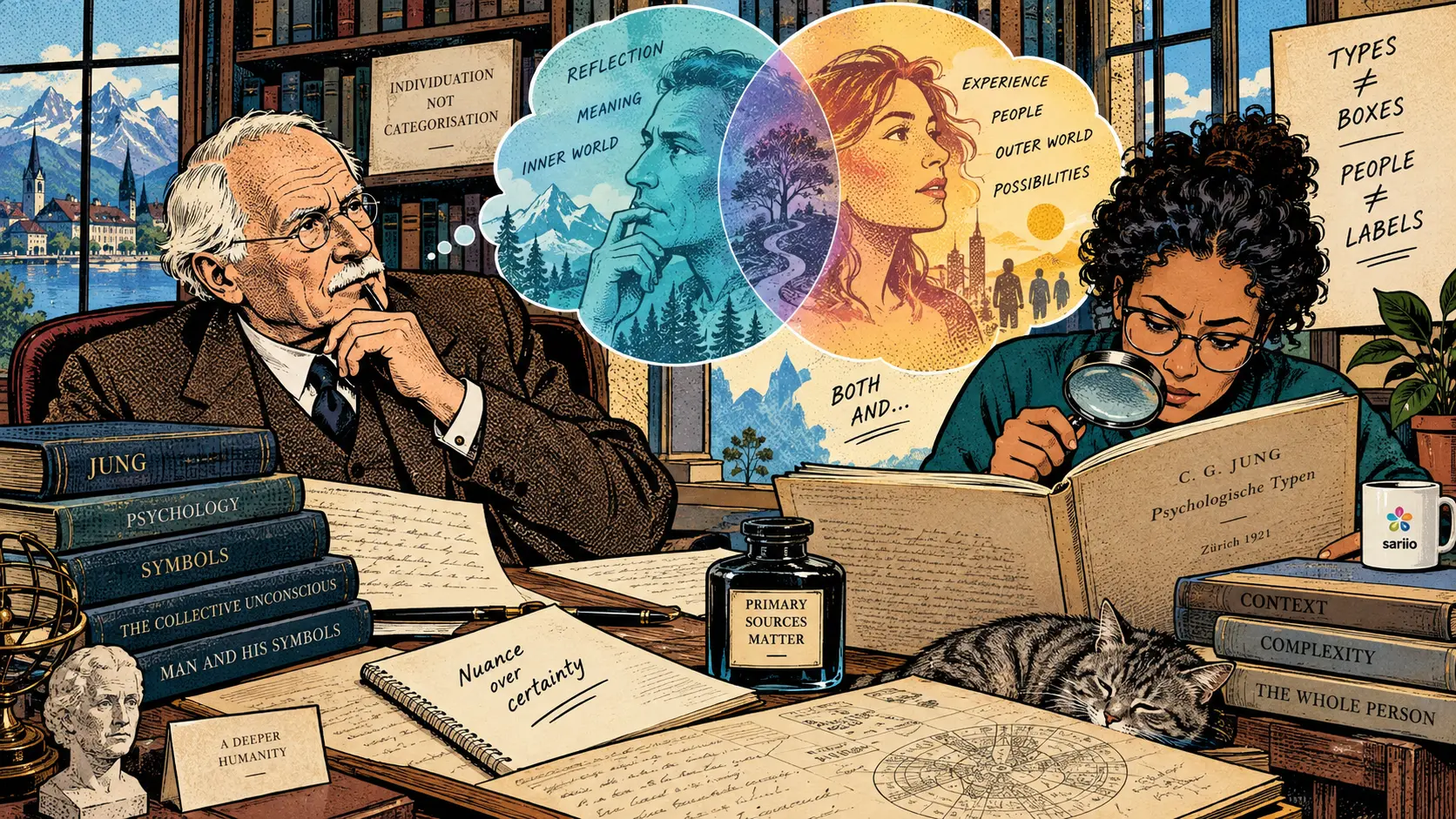
What Did Carl Jung Actually Say About Psychological Types?
- Jung offered tendencies from clinical observation - directions of energy, not boxes.
- His own words: type classification is "a childish parlour game"; "every individual is an exception to the rule".
- A pure introvert or extravert, he said, would be in the lunatic asylum.
- The forced either/or format was added later by Myers and Briggs; the cautions did not survive the adaptation.
The strangest fact in the personality-testing industry is this: the man whose name gives the whole enterprise its intellectual pedigree spent much of his life warning against the thing it does.
Ask what stands behind the four-letter codes and the colour wheels and the answer is always the same: Jung. Carl Gustav Jung, Psychological Types, 1921 - the scholarly bedrock. The bedrock is real. What was built on it is another matter, and Jung's own words are the sharpest tools for taking it apart.
What are Jung's psychological types?
In Psychological Types (1921), Jung proposed two attitudes - extraversion and introversion, describing whether a person's energy orients towards the outer world or the inner one - and four functions: thinking, feeling, sensation and intuition. Combining attitude with dominant function gives the eight types of his scheme. Crucially, he presented these as tendencies observed in his clinical work, not measured categories: the attitudes and functions were directions energy habitually takes, with every person containing both poles.
Psychologische Typen appeared in German in 1921 and in English two years later; it now sits as Volume 6 of his Collected Works. It is a work of clinical observation and intellectual history - Jung ranges across theology and literature - rather than measurement: there is no questionnaire, no scoring, no data in the modern sense. He was describing patterns he believed he saw in patients, and he was explicit that the patterns were orientations of energy, present in everyone in differing proportions, with the neglected side of each pair remaining active in the unconscious.
The warnings
Did Jung believe people fit into personality types?
No - he repeatedly warned against exactly that use of his work. In a 1934 foreword he wrote that classifying people is nothing but a childish parlour game, and that the purpose of a psychological typology is understanding, not sticking labels on people at first sight. In a 1925 lecture he cautioned that every individual is an exception to the rule. Late in life he told an interviewer there is no such thing as a pure introvert or a pure extravert - such a man, he said, would be in the lunatic asylum.
The parlour-game line comes from his foreword to the Argentine edition of the very book the industry cites - a preface warning readers against the popular use of its contents. The exception line has a similarly pointed context: in the 1925 lecture (reprinted in his Collected Works) he granted that the principle of his typology was clear and simple, then immediately added that concrete reality is complicated, "for every individual is an exception to the rule". And the lunatic-asylum remark, from his 1957 filmed interview with Richard Evans, completes the picture: the attitudes were, in his words, just terms describing which way a person tends to be more influenced - never a species classification.
His clinical practice matched the caution. "We need a different language for every patient," he remarked - a working method about as far from a standardised sixteen-cell report as psychology offers.
What happened on the way to the questionnaire
Is the Myers-Briggs based on Jung?
Loosely, and with consequential changes. Katharine Briggs found Jung's work in the 1920s; her daughter Isabel Myers built the first questionnaire in the 1940s, publishing the first MBTI manual in 1962. They added a fourth scale, Judging-Perceiving, that was at most implicit in Jung, and converted his fluid tendencies into forced either/or dichotomies - the very either/or reading Jung had warned against. Neither woman was a trained psychologist, and the instrument's discrete types belong to them, not to him.
The conversions matter more than the additions. Where Jung wrote of tendencies in proportion - both poles present in everyone, the balance shifting with development and circumstance - the questionnaire format demanded an answer: E or I, T or F. Where Jung insisted the individual was the exception, the instrument's output made the category the point. The parts of Jung that survived the adaptation were the nouns. The parts that did not were the qualifications - which is to say, the science-shaped parts, the hedges and provisos a careful observer attaches to a pattern he cannot yet measure. Later psychometric work confirmed what the hedges anticipated: the scores distribute continuously, with no evidence for genuine dichotomies.
Reading Jung generously
None of this makes Jung a modern psychometrician in exile. Psychological Types rests on one clinician's observation, not controlled study, and modern trait research has superseded its architecture. But on the specific question of boxes, Jung was simply right, early: people are tendencies in proportion, both poles live in everyone, and the individual outruns every scheme.
It is worth saying plainly that Sariio's intellectual debts run through this same terrain - the preference-pair tradition descends from Jungian ideas via the metaprogramme lineage, and we would rather acknowledge the ancestry than obscure it. The design choices are where the difference is made: 60 preference pairs read on continuous scales rather than either/or cuts, both poles treated as workable positions with no better end, a twelve-minute survey retaken at least twice a year because tendencies move with context, and no type labels anywhere in the architecture. Jung's three warnings - no parlour games, no pure types, every individual an exception - function, in effect, as the suite's design brief. The industry that borrowed his nouns is reviewed instrument by instrument in Myers-Briggs, debunked? and the cult of personality.
Read your tendencies as Jung described them - in proportion, not in boxes - the individual survey is free.
Sources
- Jung, C.G. (1921), Psychological Types, Collected Works Vol. 6, Princeton University Press; overview at Wikipedia
- Quote Investigator, Every individual is an exception to the rule - sourcing the 1925 lecture text
- Jung, C.G. (1934), foreword to the Argentine edition of Psychological Types (Collected Works Vol. 6) - the "childish parlour game" passage
- Jung, C.G. (1957), interview with Richard Evans, University of Houston; transcribed in C.G. Jung Speaking (Princeton, 1977)
- Simply Psychology, The Myers-Briggs Type Indicator - the Myers and Briggs adaptation history