 sariio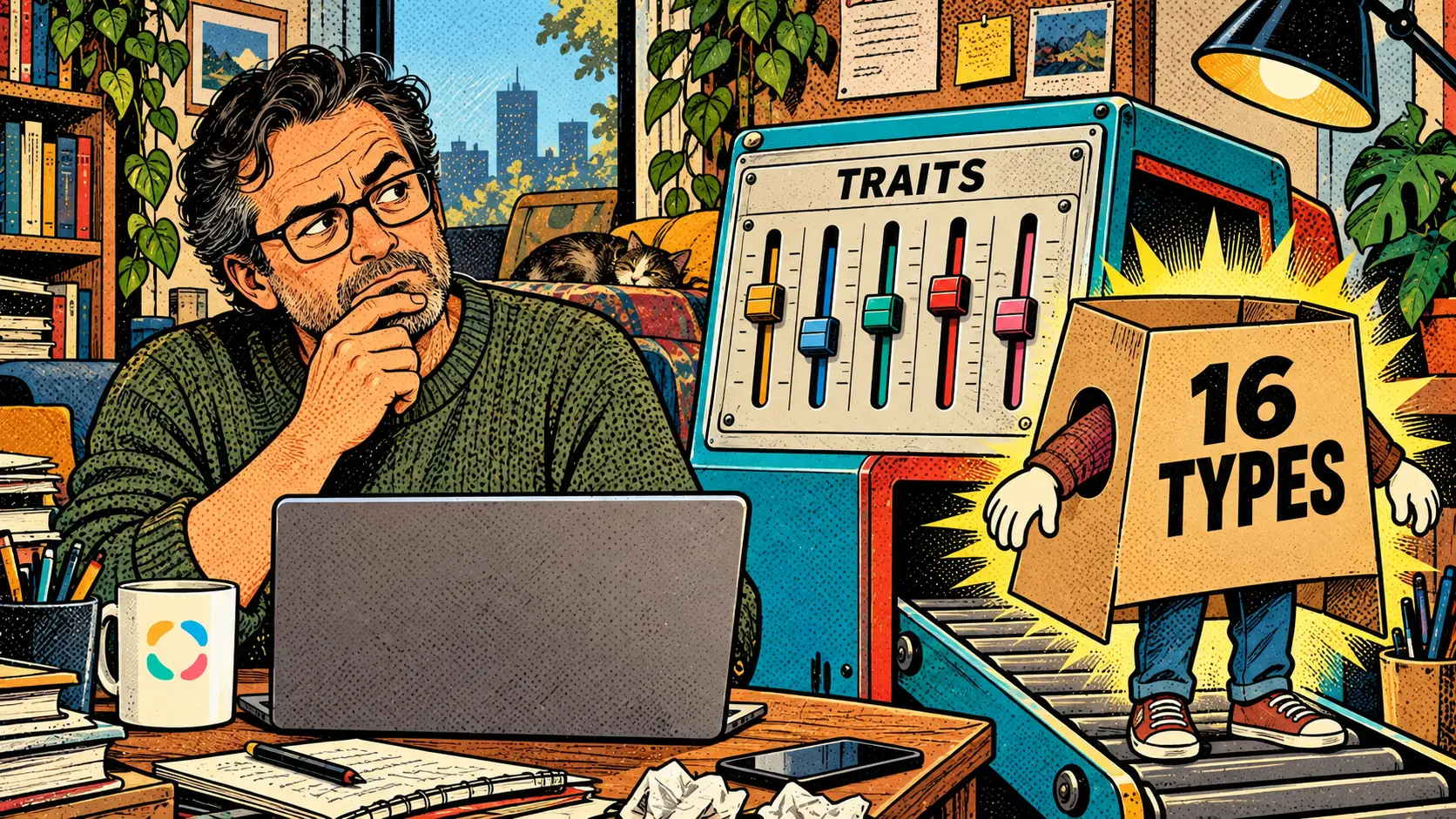
16Personalities, Reviewed: The Free Test That Conquered the Internet
- By its own account, it is a Big Five reworking wearing MBTI letters - the theory and the costume disagree.
- All reliability figures are self-published; no independent peer-reviewed validation was found.
- "91.2% accuracy" is user satisfaction, not measurement - the Barnum effect has a dashboard.
- Its trait engine is a real improvement; the letters then discard what the engine measured.
The most-taken personality test in history is not the Myers-Briggs. It is a free website, launched in 2011, whose counter now reads over 1.5 billion tests - roughly 145,000 more every day. 16Personalities has introduced more humans to the idea of a personality type than every corporate instrument combined, and for millions of people its sixteen characters, with their names and avatars, simply are what personality means.
Which makes it worth doing what few of its takers ever do: reading the company's own science pages.
Is 16Personalities the same as Myers-Briggs?
No, and its publisher says so. The NERIS Type Explorer borrows the four-letter code format 'for its simplicity and convenience' but explicitly abandons Jungian cognitive functions, describing its model instead as a reworking of the Big Five trait dimensions, with an added fifth letter for Assertive or Turbulent identity. So a 16Personalities INFJ and an MBTI INFJ are outputs of different theories that happen to share a costume - one reason type communities argue endlessly about mistyping between the two.
Credit where due: this is unusually candid. The company's theory page states plainly that Jungian concepts are "very difficult to measure and validate scientifically" and that it has instead "chosen to rework and rebalance the dimensions of personality called the Big Five personality traits". Underneath the sixteen characters sits five continuous scales - Energy, Mind, Nature, Tactics, Identity - each described by the publisher as "a two-sided continuum". As engine choices go, that is the scientifically respectable one: the Big Five is the consensus model that replaced types in academic psychology.
The oddity is what happens next. Having built a trait engine because types don't validate, the product then dresses every result as a type.
The self-published numbers
Is 16Personalities accurate?
Its measurement layer is more defensible than the MBTI's - it measures five continuous traits aligned with the Big Five, psychology's consensus model - but every published reliability and validity figure comes from the company itself, and we could find no independent peer-reviewed validation of the instrument. The much-quoted '91% accuracy rating' is a user-satisfaction figure with no published methodology, and satisfaction is what horoscope-style descriptions are engineered to produce. Solid trait engine, self-graded homework, and a type costume that reintroduces the problems traits solved.
The company's reliability page reports Cronbach's alphas from .75 to .87 across the five scales and test-retest correlations of .74 to .83 over five to seven months - respectable numbers, if accurate. But they are the company's numbers, from the company's data, on the company's website, with no named authors, no journal, no peer review. The nearest thing to independent literature is the occasional academic paper using the test as a convenience measure - use, not validation.
Then there is the homepage's boldest figure: a "91.2% accuracy rating", alongside the promise of a "freakishly accurate" description. No methodology is published, and the phrasing tells you what is being measured: whether takers feel described. Feeling described is the Barnum effect's home turf - flattering, mostly-positive portraits written at a level of generality that fits wide swathes of humanity produce high agreement regardless of measurement quality. Astrology scores well on the same test.
The costume problem
Why does 16Personalities use type letters if it measures traits?
Because letters are a better product, even where scales are better measurement. A four-letter identity is memorable, shareable and community-forming in ways a five-number profile is not - and 1.5 billion completed tests suggest how well that works. The cost is scientific: converting continuous scores into either/or letters throws away the position information, files the many people near the middle of each scale into arbitrary camps, and invites the retest instability that has dogged type instruments for decades.
This is the review's verdict in one move. 16Personalities solved the measurement problem - real scales, sensible model - and then unsolved it at the reporting layer, because identity sells and position does not. A person scoring 52% introverted is handed the same "I" and the same character portrait as one scoring 95%, and a week's mood swing can flip the letter entirely. Pittenger's old caution about dichotomising continuous distributions applies here exactly as it does to the MBTI, and the company understands the issue well enough to publish percentage scores alongside the letters. The letters are what people remember.
What the 1.5 billion tell us
One more number deserves respect rather than scorn: a billion and a half completions is the largest demonstration in history that people want to understand how they work. That appetite is real, it is global, and it walked in without a consultant. The industry's job - our industry's job - is to feed it something that holds up.
Sariio MAPS takes the road 16Personalities built an engine for and then left: continuous scales, kept continuous. Sixty work preference pairs, each read as a position rather than converted to a letter; work-specific rather than general personality; retaken at least twice a year, because a twelve-minute reading is a snapshot and people move; with the AI reading positions and change, and no character, avatar or box anywhere in the architecture. Independent scrutiny is the other half of the bargain - our methodology and its evidence base are published for exactly the inspection this review applies to others. What the free test proves is the appetite. What the appetite deserves is measurement that survives its own science pages.
Keep the scales, skip the costume - the individual survey is free.
Sources
- 16Personalities, Our Theory - the Big Five reworking and the acronym-format admission
- 16Personalities, Reliability and Validity - self-published psychometrics
- 16Personalities homepage - test counts and the 91.2% accuracy figure
- Pittenger, D.J. (2005), Cautionary Comments Regarding the Myers-Briggs Type Indicator, Consulting Psychology Journal: Practice and Research, 57(3) - the case against dichotomising continuous scores
- Goldberg, L.R. (1993), The Structure of Phenotypic Personality Traits, American Psychologist, 48(1) - the Big Five consensus