 sariio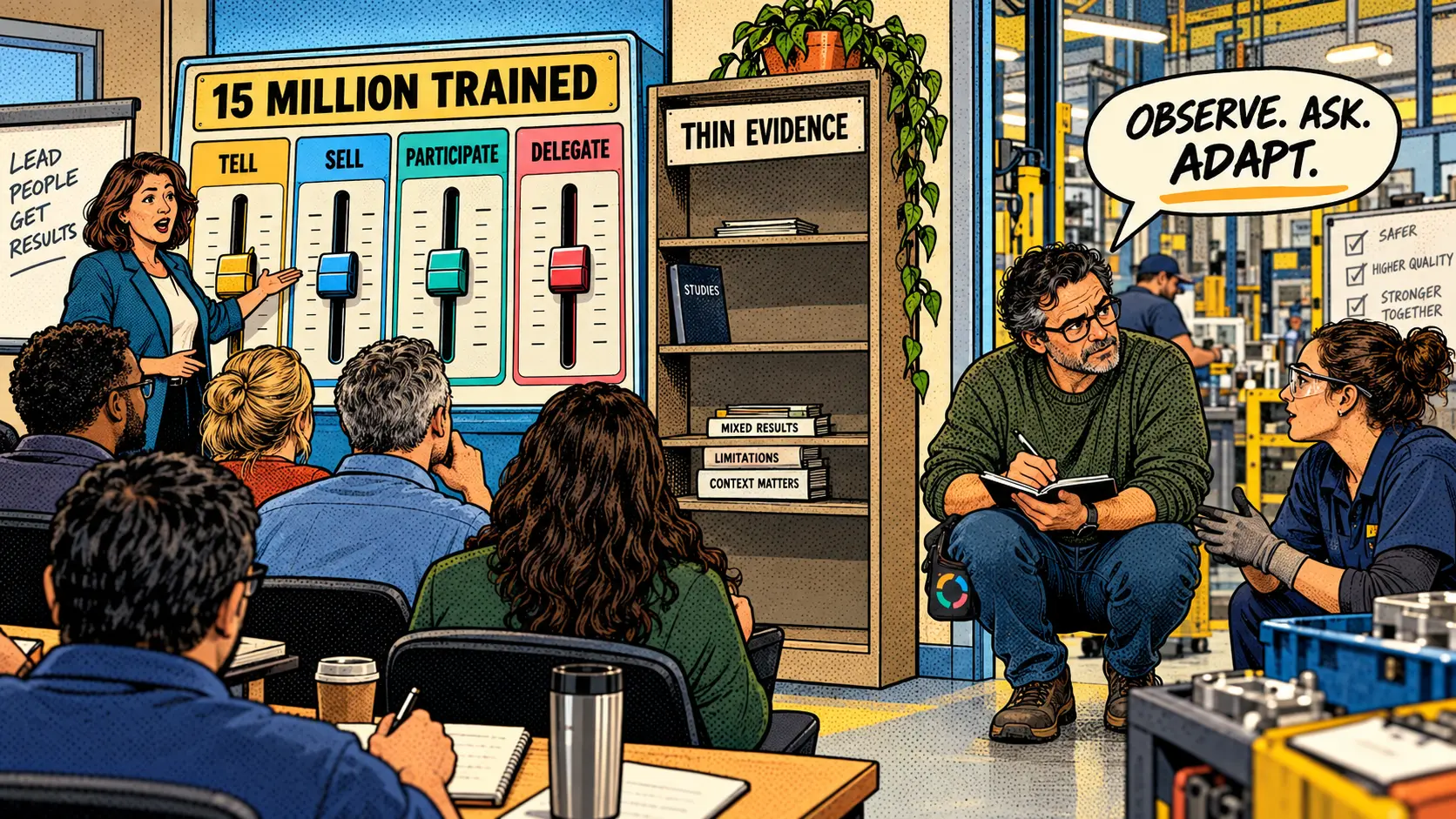
Situational Leadership, Reviewed: The Most Taught Model With the Thinnest Evidence
- The core instinct - adapt your leadership to the person - is right and worth keeping.
- The specific matching prescriptions have failed empirical tests for four decades.
- The 2007 revision predicted outcomes worse than the 1972 original in the largest recent test.
- The model diagnoses people by competence and commitment alone - two variables for a whole person.
Here is a puzzle from the history of management training. A model is critically reviewed in 1983 and found conceptually inconsistent. It is tested in the field in 1987 and only partially supported. Re-reviewed in 1997: still inconsistent. Tested again in 2006, and again in 2009 - the newer version performing worse than the old. And across those same decades it becomes one of the most widely taught leadership frameworks on earth, with its publisher reporting over fifteen million leaders trained.
Situational Leadership is the clearest case study we have of the gap between what trains well and what tests well.
What are the four styles of Situational Leadership?
The model crosses directive and supportive behaviour into four styles: S1 Telling (or Directing) - high direction, low support; S2 Selling (Coaching) - high direction, high support; S3 Participating (Supporting) - low direction, high support; and S4 Delegating - low direction, low support. Leaders are taught to match the style to the follower's readiness or development level, from D1 (enthusiastic beginner) to D4 (self-reliant achiever), moving through the styles as the person grows.
Where it came from
Paul Hersey and Ken Blanchard developed the model in the late 1960s while writing Management of Organizational Behavior, first publishing it in 1969 as the Life Cycle Theory of Leadership. The pair later split commercially: Hersey kept Situational Leadership at his Center for Leadership Studies; Blanchard launched SLII in 1985 through Leadership and the One Minute Manager - same architecture, renamed levels. The split matters to buyers mainly because it produced two competing certification industries teaching variants of a model neither had validated.
What the research found
Is Situational Leadership evidence based?
The training industry says yes; the published research largely says no. Graeff's critical reviews in 1983 and 1997 found conceptual ambiguity and internal inconsistency in both Hersey's and Blanchard's versions. Vecchio's field tests found at best partial support, mainly for low-readiness employees. Thompson and Vecchio's 2009 study of 357 Norwegian bank employees found the 2007 revision predicted worse than the original, and concluded the theory still lacks a strong empirical grounding - a striking verdict on a model taught this widely.
The pattern across the tests is worth spelling out. Vecchio's 1987 study of high-school teachers found the model's prescriptions helped for newer, lower-readiness employees and faded to nothing for experienced ones. Blank, Weitzel and Green's 1990 test was largely unsupportive. The 2006 replication with military cadets - a population practically designed for a directive-leadership model - again found little. And Thompson and Vecchio in 2009, testing three versions head to head, found the simplest version fared best and the flagship 2007 revision fared worst. When revising a theory makes it predict worse, the revision was marketing.
The Center for Leadership Studies' own website claims deployment in "more than 70% of Fortune 500 companies" and "55 Years Grounded in Behavioral Science". Both claims can be true in their way - the model is genuinely everywhere, and it genuinely emerged from the behavioural science conversation of the 1960s. Grounded in is not the same as supported by.
The good idea inside the broken model
Why is Situational Leadership so popular if the evidence is weak?
Because it teaches something true even if the model built on it is shaky: treating every employee identically is a mistake, and leaders should adapt. The framework is intuitive, easy to train in a day, gives managers a shared vocabulary and feels visibly fairer than one-style leadership. The Center for Leadership Studies reports over fifteen million leaders trained. Popularity, though, measures teachability rather than validity - the model's core matching prescriptions have repeatedly failed empirical tests.
So a fair verdict keeps the instinct and retires the machinery. Adapt to the person: yes, emphatically. Diagnose the person with two variables - competence and commitment on the current task - and prescribe from four boxes: this is where the model keeps failing, and the reason is not hard to see. People differ in far more than readiness. Two "D4" self-reliant achievers may need opposite things from their leader - one wants autonomy and silence, the other autonomy and a sounding board. The model files them identically.
The instinct deserves better instruments. Sariio MAPS reads how each person actually prefers to be led - the direction they want framed, the support they experience as support rather than surveillance, how they prefer to decide, learn and deliver - across 60 preference pairs on continuous scales, retaken at least twice a year because people move. The AI maps leader and team member together, so adapting stops being a diagnosis from four boxes and becomes a reading of the specific pair. That is the situational instinct, kept - with the person, rather than a category, at the centre. For the companion story of Blanchard's other bestseller, see The One Minute Manager, reviewed.
See what leading each person actually asks of you - the individual survey is free.
Sources
- Hersey, P. and Blanchard, K. - model history at Wikipedia: Situational leadership theory
- Graeff, C.L. (1983), The Situational Leadership Theory: A Critical View, Academy of Management Review, 8(2)
- Graeff, C.L. (1997), Evolution of situational leadership theory: A critical review, Leadership Quarterly, 8(2)
- Vecchio, R.P. (1987), Situational Leadership Theory: An examination of a prescriptive theory, Journal of Applied Psychology, 72(3)
- Vecchio, R.P., Bullis, R.C. and Brazil, D.M. (2006), The Utility of Situational Leadership Theory: A Replication in a Military Setting, Small Group Research
- Thompson, G. and Vecchio, R.P. (2009), Situational leadership theory: A test of three versions, The Leadership Quarterly, 20(5)
- Blank, W., Weitzel, J.R. and Green, S.G. (1990), A test of the situational leadership theory, Personnel Psychology
- Center for Leadership Studies, situational.com - vendor training claims