 sariio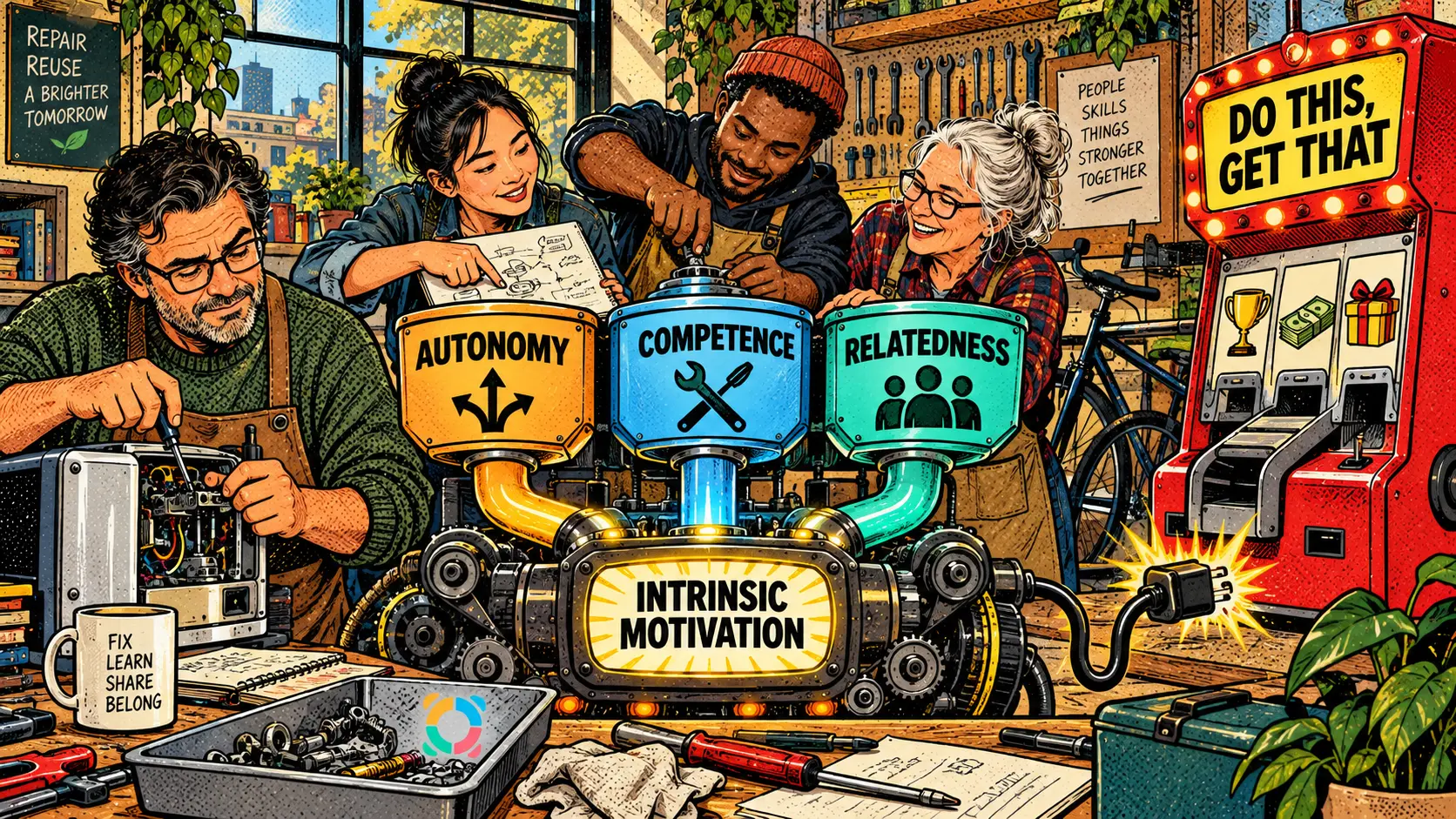
Self-Determination Theory: The Evidence Behind Autonomy, Competence and Relatedness
- The rare motivational theory that got stronger under testing: 128 experiments, then 212,000-person confirmation.
- Expected tangible rewards can undermine interest; praise tends to build it.
- Intrinsic motivation predicts work quality; incentives predict quantity - know which one your metric measures.
- The three needs are universal; how each person satisfies them at work is individual, and readable.
Most motivational theories on the management shelf share a life cycle: a striking idea, a bestselling book, then decades of failed replications politely ignored by the training industry. Maslow's staircase went that way; so did Herzberg's two factors.
Self-determination theory is the exception, and the exception matters. It is the theory that got stronger the harder it was tested - which is why it quietly underpins most serious thinking about motivation at work, including ours.
What are the three needs in self-determination theory?
Autonomy - experiencing your actions as your own choice rather than imposed; competence - feeling effective and able to grow; and relatedness - feeling connected to others and mattering to them. Deci and Ryan's theory holds that these are basic psychological needs: environments that support all three sustain intrinsic motivation and wellbeing, while environments that starve any of them produce disengagement. Van den Broeck's 2016 review of 99 workplace studies found each need contributes uniquely - they are not interchangeable.
Edward Deci and Richard Ryan built the theory from the 1970s onwards at the University of Rochester, and stated it canonically in their 2000 American Psychologist paper. What separates it from the shelf is its evidential habit: it grew out of controlled experiments rather than interviews or intuition, and it kept submitting itself to more.
The finding that started a thirty-year argument
Does money kill intrinsic motivation?
Expected, tangible rewards can undermine it, under specific conditions. Deci, Koestner and Ryan's meta-analysis of 128 experiments found rewards given for doing or completing a task reduced subsequent free-choice interest - effects around d = -0.3 to -0.4 - while unexpected rewards and verbal recognition did not, and praise tended to enhance interest. The finding was contested for years, yet the practical rule survived: pay people fairly, but making pay the reason for interesting work risks converting interest into a transaction.
The undermining effect is one of the most counterintuitive results in psychology, which is why it was fought over for decades - Cameron, Pierce and Eisenberger pressed the case against, Deci and colleagues answered in 2001, and the argument sharpened everyone's numbers. The precise version that emerged: rewards do not poison everything, but expected tangible rewards, contingent on doing an already-interesting task, shift the experienced reason for doing it. The task stops being its own reward and becomes the price of the payment. Withdraw the payment and less interest remains than was there before.
Cerasoli's 2014 meta-analysis - 183 samples, over 212,000 people - settled the workplace ledger with a distinction every incentive designer should have laminated: intrinsic motivation predicts the quality of performance, incentives predict the quantity, and heavy-handed incentives dampen the intrinsic contribution exactly where quality matters most. Judgement work, care work, creative work - the places organisations most want discretionary excellence - are the places the crowding-out effect costs most.
From the lab to the bookshop
Is Daniel Pink's Drive based on real research?
Yes - Drive popularised self-determination theory, and its core claims track the evidence. Pink translated the theory's needs into autonomy, mastery and purpose; mastery maps cleanly onto competence, while purpose is his adaptation - the third need in the research is relatedness, connection to people rather than mission. The research behind his headline - that rewards can undermine interest and that intrinsic motivation drives quality - is solid, resting on the Deci-Ryan experimental programme and confirmed at scale by Cerasoli's 2014 meta-analysis of 212,000 people.
Pink's 2009 book did for this theory what the pyramid-drawers did for Maslow - with the difference that the science he popularised was sound. The substitution of purpose for relatedness is worth knowing about, not as a gotcha but because it changes practice: a mission statement on the wall addresses Pink's purpose, while the research's relatedness is satisfied by people - being known, mattering to colleagues, belonging in a team. Organisations that bought Drive and invested in purpose campaigns sometimes starved the humbler need the evidence actually names.
The needs are universal; the satisfactions are not
Here is where four decades of evidence hand the baton to practice. The three needs are as close to universal as this field gets - Van den Broeck's review found them operating across cultures and job types. But how a given person satisfies each need at work is individual, and the variation is wide.
Autonomy for one person means controlling their schedule; for another, controlling their methods while happily following a schedule. Competence for one means visible mastery of a stable craft; for another, a steady diet of unfamiliar problems. Relatedness for one is a close-knit team in constant contact; for another, a few deep working relationships and plenty of quiet. Design a workplace around any single interpretation and you feed some people while starving others - with every good intention.
This is precisely the resolution Sariio MAPS adds to the theory. The suite is built on the same evidential ground - its intellectual ancestry runs through Adler, Pink's Drive and the preference research - and it reads how each person's autonomy, competence and relatedness are actually constituted: 60 work preference pairs on continuous scales, a twelve-minute survey retaken at least twice a year, mapped by AI for person, team and organisation with no types and no verdicts. Self-determination theory tells an organisation what people need. A preference map shows what those needs look like on Tuesday, per person - which is where a theory becomes a practice.
Read what autonomy, competence and connection look like for you - the individual survey is free.
Sources
- Ryan, R.M. and Deci, E.L. (2000), Self-Determination Theory and the Facilitation of Intrinsic Motivation, Social Development, and Well-Being, American Psychologist, 55(1)
- Deci, E.L., Koestner, R. and Ryan, R.M. (1999), A Meta-Analytic Review of Experiments Examining the Effects of Extrinsic Rewards on Intrinsic Motivation, Psychological Bulletin, 125(6)
- Deci, E.L., Koestner, R. and Ryan, R.M. (2001), Extrinsic Rewards and Intrinsic Motivation in Education: Reconsidered Once Again, Review of Educational Research - the reply in the rewards debate
- Cerasoli, C.P., Nicklin, J.M. and Ford, M.T. (2014), Intrinsic Motivation and Extrinsic Incentives Jointly Predict Performance: A 40-Year Meta-Analysis, Psychological Bulletin, 140(4)
- Van den Broeck, A., Ferris, D.L., Chang, C-H. and Rosen, C.C. (2016), A Review of Self-Determination Theory's Basic Psychological Needs at Work, Journal of Management, 42(5)
- Pink, D.H. (2009), Drive: The Surprising Truth About What Motivates Us, Riverhead Books
- American Psychological Association, Self-determination theory: A quarter century of human motivation research