 sariio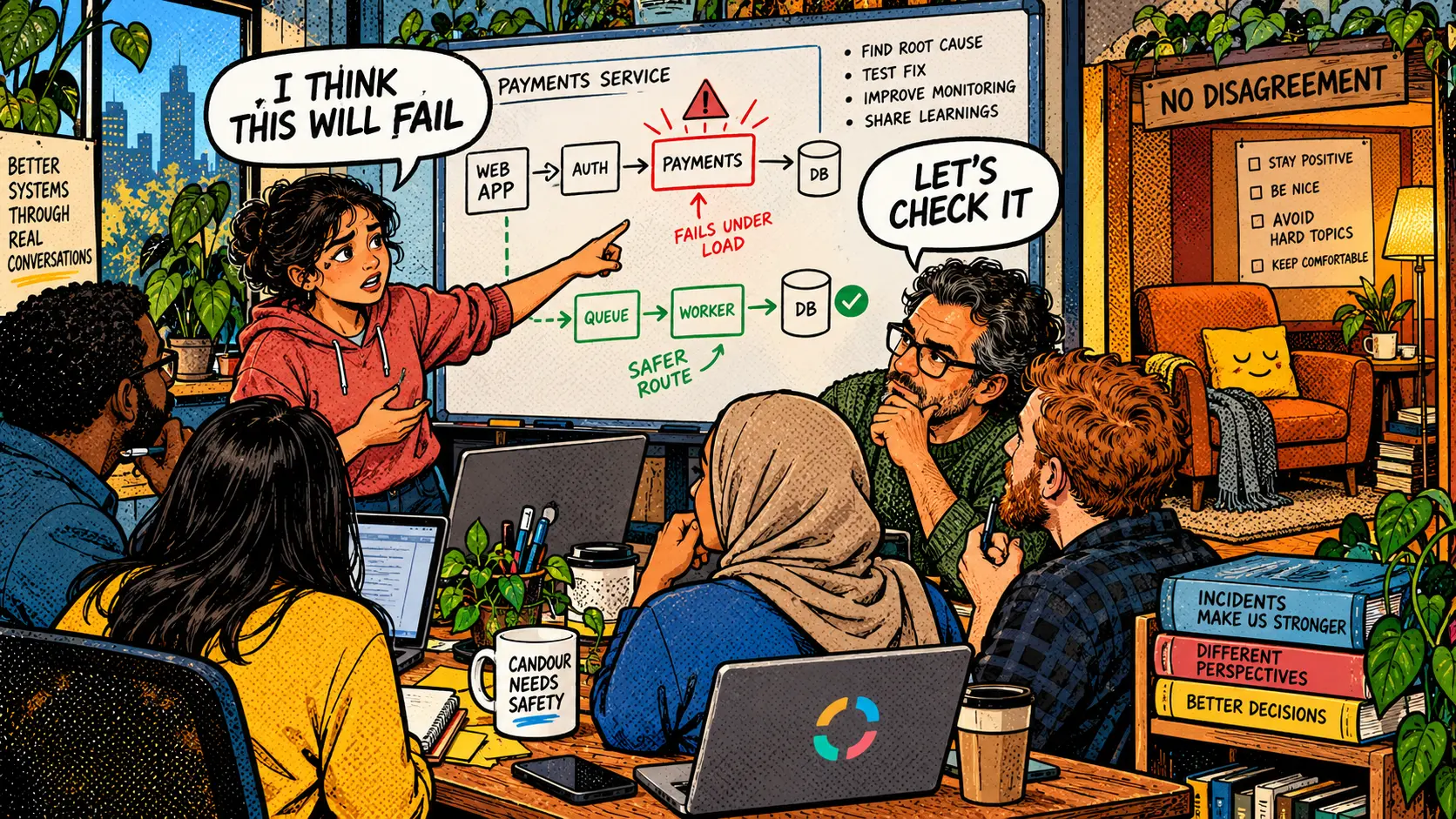
Psychological Safety: What Google Actually Found - and What Most People Get Wrong
- Edmondson's construct is about risk-taking, not comfort: safe to admit, ask, dissent.
- Project Aristotle ranked it first of five factors - but was internal, unreviewed and unreplicable.
- The meta-analytic base is real: 136 samples link safety to learning, performance and information sharing.
- Safety is built interaction by interaction - which makes it a fit problem as much as a values problem.
The most famous finding in team research began with a researcher noticing something that looked wrong. In the 1990s, Amy Edmondson was studying medication errors in hospital teams, expecting the better-led teams to make fewer mistakes. Her data said the better teams made more errors. The resolution of the paradox built her career: the better teams were not erring more - they were admitting more, because they could.
What is psychological safety?
Amy Edmondson defined it in 1999 as a shared belief held by members of a team that the team is safe for interpersonal risk taking - safe to ask a question, admit a mistake, raise a concern or offer a half-formed idea without fear of humiliation or punishment. It is a property of the team, not the individual, built interaction by interaction. In her study of 51 work teams, psychological safety predicted learning behaviour, which in turn predicted team performance.
The research base under the construct has grown well beyond one study. Frazier and colleagues' 2017 meta-analysis synthesised 136 samples and confirmed the pattern: psychological safety relates to learning behaviour, task performance, engagement and information sharing, with leadership behaviour among its strongest antecedents. Few ideas in management have this much peer-reviewed weight behind them - which makes the way the idea usually reaches organisations all the stranger, because it arrives via a study that was never published at all.
What Project Aristotle did and did not show
What did Google's Project Aristotle find?
Google studied around 180 of its own teams across some 250 attributes, expecting to find that who was on a team mattered most. Instead the strongest differentiator was how teams worked together, with psychological safety ranked first among five factors - ahead of dependability, structure and clarity, meaning, and impact. Worth knowing: the study was internal, never peer reviewed, and Google did not publish its procedures or data, so it is best read as a large company confirming Edmondson's published research rather than as independent proof.
The Aristotle story - told memorably by Charles Duhigg in the New York Times Magazine in 2016 - did more for psychological safety's fame than two decades of journals. It also imported weaknesses the journals would have caught. Google never shared its methods, statistics or raw data; critics note the success criterion itself was contested inside the study, with executives and team members defining team effectiveness differently. None of this makes the conclusion wrong. It makes the conclusion unverifiable - and the appropriate response is to rest the case on Edmondson and Frazier, where the evidence is inspectable, and treat Aristotle as a famous corroboration.
The misreadings
Is psychological safety just about being nice?
No - Edmondson has spent years correcting this reading. Psychological safety is what makes hard conversations possible, not what replaces them: in her phrase, sharing hard truths is expected. It is fully compatible with high standards and accountability; her hospital research found the better-led teams reported more errors, not fewer, because people felt able to admit them. A team that avoids conflict to keep things comfortable is not psychologically safe - it is quiet, which is frequently the opposite.
Edmondson's 2025 Harvard Business Review piece with Michaela Kerrissey catalogued the misreadings that had accumulated: that safety means agreeing with everyone (no), that it protects against consequences (no), that it can be mandated by policy (no - it is "built in a group, interaction by interaction"), that it conflicts with accountability (the reverse: it is what makes accountability discussable). The pattern in the misreadings is consistent - each one converts a demanding idea about risk into a comfortable idea about niceness.
Interaction by interaction
Take Edmondson's phrase seriously and a practical question follows: which interactions? Safety is not built by the values poster; it is built and spent in specific moments between specific people - the question asked or swallowed, the mistake admitted or buried, the half-idea offered or kept back.
And those moments have different costs for different people. Speaking up in a meeting is cheap for the person who thinks out loud and expensive for the one who thinks in silence and arrives with finished conclusions. A challenge that lands as stimulating debate for one colleague lands as exposure for another. A team can be genuinely safe for its talkers and quietly unsafe for its reflectors - same team, same leader, opposite experiences.
This is where a preference map earns its place beside the construct. Sariio MAPS reads how each person prefers to contribute - in the room or after it, immediately or considered, task-first or relationship-first - from a twelve-minute survey retaken at least twice a year, mapped by AI for the team as well as the person. A leader who can see that the team's quietest member is a private processor rather than a disengaged one can change the interaction - circulate questions before the meeting, collect dissent in writing - and safety stops being an abstraction and becomes design. The evidence says safety produces learning. Knowing your people's preferences is how the interactions that build it get chosen. Candour's other precondition - the relationship - is the subject of Radical Candor, reviewed.
See how each person on your team prefers to speak up - the individual survey is free.
Sources
- Edmondson, A. (1999), Psychological Safety and Learning Behavior in Work Teams, Administrative Science Quarterly, 44(2)
- Frazier, M.L. et al. (2017), Psychological Safety: A Meta-Analytic Review and Extension, Personnel Psychology, 70(1)
- Google re:Work, Understand team effectiveness - Project Aristotle's own account
- Duhigg, C. (2016), What Google Learned From Its Quest to Build the Perfect Team, New York Times Magazine
- Adsit, D., Unlikely That the Main Conclusion of Google's Project Aristotle is True - method critique
- Edmondson, A. and Kerrissey, M. (2025), What People Get Wrong About Psychological Safety, Harvard Business Review; summary at Harvard Chan School
- Edmondson, A. (2018), The Fearless Organization, Wiley