 sariio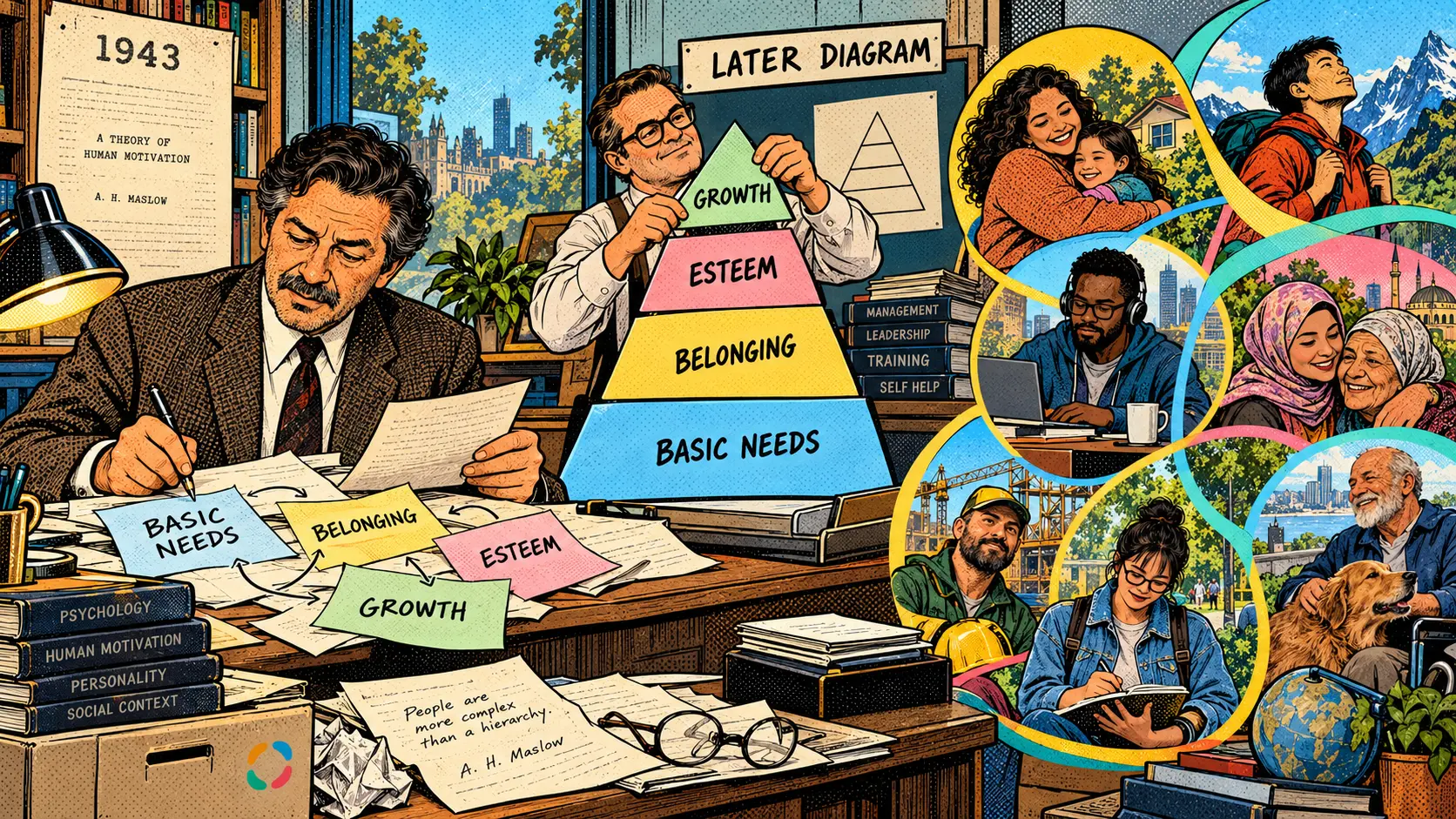
Is Maslow's Hierarchy of Needs Still Relevant? The Pyramid He Never Drew
- Maslow's 1943 paper contains no pyramid; management consultants drew it in 1957-60 to sell the idea.
- Maslow himself flagged the exceptions the training slides leave out.
- The 1976 review found little consistent support; the 2011 Gallup study across 123 countries saved the needs but sank the staircase.
- The needs are real and simultaneous - and weighted differently by each person, which is the actionable part.
What is the most reproduced diagram in the history of management training? The pyramid, surely - five coloured layers, physiological needs at the bottom, self-actualisation at the top, Abraham Maslow's name underneath.
Maslow never drew it.
Did Maslow ever draw a pyramid?
No. His 1943 paper A Theory of Human Motivation contains no pyramid and no diagram at all - the word pyramid does not appear in it. Bridgman, Cummings and Ballard's 2019 history in Academy of Management Learning & Education traced the pyramid to management writers in the late 1950s: a stepped diagram by Keith Davis in 1957 and the full pyramid by consultant Charles McDermid in 1960, built to sell the idea to business audiences. Maslow himself wrote that the order of needs had many exceptions.
The 1943 paper is more interesting than its diagram. Maslow proposed five sets of needs - physiological, safety, love, esteem and self-actualisation - and suggested that satisfied needs stop motivating while unsatisfied ones organise behaviour. But he hedged in ways the pyramid erased. He wrote plainly that "there have been a number of exceptions" to the ordering, and offered a subtler picture: an average person might be, in his illustration, largely satisfied in physiological needs and only slightly satisfied in self-actualisation - all the needs active at once, in decreasing percentages. The staircase, where one level must be completed before the next unlocks, was the consultants' addition. It made a better slide. It was not the theory.
What happened when it was tested
Is Maslow's hierarchy of needs scientifically proven?
The strict hierarchy is not. Wahba and Bridwell's 1976 review concluded the theory had received little clear or consistent support and was close to untestable as stated. The partial rescue came in 2011: Tay and Diener analysed Gallup World Poll data from 123 countries and found the needs themselves are real and universally linked to wellbeing - but people can report self-actualisation and strong relationships while basic needs go unmet. The needs are real; the fixed staircase is not.
The 1976 verdict was severe: across the research then available, Wahba and Bridwell found the need categories hard to verify and the ordering unsupported, judging the theory "almost nontestable" as formulated. For a generation that settled it academically - while the pyramid went on conquering the training room.
Tay and Diener's study is the fair-minded postscript. Using Gallup data across 123 countries, they found the needs Maslow named are genuinely universal - fulfilment of each one is associated with wellbeing everywhere they looked. What failed was the sequence: a street vendor with unmet safety needs can still draw deep wellbeing from family and mastery; a wealthy executive with every lower layer secure can be starved at the top. Different needs also fed different kinds of wellbeing - basic provision tracked how people evaluate their lives, while relationships, respect and autonomy tracked how their days actually feel.
Why the pyramid persists
Bridgman and colleagues' history answers this too. The pyramid arrived exactly when post-war management education needed it - a scientific-looking, optimistic, teachable model of the worker for the new MBA cohorts, championed into the curriculum partly through Douglas McGregor's enthusiasm for Maslow. It survives for the same reason: it is unbeatable as a slide. One image, instantly memorable, apparently explanatory. The training industry does not retire its best diagram merely because the evidence went the other way.
Using what is true
Is Maslow's hierarchy still relevant in the workplace?
As a checklist of what people need from work - security, belonging, respect, growth - it remains a humane and useful reminder. As a sequence, it misleads: the evidence shows people pursue meaning, connection and mastery alongside security rather than after it, and each person weights the needs differently. A manager using the pyramid as a staircase will delay development conversations that matter now; one using it as a list of simultaneous human needs, weighted differently per person, is on defensible ground.
The phrase doing the work in that answer is weighted differently per person. This is what the pyramid, even rehabilitated as a checklist, cannot show: which needs matter most to this employee, now. One person's esteem runs through public recognition; another's through mastery that needs no audience. One is energised by belonging and team; another by autonomy and quiet. The needs are universal. The weightings are individual - and the weightings are where a manager can actually act.
Reading those weightings is the job Sariio MAPS was built for: 60 work preference pairs on continuous scales, from a twelve-minute survey retaken at least twice a year, mapped by AI for the person, the team and the organisation. Where the pyramid offers one ordering for everyone, a preference map shows how this person actually ranks connection, recognition, security and growth in their working life - no staircase, no verdicts, and re-read as the person changes. Maslow's real insight - that people are moved by needs, not just wages - survives every critique of his ordering. The modern instrument reads the needs person by person. The motivational theory Maslow helped inspire is picked up in Daniel Pink and the science of what motivates people.
Read how one person actually weights their needs at work - the individual survey is free.
Sources
- Maslow, A.H. (1943), A Theory of Human Motivation, Psychological Review, 50(4) - full text
- Bridgman, T., Cummings, S. and Ballard, J. (2019), Who Built Maslow's Pyramid?, Academy of Management Learning & Education, 18(1)
- Wahba, M.A. and Bridwell, L.G. (1976), Maslow Reconsidered: A Review of Research on the Need Hierarchy Theory, Organizational Behavior and Human Performance, 15
- Tay, L. and Diener, E. (2011), Needs and Subjective Well-Being Around the World, Journal of Personality and Social Psychology, 101(2)