 sariio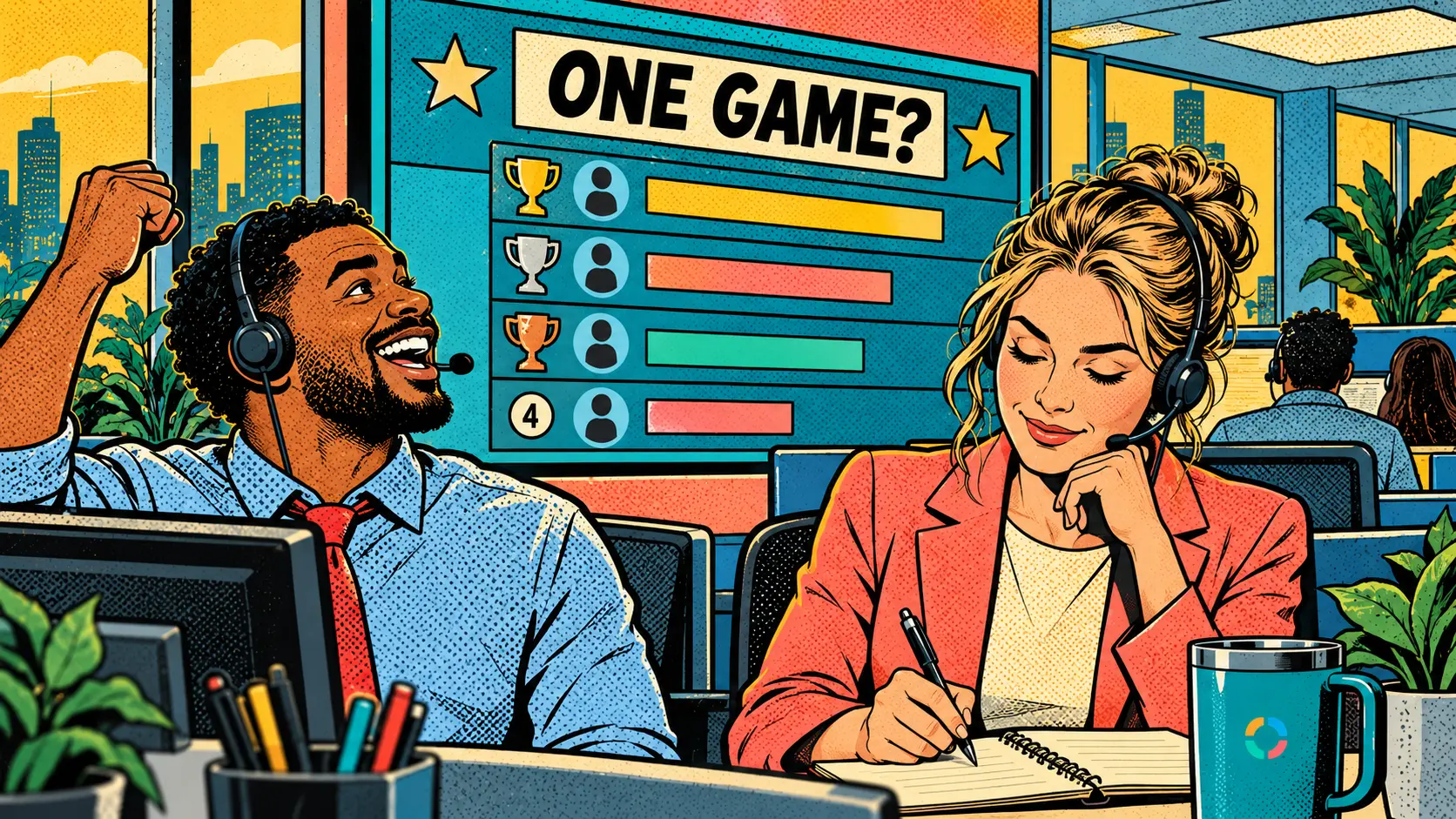
Does Gamification Work in Call Centres?
- Meta-analytic effects are real but small, and the motivational ones are the least stable.
- Consent is decisive: imposed games lowered positive feeling about work in field research.
- Effects fade with novelty; longitudinal studies show a satiation curve vendor case studies rarely mention.
- The same leaderboard motivates one agent and corrodes another - the difference is readable preference, not attitude.
The pitch is seductive: agents are disengaged, games are engaging, so make the work a game. The gamification industry is forecast to more than triple this decade, and no sector has bought harder than contact centres, where the metrics were already on a dashboard waiting to become a scoreboard.
The evidence deserves a closer look than the pitch usually gets - because it says something more useful than yes or no.
Does gamification work in the workplace?
The research verdict is a qualified yes. Sailer and Homner's 2020 meta-analysis found small but significant positive effects on learning - cognitive g = 0.49, motivational g = 0.36, behavioural g = 0.25 - with the motivational effects the least stable. The foundational 2014 review by Hamari and colleagues reached the same conclusion: gamification does work, but the results depend heavily on the context and on the users. It is a moderator-rich intervention, which means the interesting question is who it works for, not whether it works.
"Depends on the users" is doing heavy lifting in that sentence. When a meta-analysis reports unstable motivational effects, the usual reason is that strong positive responses and strong negative responses are averaging each other out. Some people flourish under game mechanics; others go flat or go home. A single number hides the split.
The consent finding
Do leaderboards motivate or demotivate employees?
Both, depending on the person and on consent. Mollick and Rothbard's field research found workplace games increased positive affect only when employees consented to them; where consent was absent, gamification made feelings about work worse, not better. A leaderboard energises people who enjoy visible competition and can corrode those who prefer steady, private mastery - the same mechanism produces opposite effects in different people, which is why blanket rollouts produce mixed results.
Mollick and Rothbard called their paper "Mandatory Fun", which captures the problem in two words. A game you chose is play; a game imposed on you is surveillance wearing a party hat. In a contact centre, where monitoring is already pervasive, a gamified dashboard can read to agents as one more scoreboard they never asked to be on - and the research says that reading has consequences for how they feel about the work.
There is darker evidence still. Hammedi and colleagues' study of gamification in frontline service work - published in the Journal of Business Research under the title "Uncovering the dark side of gamification at work" - found the approach can harm engagement and wellbeing in exactly the employee population contact centres are trying to help.
The fade
What are the disadvantages of gamification at work?
Four appear repeatedly in the research: effects fade as novelty wears off - a satiation pattern documented in longitudinal service-industry studies; imposed games without consent lower wellbeing rather than raising it; competition mechanics can damage the collaboration a contact centre depends on; and gamified metrics narrow attention to whatever scores points, at the expense of judgement-heavy work that does not. None of these is fatal, but each one is a design decision, not an accident.
The satiation finding matters most for budgeting. Hammedi, Leclercq and Steils documented what they call gamification myopia: engagement effects that decay with repeated exposure. Vendor case studies are almost always measured in the launch quarter - the top of the novelty curve. A centre buying a platform on quarter-one numbers is buying the best the intervention will ever look.
A last note on the evidence base itself: we found no peer-reviewed study of gamification specifically in contact centres with hard performance outcomes. The sector-specific numbers in circulation come from vendors. That is not a reason to dismiss the approach; it is a reason to run your own controlled pilot before an enterprise rollout, and to measure it past the novelty window.
Who is the game for?
The practical conclusion sitting under all this research: gamification is not one intervention, because a floor is not one person. The agent who checks the leaderboard hourly and the agent who finds it quietly humiliating are both real, both on your floor, and both invisible in the average.
Reading that difference beforehand is precisely what a preference map is for. Sariio MAPS reads how each person prefers to be recognised, to compete or collaborate, and to measure their own progress - on continuous scales, from a twelve-minute survey retaken at least twice a year, with no types and no verdicts. A team leader planning a gamification pilot can see which agents are likely to be energised and which will need a different lever entirely - and the AI reads the same maps at team level, so the design question becomes evidence-led: not "should we gamify?" but "for whom, and what do the others get instead?" The broader pattern - motivation levers that work only when matched to the person - is the subject of how do you motivate call centre agents.
See how differently one team prefers to be motivated - the individual survey is free.
Sources
- Sailer, M. and Homner, L. (2020), The Gamification of Learning: A Meta-Analysis, Educational Psychology Review
- Hamari, J., Koivisto, J. and Sarsa, H. (2014), Does Gamification Work? A Literature Review of Empirical Studies on Gamification, HICSS
- Mollick, E. and Rothbard, N. (2014), Mandatory Fun: Consent, Gamification and the Impact of Games at Work, Wharton School; discussion at Knowledge at Wharton
- Hammedi, W., Leclercq, T., Poncin, I. and Alkire, L. (2021), Uncovering the dark side of gamification at work, Journal of Business Research, 122
- Hammedi, W., Leclercq, T. and Steils, N. (2024), Gamification Myopia: Satiation Effects in Gamified Activities, Journal of Service Research
- TalentLMS (2019), Gamification at Work survey