 sariio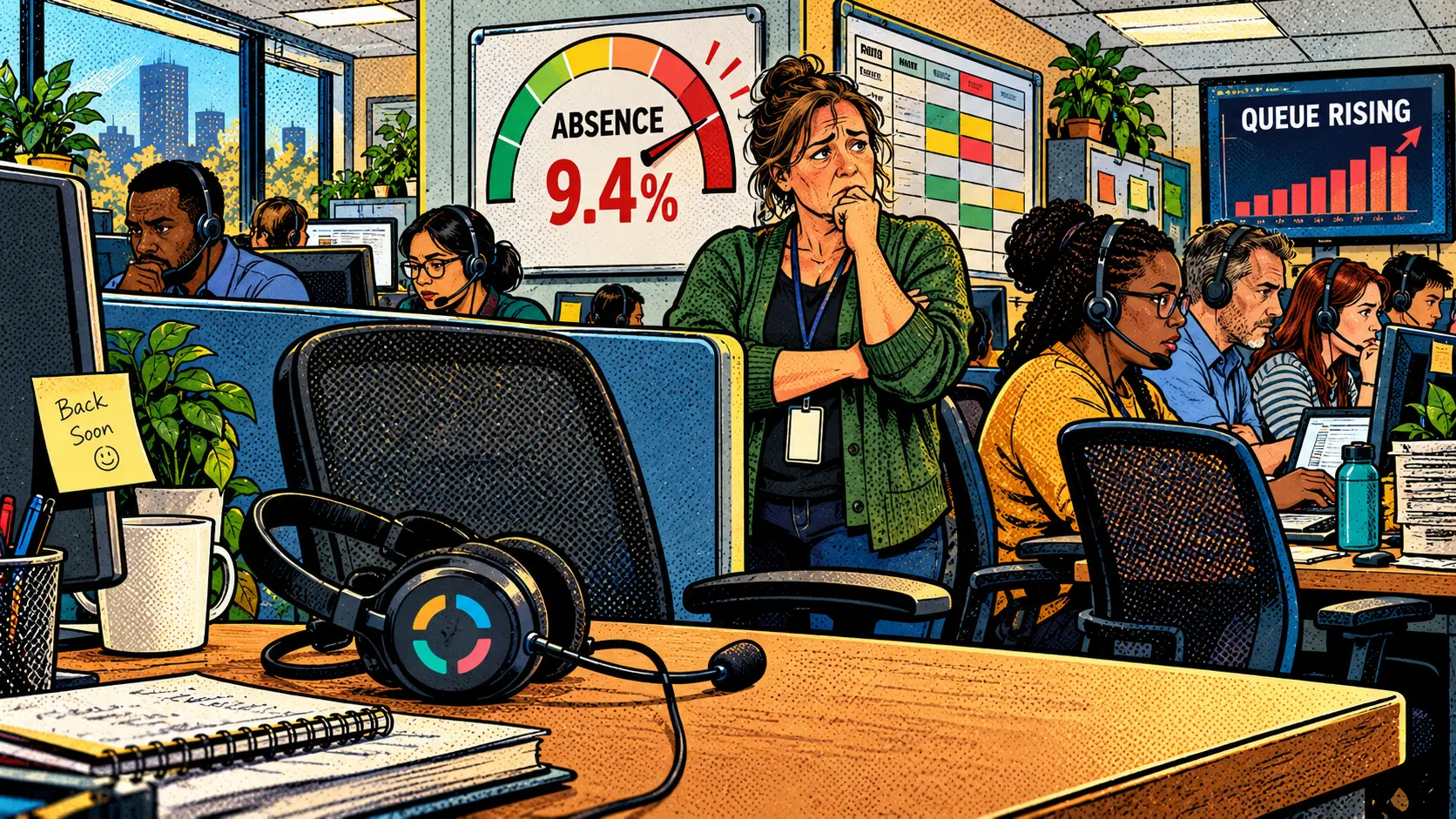
Absenteeism in Contact Centres: The Leading Indicator Most Centres Ignore
- US contact centre absence hit a 9.4% mean in 2024 - pandemic-era levels, without a pandemic.
- Engagement is the strongest known correlate: 81% lower absence in top-quartile teams.
- Attendance-point policies treat the warning light as the fault - and are linked to faster attrition.
- Absence clusters where the day fits people worst; that fit is readable before it becomes a pattern.
Every contact centre measures absence. Almost none of them read it.
Measured, absence is a shrinkage line in the workforce plan - a percentage to staff around. Read, it is the earliest signal a centre gets that something between the person and the work has broken. The agent who will resign in March starts calling in sick in November. By the time the resignation letter arrives, the data had been pointing at it for a quarter.
What is the average absenteeism rate in call centres?
ContactBabel's 2024 US Decision-Makers' Guide put the mean contact centre absence rate at 9.4% - a level previously seen only during the pandemic - with a median of 6.5%, and more than 27% of centres reporting absence above 15%. Practitioner benchmarks treat below 4% as healthy and above 8% as a problem needing structural attention. For context, the CIPD's 2025 UK survey across all sectors found average sickness absence of 9.4 days per employee per year - so contact centres run well above the general working population.
The gap between the mean and the median tells its own story: a long tail of centres with severe absence is dragging the average up. And the direction of travel matters as much as the level. Absence at pandemic heights, without a pandemic, is a sector reporting something about the work itself.
The pattern is not new. As far back as 2008, a British government survey found call centre and customer service workers roughly twice as likely as the average British worker to have taken a sick day in the previous week - nearly 5% against 2.5%.
Why the sector runs hot
Why is absenteeism so high in call centres?
Because the role concentrates the conditions that produce absence: sustained emotional labour, high monitoring, occupancy that leaves no recovery time between calls, schedules published late and changed often, and limited autonomy over any of it. Disengagement then shows up as sick days first - Gallup's meta-analysis found top-quartile engagement business units run 81% lower absenteeism than bottom-quartile units, the largest engagement effect Gallup measures. Absence is rarely random; it clusters where the day fits people worst.
That 81% figure deserves emphasis because of what it is not. It is not a wellness-programme effect or a policy effect; it is the difference between business units where people are engaged with their work and units where they are not, measured across Gallup's database of over 112,000 units. Absence tracks engagement more tightly than any other outcome Gallup measures - more tightly than turnover, productivity or profitability. Which makes the absence report the closest thing a centre has to a continuous engagement gauge, updated daily, at no cost.
The mental-health dimension has grown too. The CIPD's UK data puts mental ill health as the top cause of long-term absence, cited by 41% of employers - and emotional labour under monitoring is close to a definition of the contact centre role.
The policy trap
The standard response to rising absence is an attendance policy: points, triggers, escalations. The operational logic is understandable - service levels have to be staffed - but the evidence on punitive, team-wide attendance regimes points the wrong way: they are associated with faster attrition, not better attendance. The mechanism is not mysterious. An agent using sick days to survive a bad fit does not become healthier when threatened; they become a leaver.
There is also a workload feedback loop hiding in the workforce plan. Absence forces higher occupancy on the agents who did come in; sustained occupancy above the mid-eighties removes the recovery time between calls; exhausted agents are absent more. Centres can spend years inside this loop treating each month's absence as that month's problem.
Reading the gauge
How do you reduce absenteeism in a call centre?
Treat it as a signal, not a discipline problem. The evidence-backed levers: keep occupancy below the mid-eighties so agents get recovery time, publish schedules early and honour them, give agents genuine flexibility where possible, and coach team leaders to spot rising absence as early disengagement rather than policing it with attendance points. Punitive team-wide attendance policies are associated with faster attrition - they convert a warning light into an exit. Then fix the underlying fit: absence concentrates in people whose working preferences the role is ignoring.
The last lever is the one the sector has barely touched. Absence is individual before it is statistical: this agent, whose energy the role drains in this particular way. One agent is worn down by relentless social contact with no recovery; another by rigid scripts that leave no room for judgement; a third by constant change to a schedule they had planned their life around. Same absence line, three different causes, three different fixes.
Those differences are exactly what a preference reading makes visible. Sariio MAPS reads how each person prefers to work - the pace, the structure, the contact load, the autonomy - from a twelve-minute survey retaken at least twice a year, and its AI reads the same maps at team level, so a leader can see where the floor's preferences and the floor's reality have come apart before the absence line says so. No verdicts and no fit scores; a gauge, read early, while the fix is still a conversation rather than a counter-offer. The wider retention picture is in why call centre agents really quit and the first 90 days.
Read one team's working preferences in twelve minutes each - the individual survey is free.
Sources
- ContactBabel (2024), US Contact Center Decision-Makers' Guide, 16th edition - absence means, medians and distribution
- CIPD / Simplyhealth (2025), Health and Wellbeing at Work - UK all-sector absence at 9.4 days per employee per year
- Gallup (2020), Q12 Meta-Analysis, 10th edition - 81% absenteeism difference by engagement quartile
- NPR (2008), Survey: British call center workers call in sick a lot
- HiveDesk, How to avoid absenteeism in contact centers - operational benchmarks and cost model
- Call Centre Helper, How to calculate absenteeism