 sariio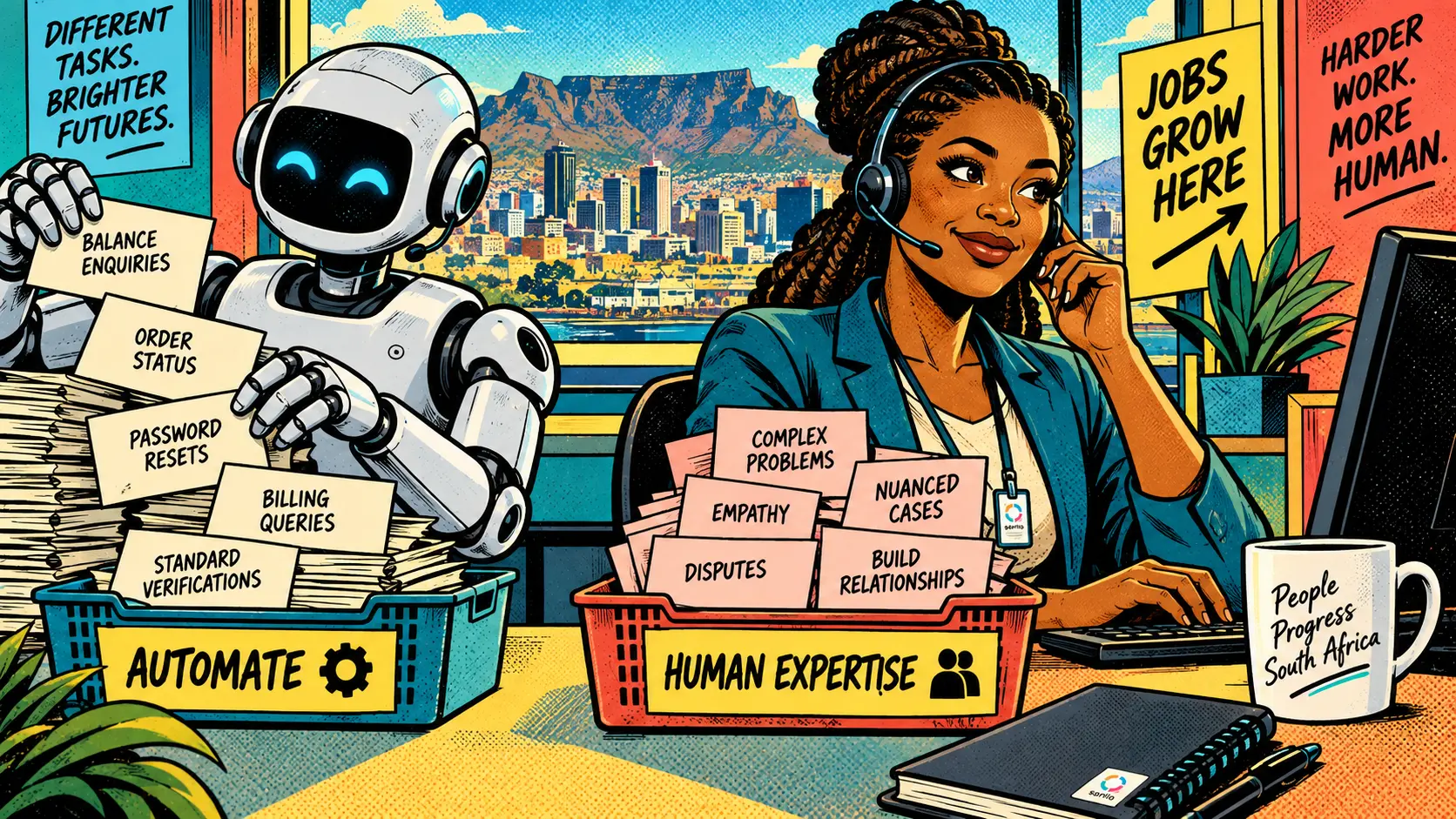
Will AI Take Call Centre Jobs in South Africa?
- Around 40% of tasks in Africa's BPO sector could be automated by 2030 - but tasks are not jobs, and only 10% of tasks are fully resilient either way.
- South Africa's GBS sector more than doubled between 2019 and 2024 and is targeting 500,000 cumulative jobs by 2030. The hiring has not stopped; Cape Town set a jobs record in 2025/26.
- Gartner's 2026 survey of service leaders found 85% expanding human agent responsibilities; only 31% have implemented or planned layoffs.
- The job that survives will be a harder, more human job - which makes who suits it a sharper question, not a softer one.
Type "call centre" into Google from South Africa and the autocomplete tells you what the country is thinking. Alongside tens of thousands of monthly searches for call centre jobs in Cape Town, Johannesburg and Durban sit a different kind of query: will AI take call centre jobs, will call centre jobs be replaced by ai, and - bluntest of all - call centre ai job fear.
The fear is not irrational. The sector is one of South Africa's few reliable mass employers of young people, and the technology aimed at it is real. But the question deserves a better answer than either the doom headline or the vendor brochure. The evidence, read carefully, says something more specific.
Will AI take call centre jobs in South Africa?
The evidence points to task change rather than wholesale job loss. Research by Caribou and Genesis Analytics for the Mastercard Foundation found around 40% of tasks in Africa's BPO sector could be automated by 2030, but only 10% of tasks are fully resilient - which describes redesigned jobs, not vanished ones. Meanwhile the sector is still hiring: South Africa's GBS industry grew from 65,000 jobs in 2019 to roughly 150,000 by 2024, and Gartner's 2026 survey found 85% of service leaders expanding human agent responsibilities rather than cutting them.
Hold both halves of that answer at once, because most commentary drops one of them. Yes, a large share of what agents currently do can be done by machines. And yes, the industry doing the automating is simultaneously hiring at record rates. Both are true because a job is a bundle of tasks, and the bundle is being rebundled.
The scale of what is at stake
How many people work in South Africa's call centre and BPO industry?
South Africa's global business services sector employed roughly 150,000 people serving international markets by 2024, up from 65,000 in 2019, according to BPESA, the industry body. Harambee counts 179,362 GBS jobs created since 2010, with retention in formal employment of 84%. The sector's stated target is 500,000 cumulative jobs by 2030, announced in March 2025. Cape Town alone added a record 11,496 BPO jobs in the 2025/26 financial year. Domestic-facing centres employ tens of thousands more.
The growth is not incidental to the AI question; it is the context that changes it. Between 2019 and 2024, sector revenue nearly tripled to around US$2.91 billion, the UK share of the workforce held at 55%, and the US share grew from 1% to 33%. In the Western Cape, the industry now contributes R24 billion a year to the provincial economy - on a par with tourism. A sector in decline sheds workers when technology arrives. A sector growing at this rate absorbs technology into its growth.
There is a second reason the stakes are unusually high here. Around 90% of the sector's new hires over the past decade have been young people, and more than 30% came from households where nobody held a job. That is impact sourcing, and it means the AI question in South Africa is not only an operational question. It is a question about the country's most effective ladder out of youth unemployment - a subject with its own article.
What the machines will actually take
Which call centre tasks will AI automate first?
The routine and the repeatable: balance enquiries, order status, password resets, simple billing queries and standard verifications. Gartner predicts agentic AI will autonomously resolve 80% of common customer service issues by 2029. The Mastercard Foundation research found customer experience roles - 44% of Africa's BPO employment - face automation of roughly half their current tasks, and more than half of entry-level tasks are automatable. What resists automation is the other half: ambiguity, emotion, judgement, escalation and any conversation where trust is the product.
Notice what that 80% prediction is a percentage of: common issues. The contacts that reach a human agent in 2029 will be, almost by definition, the uncommon ones - the distressed customer, the tangled complaint, the account that three systems disagree about, the conversation where the customer needs to be talked out of leaving. Gartner's own 2026 survey shows where operators expect the human work to go: 75% of service organisations are moving agents into new roles, concentrated in complex interactions, judgement calls and advisory work where customer trust decides the outcome.
The research firm's customer data explains why the human layer is not optional. In a Gartner survey of 5,801 US customers, 54% said they trust a human agent more than AI for recommendations; 32% said the reverse. An earlier Gartner survey of 5,728 customers found 64% would prefer companies did not use AI in customer service at all, and 53% would consider switching to a competitor over it. Whatever the technology can do, the market has a view about what it wants.
The contacts that reach a human agent in 2029 will be, almost by definition, the uncommon ones.
The experiment that already ran
What happened when companies replaced call centre agents with AI?
The best-documented case is Klarna. In February 2024 the fintech announced its AI assistant was doing the work of 700 agents, handling 2.3 million chats in its first month. By May 2025 the company reversed course and began recruiting human agents again, with CEO Sebastian Siemiatkowski conceding that cost had been too dominant a factor and the result was lower quality service. The lesson most operators have drawn is that AI removes contacts, not the need for people who can handle the contacts that remain.
Klarna matters because it was the strongest possible version of the replacement thesis, run in public, by a company with every incentive to make it work. The announcement travelled around every boardroom in the industry; the reversal travelled rather less far, which is why it is worth quoting the CEO directly: "As cost unfortunately seems to have been a too predominant evaluation factor when organizing this, what you end up having is lower quality," and "really investing in the quality of the human support is the way of the future."
South African operators watched the same experiment. The view from inside the local industry has been consistent since the generative AI wave began: the technology automates the repetitive layer while the human layer moves up in value. That position is now backed by the direction of hiring - Gartner found 63% of service organisations reducing frontline headcount gradually through natural attrition where they reduce it at all, and only 31% implementing or planning layoffs through early 2027.
None of this makes the risk zero. The Mastercard Foundation research is clear that entry-level tasks are the most exposed, that roles held by women are 10% more susceptible on average, and that the transition needs deliberate reskilling rather than optimism. South Africa's answer - the GBS Skills Strategy 2025-2030 and a sector-wide push toward what Harambee calls complex, empathy-led customer experience work - is examined in the impact sourcing companion piece.
The question inside the question
Strip the fear out of will AI take my job and a more practical question is left underneath: what will the job become, and will it suit me when it does?
The evidence sketch of the surviving role is consistent: fewer routine contacts, more difficult ones; less script, more judgement; more sustained emotional labour per hour, because the easy calls that used to give an agent breathing space are exactly what the machines absorb. For some agents that is a promotion in all but name. For others it is a redesign of the job into the shape they least prefer - and the sector's attrition problem is already a fit problem before AI sharpens it.
This is the layer where we work. Sariio MAPS reads how each person prefers to work - contact load, structure, pace, autonomy - from a twelve-minute survey retaken at least twice a year, so a centre can see which people are energised by the harder, more human work the AI era leaves behind, and which teams are drifting away from the work they now have. Not a verdict on anyone; a map of where the redesigned job and the people doing it actually stand. As the routine layer automates, that visibility stops being a nice-to-have and becomes the workforce plan.
The machines are coming for the tasks. The people question - who thrives on what remains - is the one South Africa's operators can act on now.
The companion pieces: the capability evidence is in can AI replace a call centre agent; the impact sourcing stakes are in does AI threaten impact sourcing; the retention picture is in why call centre agents really quit. For contact centre leaders: Sariio for contact centres.
Sources
- Caribou & Genesis Analytics / Mastercard Foundation (2025), '40% of tasks in Africa's growing tech outsourcing sector may be affected by AI by 2030' - task automation shares, entry-level exposure, gender gap
- BPESA (2025), 'BPESA reveals aggressive 500K job plan for South Africa's GBS sector' - sector employment, revenue, source markets, impact sourcing shares
- Harambee (2026), 'Building the youth economy in SA: services, skills, and the AI transition' - GBS jobs since 2010, retention, empathy-led CX positioning
- Gartner (2026), '85% of service and support leaders are expanding human agent responsibilities' - workforce direction, layoff figures, trust data
- Gartner (2025), 'Agentic AI will autonomously resolve 80% of common customer service issues by 2029' - the 80% prediction
- Gartner (2024), '64% of customers would prefer that companies didn't use AI for customer service' - customer preference and switching risk
- CX Dive (2025), 'Klarna changes its AI tune and again recruits humans for customer service' - the 700-agent claim and the reversal, with CEO quotes
- CapeBPO / Outsource Accelerator (2026), 'Cape Town's BPO sector adds a record 11,496 jobs' - Cape Town jobs record and Western Cape economic contribution