“That explains a few things.”
A myMAP puts work preferences into words. Read it with curiosity. What do you recognise? Where does the situation make a difference?
Explore a sample myMAP ↗ sariio
Free survey
sariio
Free survey
EDUCATION / UNIVERSITIES · COLLEGES · SCHOOLS · TRAINING
We do our best work when we play to our preferences.
Every day’s a school day.
For the people who teach, the people who learn, and the people who make education happen.
“We’re all learning.”

Illustrative scene
01 / THE PEOPLE WHO MAKE EDUCATION HAPPEN
Teaching, research, administration and leadership all depend on people working together. Start with the people in your team and a conversation about what helps each of you do your best work.
A myMAP puts work preferences into words. Read it with curiosity. What do you recognise? Where does the situation make a difference?
Explore a sample myMAP ↗Compare two myMAPs when both people agree. Use the differences to discuss something practical: preparing a meeting, giving feedback or sharing a task.
Explore a sample comparison ↗cultureMAP brings collective preferences into view. Use the heat map and narrative as a starting point for leadership discussion. The facilitated change layer follows a Culture Blueprint with David.
Explore a sample cultureMAP ↗02 / STUDENTS, COHORTS AND SHARED WORK
An induction, a group project, a training programme. People arrive with different ways of approaching the work. Give them a way to talk about those differences and decide what to try together.
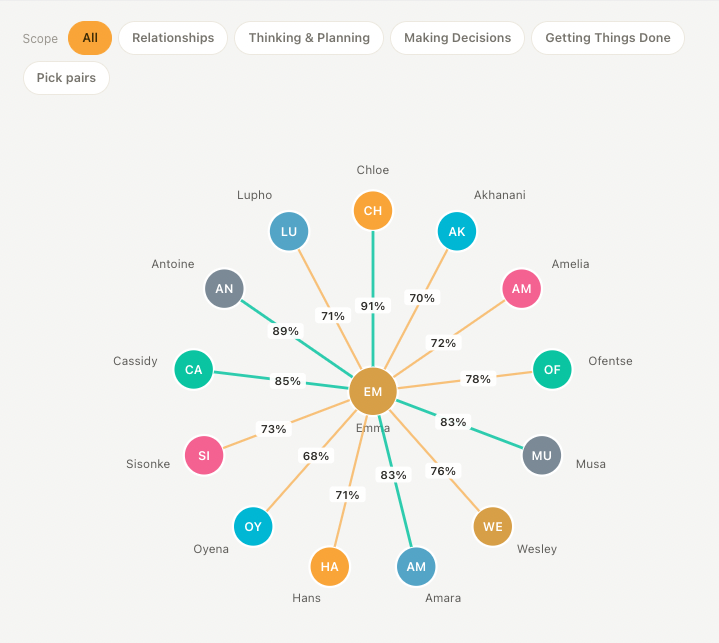
Illustrative report preview. Ask David to explore a cohort example with you.
Explore CircleMAPS with David ↗For example: share the brief before meeting, leave thinking time, and agree when everyone will contribute.
Read the thinking behind this approach ↗Coach supports a structured development conversation informed by the person’s work preferences. Students can explore a challenge and choose a next step, with trainers or mentors supporting the wider learning journey.
Read about agency and development ↗A Circle explores connections between members of a chosen group. It offers another way to discuss where preferences meet and differ, alongside the cohort view in CircleMAPS.
Explore an interactive sample Circle ↗Live samples open in a new tab, keeping this page available. Samples illustrate the tools; they are not student records.
03 / ALREADY IN PRACTICE
At Shadow Global, Sariio is used by students, trainers, senior leaders and recruiters.
These are examples of current use, rather than measured claims about attainment or retention.
“For us to be sustainable, it's this kind of continuous improvement that would really support us. Sariio is an incredible tool.”
04 / PLAYFUL ON THE PAGE. CONSIDERED IN THE THINKING.
Why does working together need practice? What does agency mean when there is still a task to complete? Explore the research, the practical possibilities and the limits of what we can claim.
A shared task needs shared expectations. Research on collaborative learning and team learning offers useful starting points for a cohort conversation.
Read: Learning to work together ↗Choice, challenge and connection belong together. How work preferences can inform a development conversation without becoming a label.
Read: Student agency and development ↗05 / START WITH YOUR PEOPLE
Education and training
Platform access for staff teams and student cohorts, shaped around your institution’s size and programme calendar.
Talk to David about educational access ↗myMAP is free forever, for everyone.
Talk with David about platform access for your staff team or adult student cohort. We can discuss programme length, students joining and leaving, and the support your facilitators need.
For schools, our starting point is staff development. Use with under-18s requires a separate suitability and safeguarding review.
Participation and sharing should be voluntary. Sariio explores work preferences; it does not grade ability or assign learning styles.
Try your own free myMAP ↗About 12 minutes. Free, always.