 sariio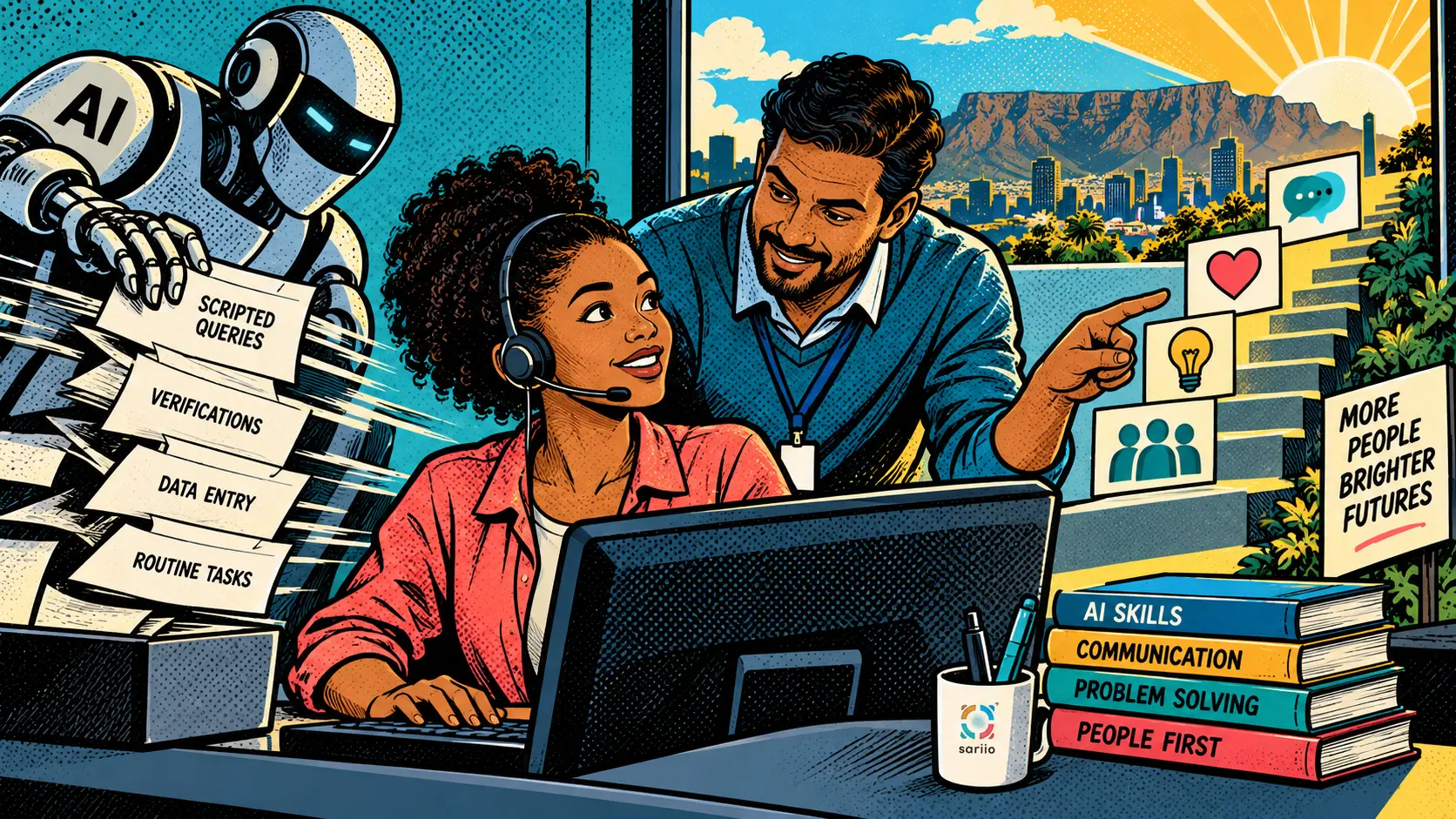
Does AI Threaten Impact Sourcing? The Question Facing South African BPO
- The collision is real: impact sourcing runs on entry-level roles, 68% of the African BPO workforce is entry-level, and more than half of entry-level tasks are automatable.
- The jobs are still growing anyway - record hiring in Cape Town, a 500,000-job national target, and 85% of service leaders worldwide expanding human roles.
- The sector's bet: redesign the first rung around empathy-led, judgement-heavy work, with a national skills strategy behind it.
- The overlooked evidence: AI helps novices most (~35% productivity gains) - which makes it a potential accelerant of impact sourcing, not just a threat to it.
Two facts about South African BPO are both true, and they are on a collision course.
Fact one: the sector has built the world's most successful impact sourcing model - 90% of its new hires are young people, over 30% from households where nobody held a job - and that model runs on entry-level roles, because a first rung is precisely what a first-time worker needs.
Fact two: entry-level roles are what AI automates first. Not senior analysts, not team leaders - the scripted, repetitive, learnable-in-a-fortnight tasks that make a job accessible to someone with no work history.
A country with 52.43% youth unemployment has more riding on how this collision resolves than any other BPO destination on earth. So it is worth being unusually careful about what the evidence actually says.
Does AI threaten impact sourcing jobs in South Africa?
It threatens the current shape of them. Research by Caribou and Genesis Analytics for the Mastercard Foundation found more than half of entry-level BPO tasks are automatable, and entry-level roles - 68% of the African sector's workforce - are precisely where impact hires start. But the jobs themselves are still multiplying: Cape Town added a record 11,496 BPO jobs in 2025/26 and the sector targets 500,000 by 2030. The realistic reading is that AI threatens the first rung as currently designed, and the sector's response is to redesign it rather than remove it.
The anatomy of the threat
Why are entry-level BPO jobs most at risk from AI?
Because entry-level work is deliberately built from the most routine tasks - the scripted queries, standard verifications and repetitive processing that let a first-time worker learn the job - and routine is what AI automates best. The Mastercard Foundation research puts customer experience roles, 44% of Africa's BPO employment, at roughly 50% task automation, with more than half of entry-level tasks automatable and tasks done by women 10% more exposed than those done by men. The very simplicity that made these roles accessible to excluded workers is what makes them automatable.
Sit with that last sentence, because it is the whole dilemma in one line. Impact sourcing works by lowering the entry bar: take someone with a matric certificate and no work history, give them a script and a queue of simple contacts, and let competence compound. Every design choice that lowered the bar - the script, the simplicity, the repetition - is also a design choice that makes the work machine-shaped. The model's greatest strength and its AI exposure are the same feature.
The gender finding sharpens it further. Women are more than 65% of South Africa's GBS hires, and the research finds tasks done by women 10% more susceptible to automation on average. Unmanaged, the AI transition would not fall evenly; it would fall hardest on exactly the people the model was built to reach.
The sector's answer
How is South Africa's BPO sector responding to AI?
By trying to move up the value chain with its people rather than without them. BPESA launched a GBS Skills Strategy for 2025-2030 to build an AI-ready workforce, and in July 2026 published a practical guide with Harambee to keep intentional impact hiring standard while roles change. Harambee's analysis argues South Africa should specialise in complex, empathy-led customer experience work - the layer AI handles worst. Gartner's 2026 data supports the direction: 85% of service leaders are expanding human agent responsibilities, and only 31% have implemented or planned AI-related layoffs.
The strategy has a genuine insight at its centre. South Africa never won BPO work by being the cheapest - India and the Philippines undercut it - but by being the destination buyers trust with complicated, emotionally loaded conversations: collections, retentions, insurance claims, vulnerable customers. That is why enterprise leaders in the US and Australia rank it their first-choice offshore CX destination. If AI hollows out the routine layer globally, the work that remains - the difficult, human layer - is the work South Africa was already best at. On that reading, AI does not erode the country's niche. It erodes everyone else's.
The timing evidence, so far, backs the optimists. The Klarna reversal showed what happens when a company bets fully on replacement: the CEO conceded lower quality and began rehiring humans. Global service leaders are redeploying agents into judgement-heavy roles, not marching them out. And the hiring numbers - Cape Town's record year, the sector's tripled revenue since 2019 - describe an industry absorbing the technology while growing.
If AI hollows out the routine layer globally, the work that remains is the work South Africa was already best at.
The evidence nobody puts in the headline
Can AI and impact sourcing coexist?
Yes, and the strongest evidence is that AI helps novices most. The Quarterly Journal of Economics field study of 5,172 agents found generative AI assistance lifted new and lower-skilled agents' productivity by around 35% - compressing months of learning into weeks - while cutting turnover by 8.6 percentage points. For impact sourcing, whose whole premise is taking people with no work history and making them productive fast, a technology that accelerates exactly that is an ally in the right hands. Coexistence depends on deploying AI behind new workers rather than instead of them.
This finding deserves more attention in the South African debate than it gets. The hardest, costliest phase of impact sourcing is the beginning: a new hire with no workplace experience, learning systems, customers and confidence simultaneously, at real risk of leaving in the first 90 days. The QJE study describes a technology that whispers the accumulated craft of the best agents into that new hire's ear from day one - and measurably keeps them in the job longer. Deployed that way, AI does not compete with the impact hire. It de-risks them.
Which resolves the collision, at least in principle. The threat version of AI and the ally version of AI are the same technology under different management decisions. Automate the routine and assist the human on what remains, and the first rung survives in a new form: smaller queues, harder conversations, a machine copilot, faster progression. Automate with cost as the only criterion, and South Africa inherits the Klarna result at national scale - with 8.8 million young people already outside the economy as the stakes.
What the redesigned rung requires
There is one requirement of the empathy-led strategy that appears in none of the strategy documents, and it is the one we would add.
If the entry-level job is rebuilt around what machines cannot do - sustained emotional labour, judgement, difficult conversations - then who suits the job changes, and the sector's ability to see who suits it becomes the binding constraint. The old first rung was forgiving: almost anyone could learn a script. The new first rung is not: an all-difficult queue energises some people and grinds others down, and the difference is invisible on a CV, in an assessment centre score, or across a cohort of first-time workers with no track record to read.
That is a preference-visibility problem, and it is the one Sariio MAPS addresses: a twelve-minute survey, retaken at least twice a year, mapping how each person prefers to work - contact load, pace, structure, autonomy - so that operators redesigning roles around human strengths can see where each person's strengths actually sit. Impact sourcing proved talent is evenly distributed even where opportunity is not. The AI era adds a corollary: so is the shape of talent, and the operators who can read it will build the redesigned rung fastest.
Does AI threaten impact sourcing? It threatens the version that treats people as interchangeable script-followers. The version that reads its people and puts the machine behind them has, on the current evidence, the strongest tailwind in the industry.
The companion pieces: what impact sourcing is and why South Africa leads is in what is impact sourcing; the wider jobs question is in will AI take call centre jobs in South Africa; the replacement evidence is in can AI replace a call centre agent.
Sources
- Caribou & Genesis Analytics / Mastercard Foundation (2025), '40% of tasks in Africa's growing tech outsourcing sector may be affected by AI by 2030' - entry-level share and exposure, CX task automation, gender gap, recommendations
- Harambee (2026), 'Building the youth economy in SA: services, skills, and the AI transition' - youth unemployment, NEET figures, empathy-led CX strategy
- BPESA (2026), 'South Africa unveils GBS Skills Strategy 2025-2030' - the national skills response
- Outsource Accelerator (2026), 'South Africa's GBS sector bets on impact sourcing' - the BPESA/Harambee practical guide
- CapeBPO / Outsource Accelerator (2026), 'Cape Town's BPO sector adds a record 11,496 jobs' - the hiring record
- Brynjolfsson, E., Li, D. & Raymond, L. (2025), 'Generative AI at Work', Quarterly Journal of Economics 140(2); summary at NBER Digest - novice gains and turnover effect
- Gartner (2026), '85% of service and support leaders are expanding human agent responsibilities' - redeployment over layoffs
- CX Dive (2025), 'Klarna changes its AI tune' - the replacement experiment and reversal