 sariio
Why the Only Winning Move Is to Leave the Circle
- Mature markets are circles: share gains provoke response, differentiation exhausts, acquisition costs rise. The circle rewards scale, not innovation.
- Nokia was the world's largest phone maker in 2008. Blockbuster had nine thousand stores in 2004.
- The testing industry is a textbook circle - the same architecture since the 1940s, defended by accreditation economics.
- The 70/20/10 rule is the practical takeaway: fund the cash cow, the deeper work, and the bets - build the new boat while the old one floats.
Every mature market has the same shape - a circle. The companies that changed the world didn't win inside it. They left. This article is about the economics of why, and about an industry where nobody has said it plainly until now.
The circle
I've been drawing this diagram for clients for years - long before Sariio existed, back when I was advising other people's brands on how to grow. The conventional market sector of any product or service looks the same. A pie chart. Your slice is your market share. Every other slice belongs to a competitor. And the arrows all point inward.
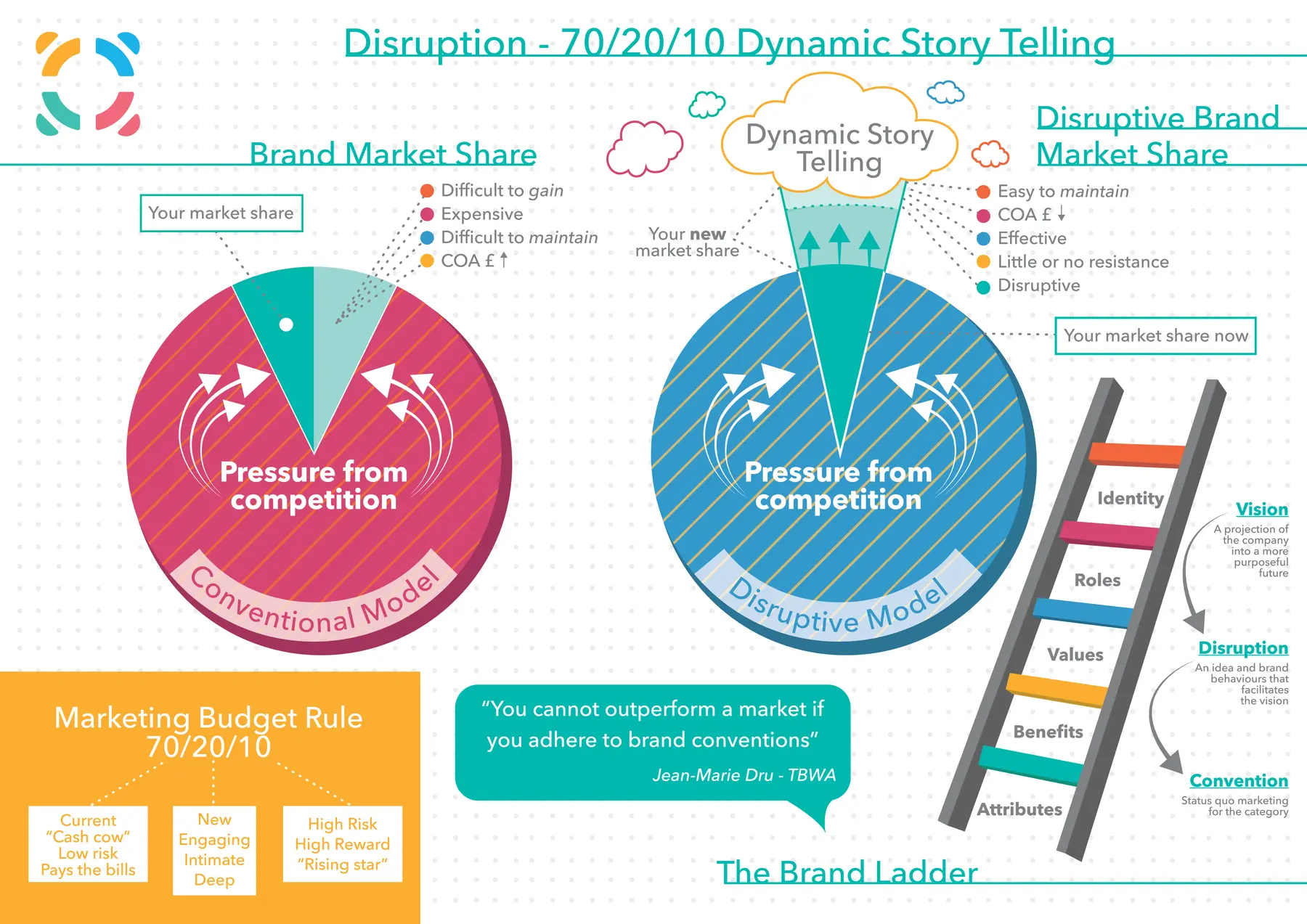
The economics of fighting inside the circle are brutal, and they get worse over time:
Difficult to gain. Share has to come from somewhere. Every point you win, a competitor loses - and they notice. The response is immediate: a price cut, a feature match, a campaign. You gained a point; now you have to defend it while gaining the next one. The cost compounds.
Expensive. Customer acquisition costs rise as the market matures. The easy wins - the customers who were looking for exactly what you offer - get taken early. What's left is persuasion, and persuasion costs money. Bigger advertising budgets win. Visibility goes to the highest bidder. If you're a small player in a mature market, the maths is against you before you start.
Difficult to maintain. This is the bit that gets you. Gaining share is expensive; keeping it is a treadmill. The moment you stop spending, the pressure from competition pushes your slice back. Tit-for-tat escalation is the default mode of a conventional market. Your competitor matches your offer. You match theirs. The margins compress. Nobody wins; everybody spends.
COA rising. Cost of acquisition trends upward structurally in a mature market. Not because anyone is doing anything wrong - because the circle is running out of room. Differentiation is exhausted. The products look alike, the promises sound alike, the prices converge. What's left is spend.
The result is a race to the bottom. Not always on price - sometimes on features, sometimes on credentials, sometimes on sheer volume of noise. But always downward. The circle rewards scale, not innovation. And the longer you stay inside it, the harder it is to imagine that there's anywhere else to be.
The people-testing circle
I know this circle intimately, because I sat inside it for years before I understood what I was looking at.
The psychometric testing industry is a textbook conventional market sector. The instruments are different - MBTI sorts you into sixteen types, DISC gives you four, Insights Discovery gives you colours, Hogan gives you scales - but the architecture is identical. A questionnaire. A normative database. A certified practitioner. A report. The conventions have been in place, with minor variations, since the 1940s.
And the fighting happens on exactly the terrain you'd expect: validity and reliability. Our factor structure is stronger than theirs. Our norms include more people. Our retest coefficient is tighter. Our accreditation programme is more rigorous. The BPS registers us. The EFPA certifies us.
Here's what gets me about this. Validity and reliability are the language of the convention. When you fight on that terrain, you've already accepted the convention's rules. You're arguing about whose box is better built, while the question nobody asks is whether people should be put in boxes at all. The sector's entire intellectual apparatus - the technical manuals, the norming studies, the accreditation standards, the peer-reviewed papers (many of them published by the instrument publishers themselves) - reinforces the architecture rather than questioning it.
And the economics of the circle apply perfectly. The cost of competing is high - accreditation programmes, normative databases, technical reports, BPS registrations, all of which must be maintained, updated, and defended. The cost of acquisition is rising - every HR director has already been sold a personality test; selling them another one means unseating the incumbent, which means matching their evidence base and their infrastructure, which means years and millions. Small gains come at enormous cost. And the whole thing is, structurally, a race to the bottom - because the instruments, for all their surface differences, are converging on the same architecture and the same claims.
The convention feels permanent from the inside. That's the thing about circles. But it isn't permanent. It's just expensive to question.
Leaving the circle
Now look at the other side of the diagram.
The disruptive model isn't a bigger slice of the same pie. It's a different shape entirely - a funnel opening upward, expanding into space that didn't exist before the convention was questioned. Your market share isn't taken from a competitor's slice. It's new. And the economics reverse:
Easy to maintain. You defined the rules of the new category. There's nobody to defend against, because nobody else is playing your game yet. The energy that used to go into tit-for-tat escalation goes into building.
COA falling. You're not bidding against mature-market incumbents for the same customers. The customers who come to you are coming because the category you've built solves a problem the convention couldn't - and they don't need to be persuaded away from the convention, because the convention was never going to give them what they wanted.
Effective. The product solves the problem differently, not just better. That's the distinction. "Better" is a comparison - it accepts the convention's criteria and claims to beat them. "Different" is a departure - it asks whether the convention's criteria were the right ones to begin with.
Little or no resistance. The incumbents aren't competing for your space. They can't - their infrastructure, their revenue model, their accreditation programmes, their entire business logic is built for the circle. Leaving the circle would mean dismantling the thing that pays their bills. So they stay. And you build.
Disruptive. The market you're building didn't exist before. That's not a marketing claim - it's the definition.
The people who saw it first
The pattern didn't start with tech companies. Howard Gossage saw it in the 1960s, running an advertising agency out of a converted San Francisco firehouse with fewer than thirteen staff. At a time when the advertising convention said scale wins - bigger agencies, bigger budgets, bigger reach - Gossage walked the other way. "Nobody reads advertising," he wrote. "People read what interests them; and sometimes it's an ad." He rejected the convention's rules entirely: don't spend more, be more interesting. Don't shout louder, say something worth hearing. Advertising Age ranked him twenty-third among the century's hundred most influential advertising people. He died in 1969, and the industry is still catching up.
Rory Sutherland, Vice Chairman of Ogilvy UK, has spent the last two decades making a version of the same argument from inside one of the world's largest agency networks. His book Alchemy (2019) is built on a single disruptive premise: the opposite of a good idea can also be a good idea. Sutherland's point is that the convention - optimise, measure, rationalise - misses the psychology. "A flower is simply a weed with an advertising budget," he writes. The product didn't change. The frame changed. That's the disruption. Not a better answer to the same question, but a better question.
Jean-Marie Dru, whose Convention→Disruption→Vision framework organises this entire series, has been saying it since 1992: "You cannot outperform a market if you adhere to brand conventions." Gossage proved it by instinct. Sutherland proved it by psychology. Dru gave it a structure. The lesson is the same in every case: the circle is a choice, not a destiny.
The companies that left
Apple didn't build a better Nokia. That's worth saying plainly, because the story gets told as "Apple won the smartphone war," and it didn't. There was no war. Apple built a pocket computer that happened to make calls, and the mobile-phone market - the entire circle of handset manufacturers competing on call quality, battery life, form factor, and carrier deals - became a footnote. Nokia's market share was intact right up until the moment it was meaningless. They were the world's largest phone manufacturer in 2008. By 2013 they'd sold the division to Microsoft. The circle didn't shrink. It became irrelevant.
Netflix didn't open better video shops. Blockbuster's circle was physical retail - late fees, local footprint, shelf space, Friday-night footfall. Inside that circle, Blockbuster was dominant. They had nine thousand stores at their peak in 2004. They saw Netflix coming - they even launched their own online service. But their business model, their real estate, their staff, their P&L, everything was built for the convention. They tried to innovate inside the circle. The circle held them. By 2010 they'd filed for bankruptcy. Blockbuster employed good people who were good at what they did. The convention was the problem, not the people.
Uber didn't compete for share inside the cab market. The black-cab convention - the Knowledge, the years of study, the spatial memory, the service pride - is a genuinely extraordinary thing. The skill is real. But the convention's architecture - licensing, fixed pricing, street hail as the primary booking mechanism, no dynamic routing - was the constraint, not the differentiator. Uber built outside it. The skill survived. The architecture didn't.
The pattern is the same in every case. The companies that changed the world didn't fight for a bigger slice. They drew a different shape.
The brand ladder
There's a model that fits alongside Dru's, and the two together are more useful than either alone.
The brand ladder - Kevin Lane Keller's framework from Strategic Brand Management (1998) - runs from the concrete to the aspirational: Attributes at the bottom, then Benefits, Values, Roles, Identity at the top. Most brands operate on the bottom rungs - competing on attributes and features. That's the convention's natural habitat. "Our instrument has a retest reliability of .82." "Our norms include 50,000 respondents." "Our accreditation takes three days." All attributes. All inside the circle.
Dru's Convention→Disruption→Vision maps onto the ladder precisely. Convention is status-quo marketing for the category - the bottom rungs, attributes and benefits. Disruption is the idea and the brand behaviours that facilitate the vision - the middle rungs, where you start to talk about values and purpose rather than features. Vision is the top of the ladder: a projection of the company into a more purposeful future. Identity. Who you are when the features stop mattering.
The people-testing industry lives on the bottom two rungs. The debates are about attributes (reliability coefficients, factor structures, normative sample sizes) and benefits (better team conversations, improved self-awareness). Nobody in the industry talks at the top of the ladder - about what the world looks like when people are read in their own language, when they own their own data, when the measurement moves with them instead of freezing them in place.
That's where the vision sits. And that's where the competition is zero.
The 70/20/10 rule
One practical tool before we close. Most businesses can't leap to full disruption overnight - the convention pays the bills, and bills are real.
The 70/20/10 budget rule - widely adopted as an innovation framework, notably by Google (described in Eric Schmidt and Jonathan Rosenberg's How Google Works, 2014) and by Coca-Cola under Jonathan Mildenhall's Content 2020 strategy - is a way to fund the vision from the convention while you build outside the circle. Seventy per cent of your resource goes to the current cash cow - low risk, pays the bills, keeps the lights on. Twenty per cent goes to new, engaging, deeper work - the kind that starts to move up the brand ladder. Ten per cent goes to the high-risk, high-reward bets - the rising stars, the category-creating moves that don't have a business case yet because the category doesn't exist yet.
The discipline is in the allocation, not the ambition. You don't need to burn the boats. You need to build the new boat while the old one still floats.
The AI accelerant
One more thing, and it might be the most important.
AI doesn't just enable better products. It lowers the cost of leaving the circle. The infrastructure that used to require a psychometrics publisher's scale - normative databases, accreditation pipelines, certified interpreters, report-generation software, the entire apparatus of the convention - can be replaced. AI reads preferences in real time, in plain language, revisited as people change. The barrier to entry for category creation in this space hasn't just lowered. It's collapsed.
The convention is still there. The incumbents are still selling. But the circle's economics are working against them now, and the AI tailwind is working for the people building outside it. The question isn't whether someone will create the preference category. It's who gets there first with something good enough to deserve people's trust.
What this means
Gossage knew it in the sixties. Sutherland writes about it now. Dru gave it a name in 1992. The testing industry has spent decades adhering to its conventions - fighting inside the circle for share, on terrain that rewards scale over innovation and credentials over honesty. The instruments look different on the surface. Underneath, they're the same architecture, serving the same assumptions, defended by the same infrastructure.
The alternative isn't a better instrument inside the circle. It's leaving the circle entirely. Preferences, not personality. The here and now, not the there and then. Plain language, not certified jargon. A reading that moves with the person, not a label that outlasts them.
People do their best work when they can play to their preferences. That's the vision. The circle can look after itself.
Questions people ask
What is the cost of competing in a mature market? In a mature market, customer acquisition costs rise structurally as differentiation is exhausted. Competitors match each other's offers, compressing margins. Bigger budgets win visibility. Small players gain share at enormous cost and struggle to maintain it. The economics favour scale over innovation.
What is category creation in business? Category creation means building a new market space rather than competing for share in an existing one. Instead of fighting incumbents on their terrain, you define new rules, new criteria, and new value. The result is a market where you have little or no direct competition - because the category didn't exist before you built it.
How did Apple, Netflix, and Uber disrupt their markets? None of them won by being better at the convention. Apple didn't build a better phone - they built a pocket computer. Netflix didn't open better video shops - they replaced physical retail with streaming. Uber didn't improve taxis - they built a different booking and routing system entirely. Each one left the conventional market circle rather than fighting inside it.
What is Jean-Marie Dru's Convention→Disruption→Vision model? A three-step strategic framework developed in 1992 by Jean-Marie Dru, Chairman of TBWA Worldwide. Convention identifies market assumptions everyone takes for granted. Disruption challenges whether those assumptions are constraints disguised as foundations. Vision describes what the world looks like when you've moved past them. Full explanation in Disruption - A Force for Good?.
Sources
- Jean-Marie Dru (1992), Convention→Disruption→Vision framework, TBWA - "You cannot outperform a market if you adhere to brand conventions"
- Howard Gossage, "Nobody reads advertising. People read what interests them; and sometimes it's an ad" - multiple attributions; Gossage died 1969
- Rory Sutherland (2019), Alchemy: The Surprising Power of Ideas That Don't Make Sense, WH Allen - the "flower is simply a weed with an advertising budget" line and the case for departing from convention
- Kevin Lane Keller (1998), Strategic Brand Management, Prentice Hall - the brand ladder/pyramid model
- Eric Schmidt and Jonathan Rosenberg (2014), How Google Works, Grand Central Publishing - Google's 70/20/10 resource-allocation rule
- Jonathan Mildenhall, Coca-Cola Content 2020 strategy - independent adoption of the 70/20/10 rule
- David Foggin, 'Disruption - 70/20/10 Dynamic Story Telling' infographic (original, pre-Sariio; author's IP) - the circle and funnel diagram this article describes
David Foggin is the founder of Sariio AI MAPS. People do their best work when they can play to their preferences.