 sariio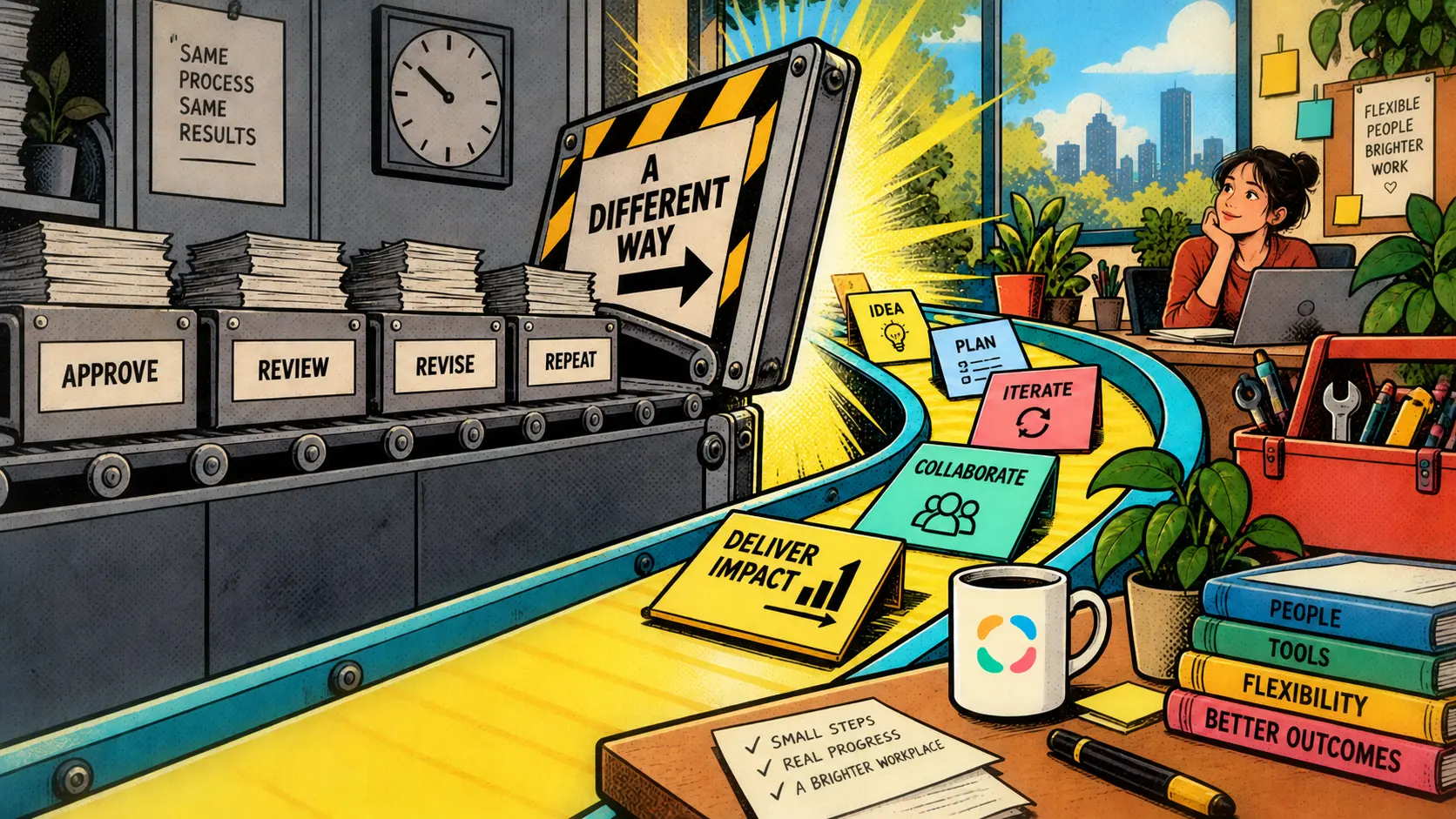
Disruption - A Force for Good?
- Dru's 1992 framework in three moves: find the convention, break it, describe the vision.
- The people-testing convention - questionnaire, type, certified interpreter, static report - has held since the 1940s.
- It persists because accreditation and consulting revenue make it expensive to question, not because the evidence supports it.
- Disruption without purpose is self-defeating. The target is the system, never the people inside it.
What a French advertising executive's 1992 framework reveals about why the people-testing industry is stuck - and what comes next.
In 1992 a French advertising executive published a full-page manifesto in Le Figaro and the Wall Street Journal. His argument was simple: you cannot outperform a market if you play by its existing rules. The framework he built around that argument - Convention, Disruption, Vision - was designed for brands and advertising campaigns. It was never meant for psychometric testing.
I borrowed it anyway. It describes what's happening to the people-testing industry more precisely than anything the industry itself has said, and it gave me the structure for an entire book and this series of articles. Here's the model, here's the man behind it, and here's why the fit is so good it's hard to believe it wasn't built for us.
Who is Jean-Marie Dru?
Jean-Marie Dru is the French advertising executive who coined Disruption as a strategic methodology in 1992. He co-founded the agency BDDP in 1984 and has chaired TBWA Worldwide, part of Omnicom, since 1998; he has written seven books on disruption and is President of UNICEF France. His three-step framework - Convention, Disruption, Vision - argues you cannot outperform a market while playing by its existing rules.
Jean-Marie Dru started in advertising in 1971, co-founded the agency BDDP in 1984, and has served as Chairman of TBWA Worldwide - one of the largest agency networks in the world, part of Omnicom - since BDDP merged into the TBWA network in 1998. He coined Disruption® as a strategic methodology in 1992 and has written seven books on the subject, from Disruption: Overturning Conventions and Shaking Up the Marketplace (Wiley, 1996) through How Disruption Brought Order (2007) to Thank You for Disrupting (2019), which profiles the business philosophies of the world's most disruptive entrepreneurs.
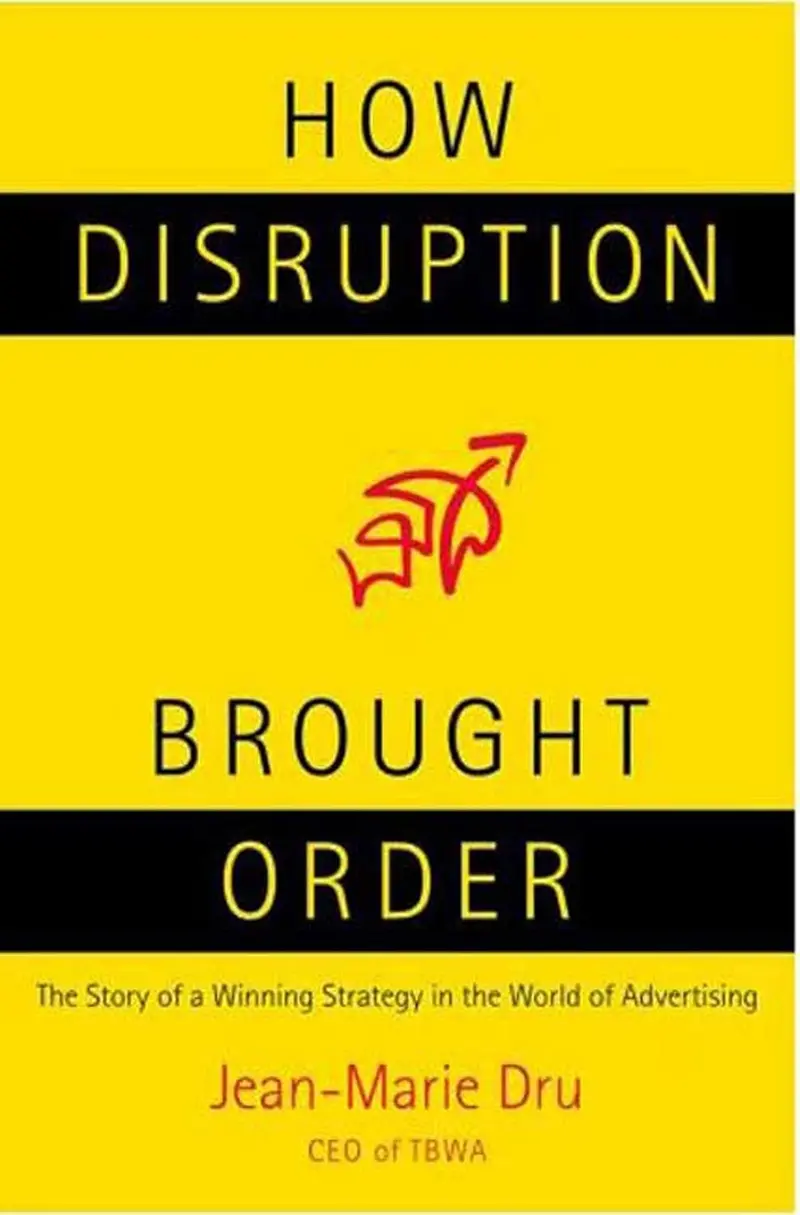
Two details matter beyond the CV. Dru is also President of UNICEF France and President of the French Academy of Medicine Foundation. This isn't a man interested only in selling things. His argument has always been that disruption, done with purpose, serves people - and that disruption without purpose is, in his words, "not only pointless but can be self-defeating." I've been sitting with that sentence for a while now. It describes how I want this body of work to land.
How I came to know the model from the inside
I should say something about how I encountered Dru's framework, because it wasn't through his books. It was through a deal.
My company at the time was called Disruption. We were doing something that the advertising industry hadn't got to yet - taking the disruption methodology beyond campaigns and market positioning and applying it to something deeper: the internal culture of a brand. The argument was that you couldn't disrupt a market convincingly if the culture behind the brand was still operating by the old conventions. The disruption had to start inside the organisation before it could be credible outside it.
John Wren, Chairman and CEO of Omnicom Group, saw that argument clearly. Omnicom had acquired TBWA in 1993, and Dru's Disruption® was already the operating methodology across the network. Wren understood that extending disruption into brand culture was the natural next step - and he agreed the deal to acquire my company on the strength of that vision.
Over lunch with Jean-Marie, we discussed how culture fitted within the framework he'd built. His first book, Disruption (1996), had laid out the Convention→Disruption→Vision model for markets and advertising. The question on the table was how that same three-step logic applied to the way organisations actually work - their internal conventions, the assumptions their people take for granted, the unwritten rules that shape behaviour long before any campaign reaches the outside world.
What struck me then - and still does - is that Dru was already thinking in the same direction. By 2007, in How Disruption Brought Order, he'd devoted an entire chapter to the argument that company culture is not a soft option but a key competitive asset. He opens it with Lou Gerstner's observation about the IBM turnaround: "Culture is just not one aspect of the game, it is the game." And Dru's own conclusion is characteristically clear: "Culture is more influential than imagination. It is our way of doing things rather than what we do, that makes the difference."
The model Dru describes is a set of concentric circles. Culture sits at the bullseye - the core of the brand. Products and services surround it. Advertising occupies the outer ring, delivering the brand promise to the world. But the promise can only be as good as the culture at the centre. If the culture is hollow, the advertising is noise. If the culture is real, the advertising barely needs to sell - it just needs to tell the truth about what's already happening inside.
That insight matters for everything in this series. The people-testing industry has spent decades operating on the outer ring - selling instruments as products, competing on features and credentials, advertising their validity and reliability. Nobody has looked at the bullseye. Nobody has asked what culture these instruments create inside the organisations that use them - what conventions they embed, what assumptions they reinforce, what they make people believe about themselves and each other.
I mention all of this not to place myself in the story - the framework is Dru's, and the credit belongs entirely to him and to the network he built. But it matters for what follows, because my relationship with the Disruption model isn't that of a reader applying someone else's theory from the outside. I worked inside it. The lens I'm applying to the people-testing industry comes from years of using Dru's framework in practice - first for other brands, now for an industry that hasn't examined its own conventions with anything like the rigour they deserve.
The three steps
Dru's model runs in three stages. They're deceptively simple, and the simplicity is the point.
Convention is what everyone takes for granted - "the existing ways of doing things," as Dru puts it. Not the written rules; the unwritten ones. The assumptions so embedded in an industry that nobody thinks to question them. Dru identified three types: marketing conventions (how the sector sells), consumer conventions (what buyers expect), and advertising conventions (how everyone in the category talks). Every mature market has them, and every mature market defends them - because conventions feel like the floor, not the ceiling.
Disruption is not destruction. The word comes from the Latin disrumpere - "breaking from." It's worth pausing on that, because the word has been kidnapped since 1992. Clayton Christensen's disruptive innovation - the theory that market entrants penetrate at the low end and move upmarket - is a specific, narrow definition. Dru's is broader: everything that is not gradual change. As he wrote in Forbes in 2015, Christensen's definition would exclude Uber from the disruptor category, which "defies logic." Dru's disruption isn't about where you enter the market. It's about whether you accept the market's conventions at all.
The disruption step asks: what if the convention itself is the constraint? Not its execution - its architecture. Not "how do we do this better?" but "why are we doing it this way at all?"
Vision is what Dru calls "a leap of imagination from the present to the future." It's the answer to the disruption question - not a better version of the convention, but a picture of what the world looks like when you've left the convention behind. Dru's counsel is that the vision should "consider the universe above them rather than the competition below." Don't build a better version of what exists. Build what should exist, and let the conventions sort themselves out.
What this looks like in people testing
The pattern I'd spent years applying to other brands' cultures turned out to describe my own industry with uncomfortable precision. When I looked at the people-testing sector through Dru's three-step lens, the picture was unmistakable.
Here's the convention: understanding how someone works requires a questionnaire that sorts them into a type, compared against a normative database, interpreted by a certified practitioner, and printed on a report that doesn't change until someone pays to re-sit the assessment. That convention has been in place, with minor variations, since the 1940s. MBTI, DISC, Insights Discovery, Hogan, the lot - different instruments, same architecture. The debates happen inside the convention: whose factor structure is stronger, whose norms are larger, whose retest reliability is tighter. Nobody questions the architecture itself.
Here's the disruption: the architecture is the problem. Typecasting people into boxes was the wrong unit of measurement - not because the people building the instruments were careless, but because the technology of the era demanded it. Paper questionnaires, hand-scored, norm-referenced - that was what was available. The result was a measurement system built on the there and then: a score frozen at the moment of testing, compared against a crowd the person never met, interpreted by someone else. The conventions surrounding it (accreditation, certification, normative databases, report-generation software) aren't flaws in the system. They are the system. And AI has made them unnecessary.
Here's the vision: preference-mapping that works the way modern software should work. Preferences read in the here and now - in the person's own language, revisited as they change, with both ends of every scale honourable, and results plain enough that the person themselves can act on them without needing an interpreter. Not a better personality test. A different category.
Disruption with purpose
Dru's Benetton case is worth knowing. In the early 1990s, Benetton's "United Colors" campaign was genuinely powerful - a vision of a world without racial hatred, expressed through provocative imagery that shattered advertising conventions. It worked. Then it escalated. Priests kissing nuns. AIDS imagery. Death-row prisoners. Each campaign more controversial than the last, each one further from the brand's strategic purpose, until the provocation became the point and the vision was lost.
"Disruption for its own sake is not only pointless but can be self-defeating." That's Dru's lesson, and it matters for everything in this series. The articles that follow - on MBTI, on DISC, on Insights Discovery, on the pseudoscience question - aren't written to burn an industry down. They're written to document a convention, explain why it persists, and describe what a serious alternative looks like when you build one properly. The frustration in this work is aimed at systems and conventions, not at the people inside them. The people inside them were responding to a real need with the best tools on the table. They deserve better tools, not contempt.
Why this model, and why now?
The convention in people-testing has had decades to reform itself. Decades of retest data showing that type assignments change on re-sit. Decades of critique from independent researchers. Decades of the publishers' own disclaimers - some of them extraordinary - advising that their instruments should not be used for the very purposes they're most often used for. The convention persists not because the evidence supports it, but because the infrastructure around it (accreditation programmes, consulting revenue, organisational habit) makes it extraordinarily expensive to question.
The disruption isn't Sariio arriving and attacking. It's AI arriving and making the convention's architecture visibly unnecessary. You no longer need a normative database when you can read preferences in real time. You no longer need a certified interpreter when the results are written in plain English. You no longer need a fixed type when you can re-read someone as they change. Sariio is what you build when you take the convention's own disclaimers seriously and ask: what would this look like if we started again?
That's the vision. And Dru's framework - Convention, Disruption, Vision - is the shape of the story this series tells.
The arc of this series
The articles in this collection, taken together, follow Dru's three-step shape. They weren't planned that way from the start, but the pattern became clear as the work accumulated - which is, I think, how genuine disruption usually works. You don't set out to follow a framework. You look up one day and realise the framework was describing what you were doing all along.
Part I - The Convention. What everyone takes for granted. The articles here examine the instruments the industry relies on - their origins, their claims, their evidence, their publishers' own words - and ask whether the assumptions behind them hold up to real scrutiny. [Has Myers-Briggs Been Debunked?] · [How Accurate Is Insights Discovery?] · [How Accurate Is a DISC Assessment?] · [Are Personality Tests Pseudoscience?] · [Personality Tests at Work: What the Evidence Says, Test by Test]
Part II - The Disruption. The break with the convention. This article introduces the framework. The articles alongside it examine what preference-based measurement looks like when you strip away the legacy architecture, and what AI makes possible that wasn't possible before. [What Are Work Preferences - and Why Do They Matter More Than Personality Type?] · [Why the Only Winning Move Is to Leave the Circle] · [Can ChatGPT Be My Life Coach?] · [Can AI Improve Employee Engagement?]
Part III - The Vision. What the alternative looks like in practice - for managers, for coaches, for organisations trying to retain good people and build cultures that work. [70% of Employee Engagement Is Down to the Manager] · [The Coach Who Knows You] · [Employee Retention Frameworks That Actually Work] · [How Should We Measure Employee Engagement?]
If you're new to this series, start anywhere - each piece stands alone. But if you want the full arc, the convention comes first, the disruption makes sense of the break, and the vision shows where the break leads.
What is Jean-Marie Dru's disruption model?
Convention, Disruption, Vision: a three-step strategic framework developed in 1992 for overturning market assumptions and building new categories. Convention identifies what everyone takes for granted, Disruption challenges whether those assumptions are constraints disguised as foundations, and Vision describes what the world looks like when you've moved past them.
How is Dru's disruption different from Christensen's?
Clayton Christensen's disruptive innovation theory describes low-end market entry that moves upmarket - a specific mechanism. Dru's disruption is broader: any departure from convention that isn't gradual. Dru's model is about strategic imagination; Christensen's is about market mechanics. Both are useful. They describe different things - and by Christensen's narrow definition Uber would not count as a disruptor, which Dru calls a sign the definition is too tight.
What is the disruption model used for?
Originally developed for advertising and brand strategy at TBWA Worldwide, the framework applies to any industry where entrenched conventions constrain innovation - including, as this article argues, the people-testing industry, where the questionnaire-type-interpreter-report architecture has held since the 1940s and persists on infrastructure rather than evidence.