 sariio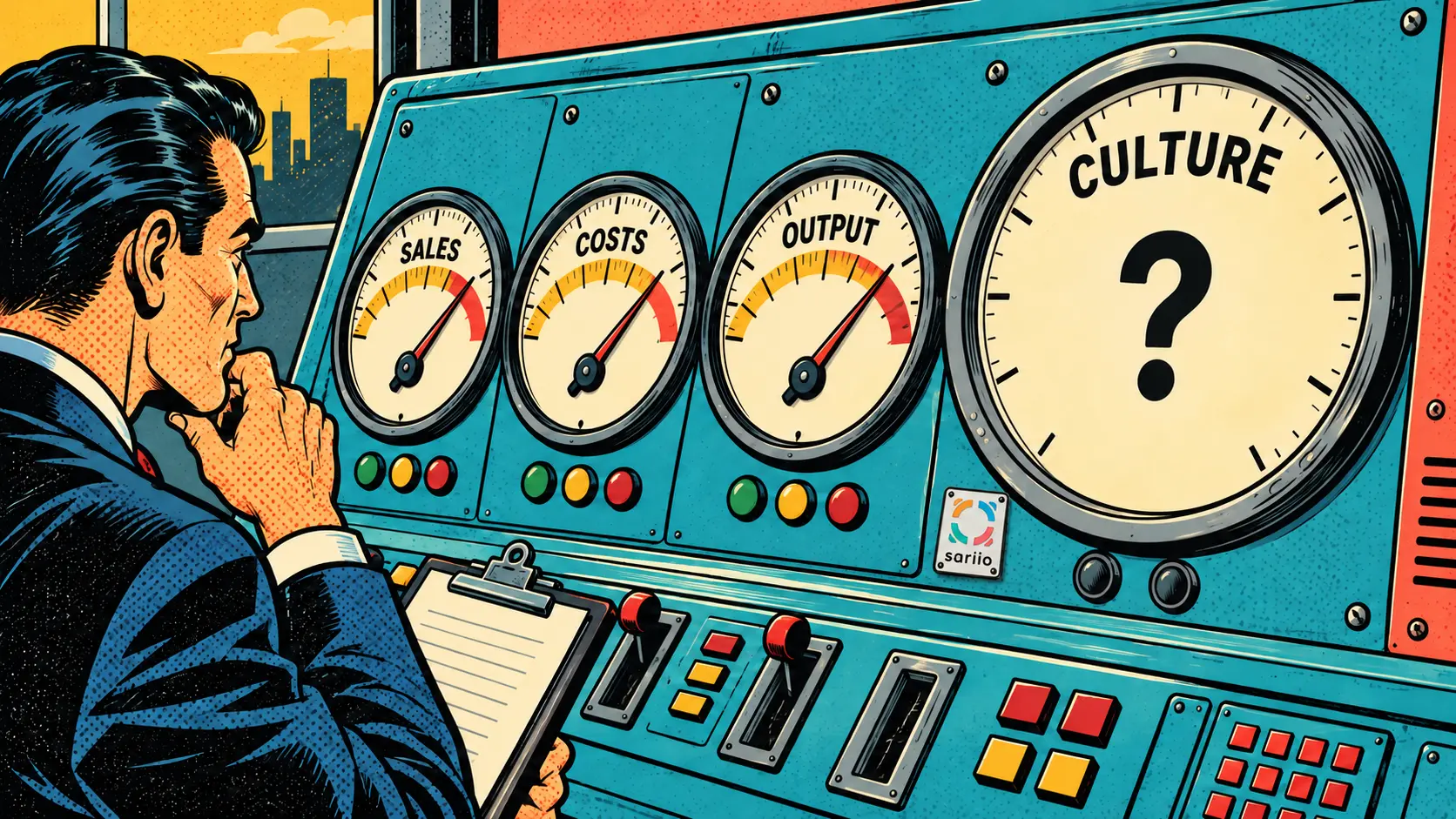
Ask a chief executive whether culture matters and you get a yes before you finish the question. Ask the same person for last quarter's culture reading and you get a pause, then an engagement score, then a values poster. That gap, between how much culture is said to matter and how rarely anyone measures culture, is the subject of this piece. The gap has a cost, and the cost has names.
Here is the finding that frames everything else. In 2022 four finance professors, John Graham, Jillian Grennan, Campbell Harvey and Shivaram Rajgopal, published the largest study of corporate culture ever run from the executive side: 1,348 senior executives surveyed and interviewed, representing a fifth of the market value of the United States. Ninety-two per cent said that improving culture increases the value of their firm. Eighty-four per cent said the culture they run needs improving. Eighty-five per cent said a poorly implemented culture makes an employee more likely to act unethically or illegally. And the authors explain, in the paper itself, why so little empirical work exists on the subject: "because culture is very difficult to measure."
Read those four sentences together. The people who run companies believe culture is the lever. They believe the culture they run is off. They believe the consequence of getting culture wrong is misconduct. And they have no instrument. If you want to change something, you have to be able to measure it first. Most organisations cannot, so most organisations do not.
Why don't organisations measure their culture?
Three barriers show up in the research. Complexity: culture lives in shared assumptions beneath awareness (Schein), so surveys of opinion measure sentiment downstream rather than the culture itself. Cost and time: changing culture is measured in years, fewer than a third of transformations both improve performance and sustain the improvement (McKinsey, 2021), and the work has been priced for large organisations. Slack: measuring and changing culture has been the preserve of organisations with the funds and the headroom to survive the process, which excludes most of the organisations losing the most people.
The rest of this article takes those three barriers in turn. Before that, the case for bothering, because the case is stronger than most boards realise.
The asset the market keeps underpricing
Start with money, because money is the language in which culture is usually dismissed.
Alex Edmans, then at Wharton and now at London Business School, asked a simple question in 2011: if you had bought the companies on Fortune's list of the 100 Best Companies to Work For, every year from 1984, how did you do? The answer, published in the Journal of Financial Economics, was an annual four-factor alpha of 3.5 per cent over 26 years, and 2.1 per cent above industry benchmarks. Compounded, that is not a rounding error; that is the difference between a fund that keeps clients and a fund that does not. The finding beneath the finding matters more: the outperformance persisted year after year, which means the market was not pricing in the intangible. Investors were able to see the list. They did not believe the list was worth money. They were wrong for a quarter of a century.
John Kotter and James Heskett reached the same place by a different road, following more than two hundred companies over eleven years and finding that culture had a measurable effect on economic performance, with the qualification that the cultures that did well were the ones that fitted the strategy and adapted. Denison linked measurable cultural traits to sales growth, return on equity and satisfaction. The research is not thin. The research is forty years deep, and the conclusion has not moved.
Then look at the other side of the ledger. In 2022 Donald Sull and Charlie Sull analysed 34 million online employee profiles and more than 1.4 million Glassdoor reviews to find out what actually predicted who left during the Great Resignation. Pay came a long way down the list. A toxic culture was 10.4 times more powerful than compensation in predicting attrition. The elements that made a culture toxic were specific: a failure to promote diversity, equity and inclusion, workers feeling disrespected, and unethical behaviour. People do not leave for money as often as leaders believe. They leave the way they are treated.
Is a good culture really worth money?
Yes, and the market underprices it. Edmans found that the 100 Best Companies to Work For earned an annual alpha of 3.5 per cent from 1984 to 2009, 2.1 per cent above industry benchmarks, and that the stock market did not fully value the intangible (Journal of Financial Economics, 2011). Kotter and Heskett tied culture to economic performance across more than two hundred companies over eleven years. Sull and Sull found a toxic culture 10.4 times more predictive of attrition than compensation (MIT Sloan Management Review, 2022).
So culture is the asset that keeps paying out, or keeps charging, for decades, and the market is slow to see either. A brand can be relaunched in a season. A culture compounds. Which brings us to the part of the argument that is usually left polite.
People do not leave for money as often as leaders believe. They leave the way they are treated.
Toxic, with a court attached
The word toxic is thrown around so freely that the finding above, 10.4 times, needs anchoring in cases where the judgement was made by someone with subpoena power. Three will do. None of these verdicts is Sariio's; every one is a regulator's, a board's independent counsel, or a statutory inquiry's.
Wells Fargo. Between 2002 and 2016 employees of one of the largest banks in the United States opened accounts customers had not asked for, in order to meet sales targets. The bank's own review put the number at about 3.5 million accounts. In February 2020 Wells Fargo agreed to pay $3 billion to resolve criminal and civil investigations by the Department of Justice and the Securities and Exchange Commission. The Justice Department's account of the case was explicit about mechanism: the conduct flowed from sales pressure set at the top and enforced down the line. That is a culture, measured after the fact, by prosecutors.
Uber. In June 2017 Uber's board published the findings of an investigation led by the former US Attorney General Eric Holder into the company's workplace. The Holder report made 47 recommendations, including rewriting the company's cultural values, creating board oversight of conduct, and limits on the behaviour that had become normal. The board adopted every one. Eight days later the chief executive, Travis Kalanick, resigned. Uber is a company that measured everything about its riders and drivers to the second, and had never measured how the company treated the people inside the building.
The Post Office. The British example is the hardest to read and the most important. Between 1999 and 2015 the Post Office prosecuted about 1,000 subpostmasters for theft and false accounting on the evidence of the Horizon computer system. In July 2025 the statutory inquiry chaired by Sir Wyn Williams found that senior Post Office employees "knew or at the very least should have known that Legacy Horizon was capable of error", and that the Post Office nonetheless "maintained the fiction that its data was always accurate" for the life of the system. The inquiry found that at least 13 people may have taken their lives, that 59 more had contemplated doing so, and that as many as 10,000 people were affected. The inquiry described the organisation's approach to compensating the people the organisation had wronged as "unnecessarily adversarial". Nobody at the Post Office set out to destroy a thousand lives. A culture did that: a culture in which the institution's data was never wrong and the people at the counter always were.
What does a toxic culture look like in practice?
Wells Fargo opened about 3.5 million unauthorised accounts under sales pressure and paid $3 billion to settle with the US Department of Justice and the SEC in 2020. Uber's 2017 Holder report made 47 recommendations on culture, values and governance, and the chief executive resigned eight days after publication. The Post Office Horizon inquiry found in 2025 that about 1,000 subpostmasters were wrongfully prosecuted while the Post Office maintained the fiction that the Horizon data was always accurate, and that at least 13 people may have taken their lives. Every one of these is a culture finding, made by a court, a regulator or an inquiry.
Three organisations, three continents of consequence, and one common thread: in each case the culture was measured only after the damage, by outsiders, at enormous cost. Each of those organisations ran an engagement survey. None of the surveys caught what the courts caught.
Empowering, with the numbers attached
The other side of the ledger is quieter, because a culture that works does not generate inquiries. The evidence has to be read from what the organisations produce.
Timpson. The British shoe-repair and key-cutting chain runs what the family calls upside-down management: the person serving the customer makes the decisions, and head office exists to support them. Around 12 per cent of Timpson's 5,000 staff either have a criminal conviction or were recruited directly from prison, at a training cost the company put at about £500,000 in a single year. The business has grown through two recessions and a pandemic on that model, and in 2024 James Timpson was appointed the United Kingdom's prisons minister on the strength of it. A culture of trust, run as a commercial strategy, in an industry with margins thin enough to punish sentiment.
Microsoft. When Satya Nadella became chief executive in 2014 he inherited a company the press had written off, and the first thing he changed was not a product. He named the culture he wanted, a growth mindset in place of a know-it-all one, and spent years enforcing the change in how people were reviewed and promoted. In January 2024 Microsoft became the second company in history to be valued at $3 trillion, with the shares up more than 1,000 per cent over his tenure. Cloud and AI did the earning. The culture change came first, and Nadella has said so at every opportunity since.
Buurtzorg. In the Netherlands, a nurse called Jos de Blok founded a home-care organisation in 2006 with no managers. Nurses work in self-managing teams of about twelve, set the rotas, and are supported by a back office of a few dozen people. By 2015 Buurtzorg employed 8,000 nurses in 700 teams caring for 65,000 patients. An Ernst and Young study found the teams met patients' needs using about 40 per cent of the authorised care hours, against an industry average of 70 per cent; KPMG found 108 hours of care per patient year against 168. Effectory named Buurtzorg the best employer in the Netherlands three years running. Ownership and responsibility, given to the people doing the work, produced better care for less money and the happiest workforce in the sector.
Notice what the three have in common. Kindness, in the plain sense of treating people as capable adults. Inclusivity, in the plain sense of bringing in people other employers turn away. Ownership and responsibility, pushed to the person doing the work, in place of blame pushed down from above. None of that is soft. Buurtzorg's numbers are harder than any consultancy's, and Timpson's margins are thinner.
A culture that works does not generate inquiries. The evidence has to be read from what the organisation produces.
Three barriers, and who they exclude
So the evidence is old, deep and one-directional, and the executives agree with the evidence. Why, then, is culture still the one thing on the balance sheet nobody weighs? Three reasons, and they compound.
Complexity. Edgar Schein, the most cited scholar in the field, described culture in three layers: the artefacts you can see, the values people espouse, and beneath both the basic assumptions that guide behaviour largely outside awareness. The values poster is layer two. The thing that made a Post Office manager trust the computer over the counter clerk is layer three, and nobody at the Post Office was in a position to write that assumption down, because assumptions at that depth are not experienced as assumptions. They are experienced as reality. An engagement survey asks people to rate the organisation, which measures sentiment downstream of the culture; two organisations can post the same score for opposite reasons, and the score alone cannot tell you which one you are running. That argument is made in full in Do employee engagement surveys work? and Organisational culture is language and behaviour.
Cost and time. Sariio brings together work-preference responses in a cultureMAP heat map and narrative. Leaders can read these alongside employee feedback, management practices and operational results. Agree the scope, subscription and any facilitated work with David before starting.
Slack. The scale of an organisation affects the cost and scope of using Sariio. A smaller organisation can discuss access and any facilitated work with David around the people involved and the question it wants to explore.
Culture measurement has been a luxury good, sold to the organisations that needed it least.
Read culture at source
Here is the turn, and the reason Sariio exists.
The three barriers are real, but they are barriers to one particular way of measuring culture: asking people what they think of the organisation, then hiring experts to interpret the answers. There is another way in, and the research pointed to the door forty years ago.
Culture is "the way we do things around here", in Marvin Bower's phrase from 1966. What people do follows what they prefer. And in 1987 Benjamin Schneider showed why the aggregate of those preferences is the culture: people are attracted to organisations that suit them, organisations select people who suit them, people who do not fit leave, and over time the people who remain shape the place. The people make the place. Measure how the people prefer to work, aggregate the readings, and the shape of the culture appears.
That is what Sariio's cultureMAP is: every person's reading of how they prefer to work, taken from a survey of about 12 minutes, aggregated and anonymised into one picture of the organisation. Nobody is asked to rate the culture. Nobody is asked to rate the boss. The picture is built from what people say about how they prefer to work, which is a question people answer more candidly than any question about the organisation that employs them. You can see one for yourself: a real, anonymised cultureMAP from a client operation is open to anyone, and Why culture can be mapped explains how the picture is built.
Now take the three barriers in turn, because a claim to cut through them is only worth making if each barrier is answered on the terms that raised the barrier.
Complexity. The barrier was that culture lives in Schein's third layer, the assumptions people cannot write down, and that surveys of opinion measure the second layer at best. A preference is not an opinion. Someone who prefers to decide quickly, or to keep options open, or to protect the task over the relationship, is describing a habit of behaviour, and a habit is what an assumption looks like from the outside. Read a few hundred of those habits together and the assumptions the organisation runs on become visible as a shape: where people cluster, where they split into camps, and where the shape sits against the strategy the leadership team describes. The reading does not name the assumption for you. The reading shows you where to look, which is more than any engagement score has ever done, and a person reads the map and decides what the shape means.
Cost and time. Sariio brings together work-preference responses in a cultureMAP heat map and narrative. Leaders can read these alongside employee feedback, management practices and operational results. Agree the scope, subscription and any facilitated work with David before starting.
Slack. The scale of an organisation affects the cost and scope of using Sariio. A smaller organisation can discuss access and any facilitated work with David around the people involved and the question it wants to explore.
Two things a cultureMAP will not do, because trust in a measurement depends on knowing the limits of the measurement. A cultureMAP will not score the culture, rank the organisation or prescribe a change: there are no good or bad regions on the map, only accurate ones, and every decision that draws on the reading is made by a person with the evidence beside them. And Sariio takes no biometric input and analyses no voice, face or video; the whole reading rests on what each person said about how they prefer to work, and chose to share.
How does Sariio measure culture without a culture survey?
Culture is what people do, and what people do follows what they prefer. Sariio reads each person's work preferences from one survey of about 12 minutes, then aggregates every reading, anonymised, into a cultureMAP: where the organisation's preferences cluster, where the organisation divides into camps, and how ready the culture is for each of Kotter's eight change accelerators. No separate culture questionnaire is issued. The reading is re-taken periodically, so the culture is measured before, during and after any change, at a fraction of the cost of a programme.
And the thing the reading shows is the thing the empowering examples share. An organisation that wants a culture of kindness, of inclusivity, of ownership and responsibility in place of blame, can now see how far the culture already leans that way, where the camps are that will resist, and which of Kotter's accelerators is warm enough for a start. Wells Fargo's sales pressure, Uber's values, the Post Office's certainty about a computer: each was a distribution of preferences a map shows, and a map is read years before a court sits.
What do you need to understand before choosing a change?
The research above shows why leaders take culture seriously. Before choosing an intervention, clarify what you need to understand and what evidence would help you decide. Work preferences can contribute to that discussion alongside other evidence; they do not establish the cause of a business outcome.
Talk to David about the culture question your organisation wants to explore.
Sources
- Graham, J.R., Grennan, J., Harvey, C.R. and Rajgopal, S. (2022), 'Corporate culture: Evidence from the field', Journal of Financial Economics, 146(2), pp. 552-593 - 1,348 executives; 92 per cent, 84 per cent, 85 per cent, 69 per cent; "very difficult to measure". Summary at the Harvard Law School Forum on Corporate Governance
- Edmans, A. (2011), 'Does the Stock Market Fully Value Intangibles? Employee Satisfaction and Equity Prices', Journal of Financial Economics, 101(3), pp. 621-640 - 3.5 per cent annual alpha, 1984 to 2009
- Kotter, J.P. and Heskett, J.L. (1992), Corporate Culture and Performance, Free Press
- Denison, D.R. (1990), Corporate Culture and Organizational Effectiveness, John Wiley & Sons. See also Denison Consulting
- Sull, D. and Sull, C. (2022), 'Toxic Culture Is Driving the Great Resignation', MIT Sloan Management Review - 10.4 times; 34 million profiles; 1.4 million reviews
- Gallup (2026), State of the Global Workplace - one in five engaged; $10 trillion
- CBS News (2020), Wells Fargo agrees to pay $3 billion settlement in fake accounts scandal; CBS News (2017), Wells Fargo says 3.5 million accounts involved in scandal
- CNBC (2017), Uber: Holder report recommendations; Fortune (2017), Uber CEO Travis Kalanick resigns
- Post Office Horizon IT Inquiry (2025), first volume of the final report, as reported by ITV News - about 1,000 prosecutions; at least 13 suicides; 59 who contemplated suicide; up to 10,000 affected; "maintained the fiction"
- Reasons to be Cheerful (2023), The UK retailer that recruits its employees from prisons - 12 per cent of 5,000 staff; £500,000 training cost
- Fortune (2024), Microsoft hits $3 trillion market capitalisation - shares up 1,006 per cent under Nadella
- Commonwealth Fund (2015), Home Care by Self-Governing Nursing Teams: The Netherlands' Buurtzorg Model - 8,000 nurses; 700 teams; Ernst and Young 40 per cent against 70; KPMG 108 hours against 168; Effectory best employer 2010 to 2012
- Schein, E.H. (2017), Organizational Culture and Leadership, 5th edn, John Wiley & Sons - artefacts, espoused values, basic assumptions
- McKinsey (2021), The science behind successful organizational transformations - 1,034 respondents; fewer than a third; 60 per cent against 12
- Kotter, J.P. (1995), 'Leading Change: Why Transformation Efforts Fail', Harvard Business Review - 70 per cent
- Bower, M. (1966), The Will to Manage, McGraw-Hill - "the way we do things around here"
- Schneider, B. (1987), 'The People Make the Place', Personnel Psychology, 40(3), pp. 437-453