Retention in the first ninety days, for BPOs and in-house contact centres.

Why do new starters leave inside ninety days?

TL;DR COPC puts around 70 per cent of a contact centre's first-year leavers inside the first ninety days (COPC, 2024), and Gallup finds only 12 per cent of US employees say their company does a good job of onboarding (Gallup, 2021). Sariio reveals how each new starter works best on day one, so the team leader knows how to open the first conversation before the first week ends. Read moreShow less

Around seven in ten leavers go inside ninety days.

COPC's research puts around 70 per cent of a contact centre's first-year attrition inside the first ninety days (COPC, 2024), and SQM Group reports the same pattern across the centres SQM surveys (SQM Group, 2023). The weeks that decide whether a new starter remains are therefore the weeks in which the team leader knows that person least.

Sariio reveals the new starter on day one.

A twelve-minute survey of work preferences, completed on the first day, reveals to the new starter how they work best and shows the team leader the same reading before the first conversation, so the manager's active part, which Gallup finds behind onboarding people call a success, begins in week one (Gallup, 2021).

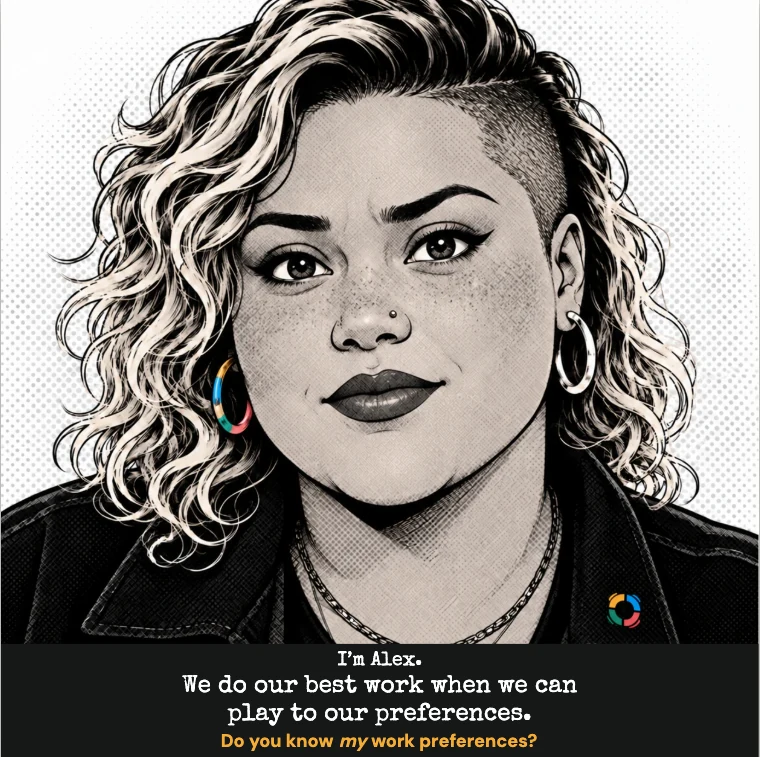
Alex, drawn in black and white with blonde curls, red lipstick and a denim jacket, on the cover of the Sariio book.
Alex, on the cover of the book behind Sariio. Open the book.

The first ninety days

New starters can leave when their team leader doesn't get them.

TL;DR Gallup finds 52 per cent of people who leave say their manager had a way to keep them, and 51 per cent say neither their manager nor another leader spoke with them about their future in their last three months (Gallup, 2019). In a contact centre, where around 70 per cent of first-year leavers go inside ninety days (COPC, 2024), those three months are the whole employment. Read moreShow less

Half of leavers say a conversation was missing.

Gallup's exit research finds 52 per cent of people who left voluntarily say their manager or organisation had a way to keep them, and 51 per cent say that in the three months before they left, neither their manager nor any other leader spoke with them about their job satisfaction or their future (Gallup, 2019). A contact-centre agent who leaves at week ten has had those same three months and nothing more.

Onboarding is where the manager matters most.

Only 12 per cent of US employees say their company does a good job of onboarding, yet people whose onboarding was exceptional are 2.6 times as likely to be extremely satisfied with their workplace (Gallup, 2021). People whose manager took an active part are 3.4 times as likely to call their onboarding a success, which is why the team leader rather than the trainer carries the first ninety days. COPC finds agents satisfied with their training twice as likely to remain for a year (COPC, 2024).

Pay is the smaller part of the reason.

Asked what matters most in a job, people put engagement and culture first at 37 per cent, wellbeing second at 31 per cent and pay third at 16 per cent (Gallup, Employee Retention and Attraction indicator, 2025), and people who use their strengths every day are 15 per cent less likely to quit (Gallup, 2015). Gallup's ranking puts engagement and culture above pay, and an agent who is understood in the first fortnight has had the first experience of both.

Nine in ten new sector jobs went to young people.

The sector added 26,346 jobs in 2025 and around 90 per cent went to young people (BPESA, 2025), in a country where Gallup records 18 per cent of employees engaged (Gallup, 2026), so for a large share of agents the first ninety days are their first ninety days in the sector, and for some the first in any job.

When a contact centre's first-year leavers go
When first-year leavers go Around 70 per cent of first-year attrition happens in the first 90 days; the remaining 275 days account for the rest. Days 1 to 90 Days 91 to 365 around 70% of the year's leavers the rest The bars show the 70 per cent share; the split of the remaining 30 per cent is not reported.

COPC, 2024; the same pattern in SQM Group, 2023.

12%of US employees say their company does a good job of onboarding
3.4×as likely to call onboarding a success when the manager takes an active part
51%of leavers say neither their manager nor another leader spoke with them about their future in their last three months

Gallup, 2021; Gallup, 2019

Alex's first week

Alex's team leader knows her on day one.

Alex could be anyone joining your floor. Her survey results are real; her name is not.

TL;DR On her first day Alex completes a twelve-minute survey of work preferences and reads her map before anyone else. Her team leader reads the same map before their first conversation, so the first week's coaching fits Alex rather than the average new starter. Read moreShow less

Alex reads her map before her team leader does.

Sariio calls her map a myMAP, a personal reading of how she works best, drawn from the survey she completed on day one. Alex sees the map first and her team leader reads the map after her, which is why she recognises herself in the conversations that follow rather than meeting a description written about her. She retakes the survey as the months pass, because preferences move with the work and the map is kept current.

Her team leader opens the first conversation her way.

Alex prefers to work a problem through on her own first, so her team leader sends the point for discussion ahead and opens by asking what Alex noticed. Gallup finds people 3.4 times as likely to call onboarding a success when the manager takes an active part (Gallup, 2021), and a team leader who knows this about Alex in week one is taking that part from the first conversation.

The weekly conversation begins in week one.

Each week Alex's team leader talks with her about one call, prepared around her strengths and the way she receives feedback, so the ninety days in which around 70 per cent of first-year leavers go (COPC, 2024) become ninety days in which someone who knows how she works coaches Alex. Coaching & performance shows one of those conversations in full.

What Alex's team leader knows on day one

How Alex approaches a new problem
She works the problem through alone first, then asks.
How Alex receives feedback
Alex prefers to see the point in writing before the conversation and to be asked what she noticed.
What Alex has already seen
Her map, in full, ahead of her team leader.

Her survey results are real; her name is not.

For your operation

Here's what changes in the first ninety days.

The team leader knows each new starter in week one.

The team leader reads each new starter's map in the first week, so the conversation about how the agent is finding the job, which Gallup finds 51 per cent of leavers went without (Gallup, 2019), happens in the first fortnight.

The team leader coaches to strengths.

The team leader prepares each weekly conversation around what the agent does well and how the agent receives feedback, because Gallup finds strengths-based conversations the ones people call meaningful and weaknesses the topic they rate least (Gallup, 2026).

You measure leavers inside ninety days.

The measure is the share of each intake still on the floor at day ninety, alongside what new starters and team leaders say when asked directly whether the first weeks felt fair and useful.

Alongside what you run

Nothing in your induction changes.

TL;DR Your training, compliance and nesting run as they do today. Sariio adds a twelve-minute survey on day one and a reading the agent sees first, held in the EU, and nothing from your operation trains a model. Read moreShow less

A survey on day one is the whole addition.

Induction, product training, compliance sign-off and nesting carry on as they are. The survey asks about work preferences rather than personality, and the agent retakes the survey as the months pass, because preferences describe how a person works here and now and change as the person does, which is why Sariio is neither a personality test nor a recruitment screen and competes with neither. Sariio holds results in the EU, in Frankfurt, and the agent reads them before anyone else. Nothing from your operation trains a model. Trust and AI governance carries the full declaration.

Your questions

Three questions come up in first meetings.

Does Sariio predict who will leave?
No. A preference changes no score and names no leaver; a preference tells the team leader how to talk with this person.
Will agents feel assessed?
The agent reads the map before anyone else, and the map says how they work best rather than how well.
Can you prove attrition in thirty days?
Sariio makes no claim. One intake and one team leader for a defined period show whether the fit is there.

Working together

Start with one intake.

Bring one intake of new starters, their team leader and half an hour online, and we'll settle what you want to improve, who's involved and how we'll both know whether the first ninety days went differently. I'll say where Sariio can help and where Sariio can't.

A second meeting brings a written proposal for that intake.

Useful to bring

The intake, the team leader and the measure.

When the next intake starts, who leads that team, how many of the last intake were still on the floor at day ninety, and what leavers told you on the way out.