Your best agents share a profile. Now you can see what that profile is.
Attrition in this industry runs between 31 and 39 per cent a year (ContactBabel, 2024 (opens in new tab); NICE, 2025 (opens in new tab)), and replacing one average agent costs around $20,800 (SQM Group (opens in new tab)). Behind both numbers sits a pattern your operation already contains: the people who stay and perform tend to share preferences the leavers didn't. Sariio measures that pattern, and I help you act on the result.
Four decisions you currently make on instinct
Interview against the profile of success
Build a successMAP from your top performers in a role - your best salespeople, your longest-tenured agents. Candidates take the same survey - sixty statements, around ten minutes - and the interview becomes a conversation about where their preferences sit against the people who already succeed. The app reads the benchmark across six dimensions of working preference, shows which of them are predictive for the role, and places each candidate against that pattern, dimension by dimension - and a match is not a merit ranking. There is no automated screening; the interview stays a human conversation, better informed. Nigel Frank International put the effect plainly: "By using Saviio we have reduced our drop-out rate by over 35% leading to improved customer satisfaction and repeat business levels."
Land new people in the team they actually joined
A teamMAP shows a new starter's manager where this person's preferences sit within the team from day one - who they will find easy, where friction is likely, and what kind of first month plays to their strengths. Most agent attrition happens inside the first ninety days (SQM Group (opens in new tab)) - the window where a map matters most.
Give team leaders something real to work with
Gallup attributes 70 per cent of the variance in team engagement to the manager (opens in new tab). A myMAP gives each team leader a two-minute read on how each agent genuinely prefers to work - and Ask Sariio answers questions about any profile in the moment, grounded only in what that person's survey recorded.
See the culture before the culture surprises you
A cultureMAP shows the whole operation at once: where the collective centre of gravity sits, where views pull in different directions, and what the culture finds hard to see about itself. Held against your attrition and quality numbers, the map turns a retention hunch into an evidenced conversation with your board or your client.
Everflow: holding a live pilot to the numbers
Everflow, a UK business water and utilities supplier, engaged me between February and May 2026 as their strategic on-site representative in Cape Town, for a sales pilot with an outsourcing partner. The brief: hold the pilot to Everflow's own commercial objectives and sales method, advise their head of direct sales independently on whether the operation could scale, and give a clear go or no-go recommendation at the end.
Two things were written into that brief which are usually left to chance - bridging the gap between how Everflow works in the UK and how the Cape Town operation works, and keeping turnover and engagement steady inside the partner's team. And the clearest learning concerned selection: the next cohort improves when the role is profiled properly first, from the people already succeeding in the same role in the UK, and candidates are considered against that evidence. That is precisely the job a successMAP does.
"I asked David to lead our Cape Town pilot because he has worked on both sides of an outsourcing relationship, and I wanted someone who would represent Everflow's interests without treating our partner as a supplier to be managed at arm's length. He held the operation to our commercial objectives and our sales method, and at the same time kept the partner's team engaged and their turnover steady. Those two things usually pull against each other. When the pilot ended, he gave us a clear recommendation rather than a comfortable one."
Len Curtis, Chief Sales Officer, Everflow Utilities - August 2026
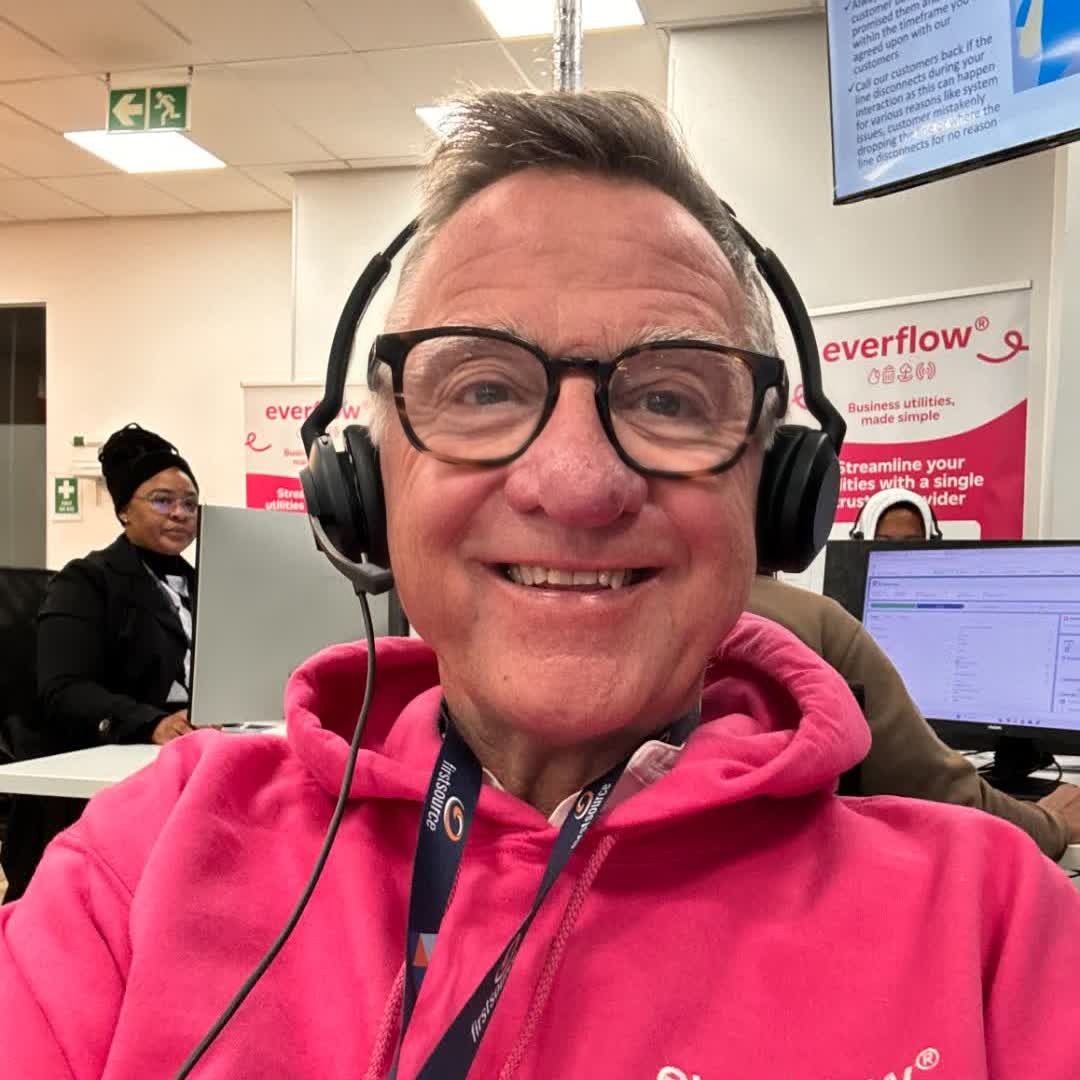
Leading Everflow's sales pilot on the contact-centre floor, Cape Town.

With Shadow Global's COO and CEO, Cape Town.
Shadow Global: fit conversations for first-time workers
Shadow Global exists, in their own words, to create "sustainable pathways to employment and meaningful permanent work for excluded youth" - young South Africans entering the formal economy for the first time, recruited only once a permanent job is already secured with an employer partner. Since founding in 2020 they have opened their first career-creation centre in Mitchells Plain and, by their own count, placed more than a thousand graduates into contact-centre work.
Their challenge is one every BPO recruiter will recognise, sharpened: candidates with no CV, no work history and no referee - and employer partners who need confidence about fit before they commit. Preference maps give both sides something no CV could: evidence about how a person prefers to work, from the person's own answers.
"For the first time our employer partners can hold a data-led conversation about fit at interview."
Shadow Global - South Africa's first impact-sourcing organisation (opens in new tab)
I've done the jobs your floor does
Advice about contact centres tends to come from people who have never sat in one. I spent two years doing the resourcing and screening for Sitel on the Sage account, worked the same way for Inkfish in Nottingham on American Express and Domestic & General, and in 2026 spent four months on the floor in Cape Town as Everflow's strategic on-site representative for a live outsourced sales pilot. When we talk about your operation, we talk about the reality of it.
The full track recordWhat attrition costs you - and what changing it is worth
Before you talk to anyone, do the sums on your own operation. Every figure below is yours to change, the assumptions are shown underneath, and the improvement line is exactly that - your assumption, not our promise. The Structured Pilot exists to measure it against your baseline.
The sums, in the open
- The formula. Leavers = agents × attrition. Annual cost = leavers × (salary × cost-per-leaver share). The value line multiplies that cost by the reduction you set - a relative cut, so 10% means 10% fewer leavers, not a ten-point drop in the rate.
- Your attrition percentage. Leavers over twelve months ÷ average headcount × 100 (Call Centre Helper). People join and leave all year, so use the average of your twelve monthly headcounts - the shortcut of (start + end) ÷ 2 will flatter or overstate a floor that is growing or shrinking. Count voluntary and involuntary leavers together unless you say otherwise, and annualise a shorter period by scaling it up - a monthly rate × 12. Agree the definition before comparing sites or suppliers; the percentage moves more on the definition than most people expect.
- Survey consumption. The cost side allows two surveys per agent in the year - the first read and a re-survey - plus a first survey for each replacement hire, sized by your churn number. One credit is one survey, always.
- Replacement-cost benchmarks. SQM Group: 30–50% of salary, around $20,800 for an average performer. Gallup: one-half to two times salary.
- Attrition benchmarks. ContactBabel, 2024; NICE, 2025.
- Cost basis. Surveys are bought as credits - £29 at the unit rate, falling to £14 a survey at volume, with the 100-pack at £19. The platform fee is set by the size of the organisation, never per seat - £49 to £399 a month by band, with every report, comparison and AI narrative included; above 750 people it is agreed in conversation. Onboarding consulting is £750 a day, typically 10 to 20 days.
- No small print. Nothing here is a quote or a promise - it is your own arithmetic, made visible, and the real figure is agreed in a conversation.
Questions operations directors ask about the pilot
How long does a Sariio pilot take?
Sixty days, on a cohort of 50 to 100 agents and their team leaders. Your baseline attrition and performance numbers are captured before the first survey, the cohort is mapped, the team leaders are trained to use what the maps show, and the results are read back to your operations board at day sixty - with a clear recommendation, not a comfortable one.
What does a pilot cost?
Pilot pricing is set by cohort size and scope, and agreed in a conversation before anything is signed - there is no self-serve checkout and no card. The arithmetic that matters sits just above this FAQ: a calculator where you can set your own floor size, attrition and salary figures and see what attrition costs you now, what changing it is worth, and an indicative year-one cost with payback.
What do my agents see, and who owns their data?
Each agent gets their own myMAP first - their results belong to them, reach them before anyone else, and sharing is the point of the design. Consent is captured before every survey, the survey passes no verdict on ability, and there are no types, grades or rankings. Agents are not being watched; they are being read accurately, in their own words, from their own answers.
Will this screen candidates automatically?
No - and it is built so it cannot. The app applies no threshold, rejects nobody and shortlists nobody on its own. Where a successMAP benchmark is used in hiring, it shows where a candidate's preferences sit against the people who already succeed in the role, and a human decides what that means. That commitment is written into the contract as well as the design.
What happens after the pilot?
If the day-sixty read-out makes the case, the platform rolls out across the operation: an annual platform fee set by the size of the organisation - never per seat - with surveys bought as credits and every report included in the fee. Add a Customer Success retainer where you want our people alongside yours - continued enablement, quarterly re-surveys and review. If the numbers do not make the case, you will hear that plainly too.
Bring one role. I'll show you the profile behind it.
The fastest way to test this is on a single role with a clear KPI - your top team versus the churn. Tell me about your operation, and I'll tell you plainly what a successMAP would and would not reveal.
14-day trial with 10 survey credits, no card required - we set it up together after a conversation. See the product first? See six people placed against a successMAP How deployment works - plans & pricing. What attrition costs you - run your own numbers above. Taking this to a colleague? the one-page pilot outline (PDF).