Coaching & performance. For BPOs and in-house contact centres.

Feedback lands when the manager knows the agent.

TL;DR Gallup finds meaningful feedback in the past week behind 80 per cent engagement, and only 16 per cent of people call their last manager conversation meaningful (Gallup, 2026). Sariio reveals each agent's strengths and how each agent receives feedback. Read moreShow less

Only 16 per cent call their last conversation meaningful.

80 per cent of people who received meaningful feedback in the past week are fully engaged, and only 16 per cent call their last conversation with their manager meaningful; the difference, in Gallup's study, is appreciation, goals and the person's strengths rather than a list of faults (Gallup, 2026).

Sariio prepares the conversation around the agent.

Sariio reveals those strengths and how each agent receives feedback, from a twelve-minute survey of work preferences, and prepares each coaching conversation from the call and your own campaign standard, so your managers coach every week, soon after the call, in a way each agent recognises as theirs.

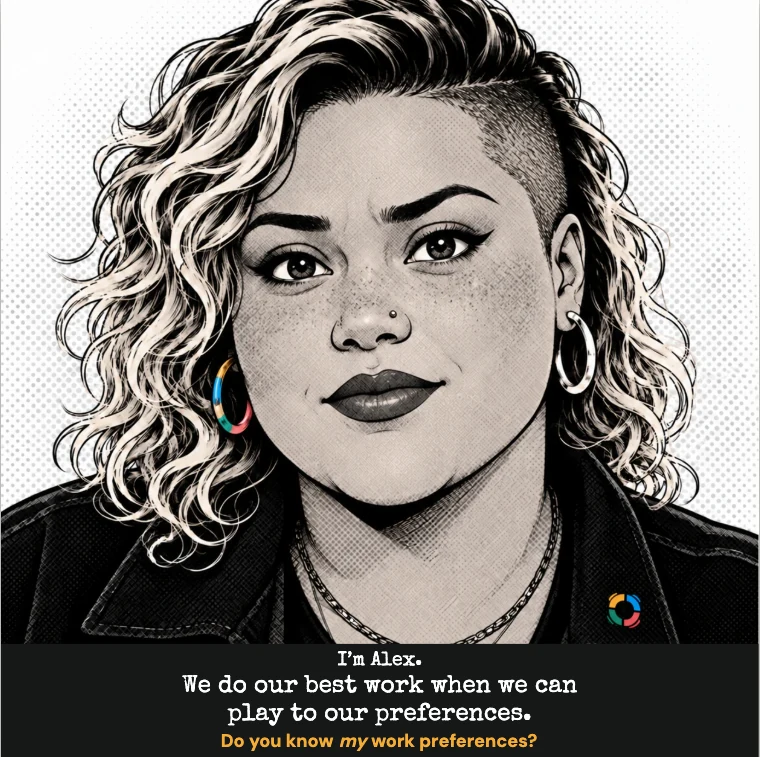
Alex, drawn in black and white with blonde curls, red lipstick and a denim jacket, on the cover of the Sariio book.
Alex, on the cover of the book behind Sariio. Open the book.

The manager's week

The conversation that keeps an agent happens early.

TL;DR Most agents who leave go inside ninety days (SQM Group, 2023), and managers are the least engaged group Gallup records (Gallup, 2026). A weekly conversation that lands is Gallup's answer. Read moreShow less

Managers are the least engaged they've been.

A contact-centre manager runs the queue, covers absence and files the reports, and is expected to coach as well. Gallup puts manager engagement at 22 per cent worldwide, after the sharpest fall of any group of workers the year before (Gallup, 2026; Gallup, 2025). Most agents who leave do so inside the first ninety days (SQM Group, 2023), the same window in which a new starter is finding out whether anyone here understands how they work.

Gallup's answer is weekly, and about strengths.

A weekly conversation of fifteen to thirty minutes, built on appreciation for recent work, the person's goals and the person's strengths; the one topic people rate as less meaningful is a conversation about their weaknesses (Gallup, 2026). Sariio prepares that conversation, so the manager spends the week's fifteen minutes on the agent rather than on the preparation, and walks in knowing what this agent does well and how this agent receives feedback.

80%of people who received meaningful feedback in the past week are fully engaged
16%say their last conversation with their manager was meaningful

Gallup, 2026

What makes feedback meaningful, in the order people rank each topic
What makes feedback meaningful Ranked by employees: appreciation for recent work first, then relationships with teammates, current goals and priorities, and the person's strengths. Weaknesses rated least meaningful. Appreciation for recent work Relationships with teammates Current goals and priorities The person's strengths Weaknesses, rated least meaningful

Ranking, not percentages: Gallup reports the order in which employees rate these topics. Gallup, 2026.

Alex's one2one

Sariio reads one call with Alex in mind.

Alex could be anyone on your floor. Her survey results are real; her name is not.

TL;DR From one of Alex's calls, Sariio draws the moment worth discussing, your campaign standard behind that moment and one action for Alex to adopt, in a short note for her manager that opens the way Alex receives feedback. Read moreShow less

The manager reads one short note.

The note is called a one2one, a conversation with an agent about a single call. The call, your campaign standard and Alex's myMAP, her personal map of work preferences, arrive in the manager's hands as a short note that quotes what went well, names the moment worth revisiting alongside the standard, and proposes one action for Alex to adopt on the next call. Alex prefers to work a problem through on her own first, so the note suggests sending the moment ahead and opening by asking what Alex noticed. Her manager reads, changes what needs changing, and only then does Alex see anything.

The conversation carries on between one2ones.

Between one2ones Alex carries on the conversation with Sariio Coach, about her own preferences and the action she chose, and her manager asks Ask Sariio how best to open the next conversation with her. The campaign sets the standard and a preference changes no score. The coaching belongs to Alex.

app.sariio.ai · one2one
Sample campaign · Billing inboundAlex · coached by her manager · 21 Sept
5:32Duration
69%Agent talk
20%Customer talk
10.0sLongest silence
0Interruptions
148Agent WPM
64% Below pass mark 7 pass · 4 fail
C1C2C3C4C5C6C7C8C9C10C11
The five-minute one2oneAlex · 64% on the scorecard · 5:32 call
Open with1 minute

C7 Accurate resolution Your resolution was exact. You named both causes, both corrections, showed the arithmetic live, and landed on sixty-one pounds ninety-eight with a five-working-day timescale. Nothing was left vague.

C3 Understanding confirmed Before moving to a fix, you restated every element of the dispute and asked 'Have I got everything?' The customer confirmed you had. That check stopped any mismatch later.

Look at together2 minutes

The scorecard requires two identifiers confirmed before any account detail is discussed. You took the postcode, then read out the bill figure of seventy-seven pounds ninety-nine before a second identifier was collected. No second identifier was taken at any point on the call. The sequence was: one identifier, then account detail, which is a fail under C2 regardless of what followed.

Agree to adopt1 minute

Before the next call, write a two-step prompt on a sticky note: postcode confirmed, then date of birth confirmed, then account open. Treat it as a fixed sequence you run through every time, the same way you run through the closing recap. A consistent checklist removes the gap before it can appear.

Next time30 seconds

Watch C2 Identity verification (this call: FAIL) on the next call, so the next one2one can show the change.

How Alex receives feedbackfrom her myMAP

Alex works a problem through on her own first, so send the moment ahead and open by asking what she noticed.

Coached 13 OctAgreed 21 SeptOne line on how the conversation wentUndoPrint

The call is the sample campaign in Sariio; Alex's own call replaces the note when her manager coaches one. Her survey results are real; her name is not.

For your managers

Here's what changes for your managers.

Each agent hears from the manager weekly.

The preparation takes the manager minutes rather than the best part of an hour, which is why each agent on the roster hears from the manager while the call is fresh, and new starters hear first.

The standard remains the campaign's.

Your standard decides what the call needed. Sariio reads the words and the timing of the call alongside that standard, so the finding is yours and the coaching fits the agent who receives the feedback.

The note reaches the agent as the manager's.

The manager reads and endorses the note before the agent sees anything, and the note then belongs to the agent, who carries the one action into the next call, which is what makes the feedback the agent's to act upon.

Alongside what you run

Nothing you run today changes.

TL;DR Sariio works from a transcript, with whatever score or tick list you already keep alongside, and reads the words and the timing of the conversation and nothing of the voice. Read moreShow less

A transcript is enough.

Your existing assessment, scored by a platform or by a QA team, sits alongside the transcript. Sariio reads the words and the timing of the conversation, so tone, sentiment and voiceprint play no part in the reading, and the finding alongside your standard is left untouched by any preference. Transcripts are held in the EU, in Frankfurt, and nothing from your operation trains a model. Trust and AI governance carries the full declaration.

Measures you already use

Judge the coaching by what changes.

Three measures tell you: time to feedback and how many agents hear from their manager each week; the QA, customer or commercial measure you most want to move, with compliance and service quality in view; and whether agents and managers, asked directly, call the coaching fair and useful. The book behind Sariio puts the test plainly: judge coaching by what people do differently afterwards.

Working together

Start with one campaign.

Bring one campaign or one operational team and half an hour online, and we'll settle what you want to improve, who's involved and how we'll both know whether the coaching is landing. I'll say where Sariio can help and where Sariio can't.

A second meeting brings a written proposal for that campaign.

Useful to bring

The campaign, the people and the measure.

Which campaign, who coaches on that campaign, the record of the call you keep today, and the QA or customer measure you most want to move.